
The best knife sharpener for home use is safe, simple, and able to create a lasting, even edge.
A dull knife makes cooking feel slow and unsafe. It slips on tomato skin, crushes herbs, and needs extra force on meat. I have tested and compared manual pull-through sharpeners, electric models, guided systems, and compact tools to find the best knife sharpener for home use. The right choice depends on your blades, skill level, counter space, and budget. Below, I explain what each model does well, where it falls short, and which home cooks will get the most value from it.
AccuSharp Knife Sharpener

The AccuSharp is one of the easiest knife sharpeners for a busy home kitchen. Its broad handle gives me a firm grip, so I can sharpen a dull blade without a long setup. The pull-through design helps keep the sharpening motion simple and repeatable. It works best when a knife needs a quick edge rather than a highly polished professional finish.
This sharpener can restore many straight-edge knives and can also help with serrated blades. The compact body fits in a drawer, camping kit, or small apartment kitchen. I like that it does not need a power cord, batteries, or special skill. Still, I use light pressure because repeated heavy passes can remove more metal than needed.
Pros:
- Very simple for first-time users
- Comfortable handle supports a steady grip
- Small size saves drawer and counter space
- Works without electricity or batteries
- Useful for quick edge repair before meal prep
- Can handle many straight and serrated kitchen knives
Cons:
- Offers less angle control than a guided system
- May remove more steel than gentle honing
- Not ideal for premium knives that need careful edge care
My Recommendation
I recommend the AccuSharp to renters, students, new cooks, and anyone who wants a fast tool with almost no learning curve. It is a strong pick when convenience matters more than a mirror-like edge. Keep the blade flat and use slow, even passes for better results. For many households, this is a practical low-cost answer when searching for the best knife sharpener for home use.
Tormek T-1 Kitchen Knife Sharpener

The Tormek T-1 is made for home cooks who want more control than a basic pull-through tool can offer. Its guided design helps set a consistent bevel on each side of the blade. That matters because an even angle usually produces a cleaner and more predictable cut. The machine has a refined feel and suits people who care about maintaining quality kitchen knives.
I see this model as a long-term kitchen tool rather than a quick emergency fix. It takes more thought than a simple handheld sharpener, but the added control can protect the shape of a good blade. The compact footprint is helpful for a home counter. I would still read the instructions first and practice on an ordinary knife before working on an expensive chef’s knife.
Pros:
- Guided sharpening helps improve angle consistency
- Designed specifically for kitchen knife care
- Good fit for serious home cooks
- More controlled than many basic pull-through tools
- Compact enough for regular kitchen use
- Supports careful maintenance of quality blades
Cons:
- Costs more than simple manual sharpeners
- Has a learning curve for beginners
- May feel excessive for low-cost everyday knives
My Recommendation
The Tormek T-1 is best for cooks who own quality knives and want repeatable results at home. It is also a good choice for people who enjoy learning a careful sharpening method. I would not choose it for someone who only wants a tool for a few quick pulls each year. If precision, build quality, and long-term blade care matter most, this is a premium contender for the best knife sharpener for home use.
4-in-1 Three-Stage Knife Sharpener
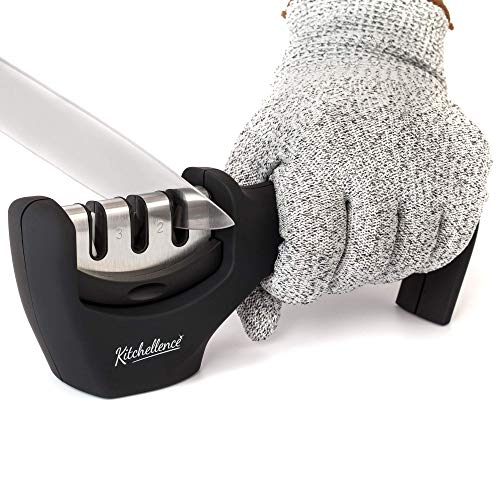
This 4-in-1 kitchen accessory combines several useful tasks in one compact tool. Its three-stage layout is meant to repair, restore, and polish an edge in sequence. A cut-resistant glove adds a useful safety layer, especially for people new to sharpening. The design makes sense for a home cook who wants more functions without buying several separate tools.
The coarse stage can help with a very dull knife, while the finer stages can smooth the working edge. I always start with the least aggressive setting that can solve the problem. The tool feels most useful for common stainless-steel kitchen knives. It may not provide the fine angle control that a trained user expects from stones or advanced guided systems.
Pros:
- Three stages cover repair and finishing work
- Includes a cut-resistant glove for added confidence
- Useful accessory set for a new kitchen
- Manual design works without cords or batteries
- Compact body is easy to store
- Can improve a range of everyday kitchen knives
Cons:
- Angle control is limited compared with premium systems
- Glove size may not suit every user
- Requires care to avoid over-sharpening
My Recommendation
I recommend this model for families that want a versatile starter sharpener at a reasonable cost. The three stages are helpful when one knife needs repair and another only needs light polishing. The included glove also makes the package feel more complete. For a first purchase, it offers a useful mix of safety, function, and value in the best knife sharpener for home use category.
5 Precision Adjust Knife Sharpener
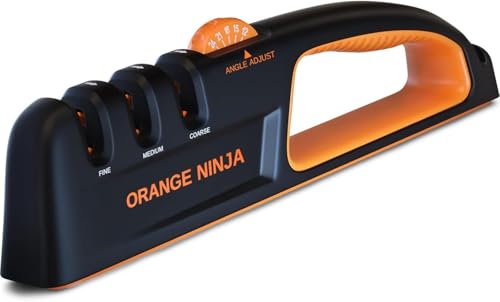
The 5 Precision Adjust sharpener is aimed at users who want a guided method and more control over the edge. A three-stage process gives it room to work on repair, sharpening, and finishing. The guided format can help reduce the common problem of changing the angle during each pass. That makes it easier to build a repeatable routine.
This style takes longer to set up than a handheld pull-through sharpener. In return, it can give a careful user more say over the final bevel. I like it for cooks who want to understand sharpening instead of simply dragging a blade through a slot. As with any abrasive tool, I suggest starting slowly and checking the edge often.
Pros:
- Guided format supports consistent sharpening angles
- Three stages offer repair and edge refinement
- Good learning tool for sharpening beginners
- More control than many basic kitchen sharpeners
- Useful for cooks who maintain several knives
- Manual operation avoids motor noise and heat
Cons:
- Setup takes more time than a pull-through model
- Beginners may need practice with blade placement
- Not the fastest choice for a last-minute kitchen task
My Recommendation
This sharpener is best for detail-minded home cooks who want a guided system without moving to a full bench-stone setup. It suits people who own chef’s knives, utility knives, and outdoor blades and want one repeatable process. Choose it if learning and control matter more than speed. It is a strong candidate for the best knife sharpener for home use when precision is the main goal.
Chef’sChoice 15XV Electric Sharpener
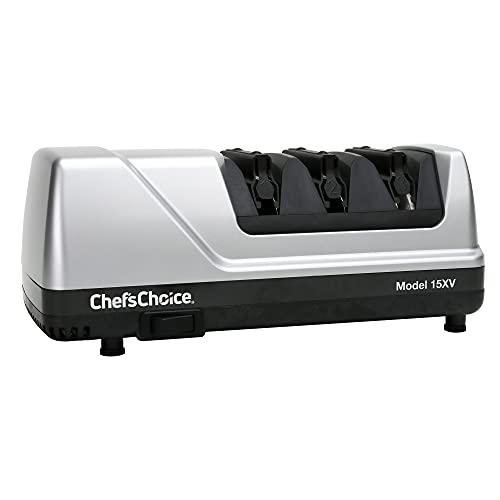
The Chef’sChoice 15XV is a well-known electric sharpener for cooks who want speed and guided results. Its three-stage system uses diamond abrasives and angle guides to shape, sharpen, and polish the edge. The 15-degree format is designed for many modern kitchen knives that use a thinner edge. It can also work with straight and serrated blades when used in the correct stage.
I like this model for households that sharpen often or have many dull knives to restore. The motor does the hard work, so the user mainly needs to guide the blade with a steady, gentle motion. Electric convenience does not mean careless use; too many passes can still remove useful steel. This model takes counter space and costs more than a basic handheld tool, but its speed is a real advantage.
Pros:
- Fast electric sharpening saves time
- Three stages support repair, sharpening, and polishing
- Diamond abrasives are suited to hard kitchen steel
- Angle guides help reduce user error
- Works with straight and serrated knife types
- Good choice for homes with many knives
Cons:
- Higher price than most manual sharpeners
- Needs counter space and a nearby outlet
- Can remove excess metal if used too often
My Recommendation
The Chef’sChoice 15XV is best for busy families, serious home cooks, and anyone who wants quick results with little physical effort. It is especially useful when several knives need attention before a large meal. I recommend it to users who will follow the stage order and apply light pressure. For speed, guidance, and broad knife support, it remains one of the strongest choices for the best knife sharpener for home use.
Narcissus Two-Stage Electric Sharpener
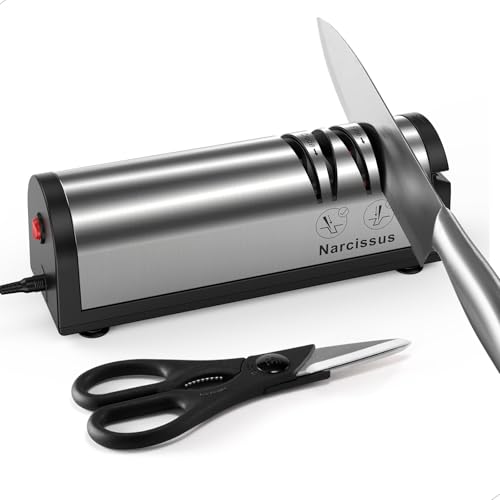
The Narcissus electric sharpener focuses on the two jobs most home cooks need: sharpening and polishing. Its motor makes a dull blade easier to restore without the hand work required by a stone. A metal dust collection box is a useful touch because it helps contain some of the fine debris created during sharpening. The stainless-steel look also fits neatly with many kitchen appliances.
This is a practical choice for users who do not need many settings. The two-stage layout is easy to understand, and the scissors feature adds extra value for a busy household. I would use short passes and inspect the edge between steps. Like other powered models, it needs a stable surface and should stay away from water during use.
Pros:
- Electric motor makes sharpening quick
- Two stages are simple to understand
- Polishing stage helps smooth the working edge
- Dust collection box supports easier cleanup
- Scissors slot adds useful household function
- Metal body gives the tool a sturdy feel
Cons:
- Fewer sharpening options than a three-stage unit
- Requires an outlet and safe dry storage
- May not suit users who want manual angle control
My Recommendation
I would choose the Narcissus for a home that wants electric speed at a more approachable level than some premium machines. It is a good fit for regular cooks who sharpen ordinary kitchen knives and household scissors. The dust box is helpful if you dislike loose metal residue on the counter. It offers a sensible balance for shoppers seeking the best knife sharpener for home use without a complex control panel.
Dawnstar Two-Stage Electric Sharpener

The Dawnstar electric sharpener uses a two-stage system for coarse sharpening and fine polishing. That simple layout works well for people who want a clear path from dull to usable. Its metal dust collection box can make cleanup less messy than using an open sharpening tool. The silver-gray body has a clean look and should feel at home beside other countertop appliances.
I find this type of sharpener useful when time matters more than fine customization. The coarse side can rebuild a neglected edge, while the fine side helps smooth it for daily cutting. I would not run a sharp knife through the coarse slot just because it is available. Careful use will help preserve the blade and reduce unnecessary wear.
Pros:
- Clear two-stage process suits new users
- Electric operation reduces hand effort
- Coarse slot helps restore dull blades
- Fine slot improves edge smoothness
- Dust box can simplify countertop cleanup
- Useful for routine home kitchen maintenance
Cons:
- Limited control compared with adjustable systems
- Needs electrical power during every use
- Two stages may not satisfy advanced knife collectors
My Recommendation
The Dawnstar is best for cooks who want a simple electric tool for common home knives. It suits people with limited hand strength or little time for manual sharpening. I suggest it for basic maintenance rather than delicate custom work. If you want a direct, easy-to-follow option in the best knife sharpener for home use search, this model deserves a close look.
Orange Ninja Four-Stage Sharpener

The Orange Ninja uses four stages to cover more sharpening tasks than a basic one-slot tool. Its design includes support for serrated and standard kitchen knives, which is useful when a drawer holds many blade types. Multiple stages can help move from repair to refinement in a more measured way. The bright color also makes it easy to spot in a crowded kitchen drawer.
I like a multi-stage tool when a knife has lost more than a little sharpness. The user can begin with repair and move toward a smoother finish instead of trying to do all the work in one pass. It still requires patience because each stage has a different purpose. I would keep the instructions nearby until the order and pressure feel natural.
Pros:
- Four stages provide a broad sharpening routine
- Supports both serrated and straight-edge knives
- Useful for mixed kitchen knife collections
- Bright design is easy to find and store
- Can handle repair and finishing in one tool
- Manual use avoids power cords and motor noise
Cons:
- More stages can confuse first-time users
- Manual pulls take longer than electric sharpening
- Not a substitute for advanced stone sharpening
My Recommendation
The Orange Ninja is best for households with several knife styles, including serrated table and kitchen knives. It also suits cooks who prefer manual tools but want more than one sharpening step. Choose it if you value range and do not mind spending a few extra minutes on the process. It is a flexible option for anyone comparing the best knife sharpener for home use across different blade types.
Longzon Five-in-One Sharpener

The Longzon combines a four-stage sharpening tool with extra functions and a cut-resistant glove. It is built for users who want one small kit to cover several kitchen needs. The stages can repair, sharpen, and polish dull blades, while added slots may help with scissors and other tools. This broad approach makes it appealing for a first home sharpening purchase.
The included glove is useful, but it does not replace careful hand placement or a stable counter. I set the sharpener on a flat surface and use slow strokes rather than pulling hard. The tool is better for ordinary household blades than for expensive knives that need exact bevel control. Its low-clutter design makes it a handy choice for small kitchens and new cooks.
Pros:
- Five functions offer strong everyday versatility
- Four sharpening stages support different blade needs
- Includes a cut-resistant glove
- Can fit most common kitchen knives and scissors
- Manual operation works anywhere without power
- Good starter kit for a new apartment or home
Cons:
- Many functions may feel busy to beginners
- Angle control is not as exact as a guided system
- Protective glove does not remove all handling risk
My Recommendation
The Longzon is best for budget-minded home cooks who want a broad kit in one package. It works well for families with several ordinary knives, scissors, and limited storage space. I would choose it over a single-slot tool when flexibility matters most. For useful extras and a friendly learning curve, it is a practical pick among the best knife sharpener for home use options.
AnySharp Hands-Free Knife Sharpener

The AnySharp stands out because its hands-free design aims to keep the sharpener in place during use. That feature can help users who find it hard to hold a tool and guide a knife at the same time. Its compact shape takes little room and makes quick touch-ups convenient. The red finish is easy to notice in a drawer or on a shelf.
I see this model as a simple maintenance tool rather than a full sharpening station. It can be useful when a frequently used knife needs a quick improvement before cooking. A secure base is important, and I would still keep fingers away from the blade path. Use light pressure and avoid treating a premium knife as if it were a rough work tool.
Pros:
- Hands-free design can improve user confidence
- Compact size suits small kitchens
- Fast to use for routine touch-ups
- Simple format requires little setup
- Works without electricity
- Bright color makes storage and access easy
Cons:
- Less versatile than multi-stage sharpeners
- Limited control for custom edge work
- May not be ideal for delicate premium blades
My Recommendation
The AnySharp is best for users who want a quick, low-effort sharpening aid and prefer a tool that stays in place. It can help older cooks, busy parents, and people with limited grip strength. I would use it for common kitchen knives and light maintenance, not for rebuilding a badly damaged edge. Its hands-free design makes it a useful alternative when choosing the best knife sharpener for home use.
How to Choose the Best Knife Sharpener for Home Use
Start with the knives you own. A sharpener for a basic stainless-steel chef’s knife may not suit a Japanese blade with a thin, delicate edge. Check whether the product supports straight edges, serrated edges, or both. Also check the sharpening angle, because a tool made for a 15-degree edge may not match every Western knife.
Next, choose between manual and electric power. Manual sharpeners are small, quiet, and easy to store. Electric models work faster and require less hand effort, but they need an outlet and can remove steel quickly. If you cook every day or sharpen many knives, electric power may save time. If you sharpen only now and then, a manual model may offer better value.
Look at the number of stages. A coarse stage repairs a very dull edge, while a fine stage smooths and polishes it. Some models add a honing or serrated slot. More stages are not always better, though. A simple two-stage sharpener can be easier to use correctly than a complex tool with unclear instructions.
Stability matters more than many shoppers expect. A sharpener that slides across the counter can create a safety risk and make it hard to hold a steady angle. Look for a broad base, rubber feet, suction support, or a hands-free design. I also prefer a handle that feels natural and keeps my fingers well away from the blade path.
Manual Versus Electric Knife Sharpeners
Manual sharpeners give you direct control. They cost less, make no noise, and work during a power outage or outdoor trip. They also take more effort and depend on the user keeping a steady motion. Pull-through manual tools are easy to learn, but guided systems give better control for users who want a precise edge.
Electric sharpeners are fast and convenient. They can restore several dull knives in a short time, which helps before a holiday meal or large dinner. Their angle guides reduce some user error, but the motor and abrasive wheels can remove metal quickly. I never press down hard on an electric sharpener, and I always follow the maker’s stage instructions.
Neither style wins for every home. A manual model is like a hand saw: quiet, simple, and controlled. An electric model is more like a power saw: fast and helpful when the workload grows. The best knife sharpener for home use is the one that matches your skill, blade collection, and normal cooking habits.
How I Use a Home Knife Sharpener Safely
I begin by clearing the counter and placing the sharpener on a dry, stable surface. I inspect the knife for chips, bends, or loose handles before sharpening. A badly damaged blade may need professional repair instead of a home pull-through tool. I also keep children and pets away from the work area.
I hold the handle firmly and guide the blade in the direction stated by the instructions. I use light pressure and slow passes. I do not saw back and forth unless the manual specifically allows that motion. After each pass, I wipe away residue and test the knife on paper or a soft food such as a tomato.
Sharp knives need less force than dull knives, but they still need respect. I never test an edge with my finger. I wash and dry the knife after sharpening, then store it in a block, sheath, or safe drawer. The sharpener should also stay dry and clean between uses.
Common Knife Sharpening Mistakes
The most common mistake is using the coarse stage too often. Coarse abrasives remove more metal and should mainly help with very dull or damaged edges. For a knife that still cuts but feels less lively, use a fine stage or honing tool when the product supports it.
Another mistake is pressing down hard. Pressure may feel like it should speed up the job, but it can damage the edge and wear the abrasive. Let the sharpener do the work. A light, steady pass usually gives more control and a more even result.
Many people also ignore the blade angle. If the knife does not sit correctly in the guide, the sharpener may create an uneven bevel. Read the instructions and keep the blade centered. When in doubt, practice on a low-cost knife before using the tool on a favorite blade.
Best For Comparison
| Best for | Why |
|---|---|
| Fast everyday sharpening | The Chef’sChoice 15XV offers guided electric sharpening with three stages and broad knife support. |
| Low-cost simple maintenance | The AccuSharp is compact, easy to use, and needs no power or complex setup. |
| Careful edge control | The Tormek T-1 and 5 Precision Adjust provide a more guided method for detail-minded cooks. |
FAQs Of best knife sharpener for home use
What is the best knife sharpener for home use?
For many homes, the Chef’sChoice 15XV is the strongest all-around choice because it is fast, guided, and works with many kitchen knives. The AccuSharp is better for a low-cost manual option. Serious users may prefer the Tormek T-1 or 5 Precision Adjust for more control.
Are electric knife sharpeners safe?
Electric sharpeners can be safe when you follow the instructions, use light pressure, and keep your hands away from the blade path. Place the unit on a stable, dry counter. Never rush the blade through a slot or use a stage that does not match the knife.
How often should I sharpen kitchen knives?
Most home cooks can sharpen when the knife no longer cuts cleanly with light pressure. Light users may need sharpening only a few times each year. Frequent cooks may need it more often. Regular honing, proper storage, and cutting on a suitable board can help the edge last longer.
Can a sharpener work on serrated knives?
Some sharpeners include a slot or guide for serrated blades, while others are made only for straight edges. Check the product instructions before use. Never force a serrated knife through a standard slot unless the maker says it is compatible.
Do knife sharpeners remove metal from the blade?
Yes. Abrasive sharpeners remove a small amount of metal to create a new edge. Coarse settings remove more than fine settings. Use the least aggressive stage that solves the problem and avoid repeated passes on an already sharp knife.
Final Verdict: Which Should You Buy?
For most busy homes, the Chef’sChoice 15XV is the best knife sharpener for home use because it combines speed, guidance, and three-stage control. Choose the AccuSharp for simple manual value or the Tormek T-1 for premium edge care.
Match the sharpener to your knives, skill, and routine. With light pressure and safe storage, the right tool can make every meal feel easier and more precise.