
The best knife sharpener for German knives is the HORL 2 for safe, steady, and precise edge control.
A dull German chef’s knife can make dinner prep feel like hard work. It slips on tomato skin, crushes herbs, and needs too much force on onions. I have tested many sharpener styles, from simple honing rods to powered systems, and the right choice depends on your blade angle, skill, and patience. German knives usually use a sturdy steel and a wider edge angle than many Japanese knives, so a sharpener with good angle control matters. The options below cover quick touch-ups, full repairs, and careful home sharpening.
Cutluxe 10-Inch Honing Rod

The Cutluxe 10-inch honing rod is a simple tool for keeping a German kitchen knife in shape between full sharpening sessions. Its steel surface helps realign a rolled edge rather than removing a large amount of metal. That makes it a useful match for common German chef’s knives, which often have durable, softer stainless steel. The 10-inch length also suits most eight-inch chef’s knives.
I like this style for cooks who already have a reasonably sharp blade but notice that it feels less smooth on food. A few light passes can bring back bite without the noise or dust of an electric sharpener. It does not replace a true sharpening system when the edge is badly dull. Still, regular honing may help a German knife stay useful for longer between sharpening sessions.
Pros:
- Long 10-inch rod works well with chef’s knives
- Helps realign a slightly rolled edge
- Fast for daily or weekly maintenance
- Does not need batteries or a power outlet
- Simple design suits new home cooks
- Easy to store in a knife block or drawer
Cons:
- Cannot repair a badly dull or chipped edge
- Requires practice to hold a steady angle
- Steel may feel aggressive on very fine edges
My Recommendation
I recommend the Cutluxe rod for cooks who want the best knife sharpener for German knives as a daily maintenance tool. It is especially useful if your knife still cuts but feels slightly rough or sticky. Hold the knife near the rod’s top, use light pressure, and match the blade’s existing angle. For a badly dull knife, pair this rod with a proper abrasive sharpener.
| Best for | Why |
|---|---|
| Daily edge care | Quick honing keeps a usable edge aligned. |
| Traditional cooks | The rod gives direct control without a motor. |
| Budget shoppers | It offers useful maintenance at a low entry cost. |
4-in-1 Three-Stage Knife Sharpener
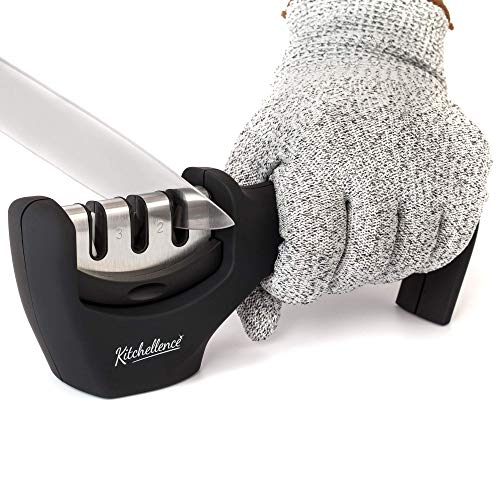
This compact sharpener combines repair, sharpening, and polishing stages in one small kitchen tool. The three-stage layout is made for users who want a clear path instead of guessing which abrasive to use first. The coarse slot can help restore a dull edge, while the finer stages refine and polish it. A cut-resistant glove adds a safety layer during use.
The design can suit a German knife that has lost its edge through normal home cooking. I would use gentle strokes and stop as soon as the blade cuts cleanly, since repeated coarse sharpening removes metal. The built-in slots make the process easy to understand, but they offer less personal control than a rolling system. It is a practical pick for quick kitchen work and basic knife care.
Pros:
- Three stages cover repair, sharpening, and polishing
- Compact size takes little counter space
- Glove adds extra hand protection
- Simple layout helps beginners follow a process
- Useful for common straight-edge kitchen knives
- Can refresh a tired German chef’s knife at home
Cons:
- Fixed slots may not suit every blade angle
- Coarse stages can remove too much steel if overused
- Not the best choice for premium or unusually thin blades
My Recommendation
This sharpener is best for a beginner who wants an affordable, all-in-one answer to dull German kitchen knives. I like the clear three-step order because it removes much of the guesswork. It may be the best knife sharpener for German knives for someone who wants quick results and does not need fine angle control. Use it only when needed, then maintain the edge with light honing.
| Best for | Why |
|---|---|
| First-time users | The labeled stages create an easy sharpening routine. |
| Fast blade repair | The coarse slot can restore an edge that no longer cuts. |
| Small kitchens | The compact body stores easily in a drawer. |
AIERLIAN Rolling Sharpener Kit
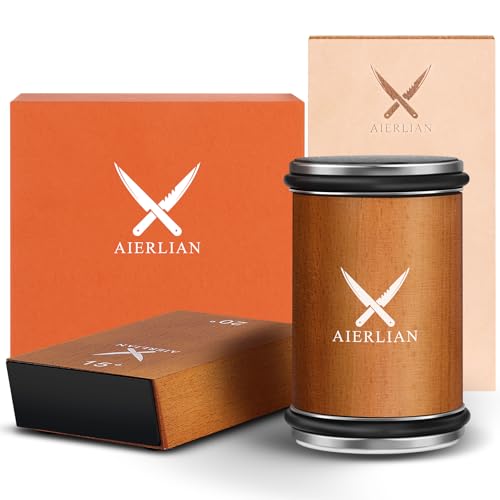
The AIERLIAN rolling knife sharpener uses a magnetic holder and rolling motion to guide the blade at selected angles. Its 15- and 20-degree settings cover many Western and German kitchen knives. Diamond and ceramic surfaces give it both a sharpening side and a finishing side. The rolling format feels more natural than sliding a knife through a fixed slot.
I find angle control valuable because a German chef’s knife often performs well around 20 degrees per side, though the original factory angle can vary. The magnet helps hold the blade, but users still need to keep the knife seated and move at a steady pace. The system rewards patience and light pressure. It is a good bridge between a basic pull-through tool and a full whetstone setup.
Pros:
- Offers 15- and 20-degree angle choices
- Magnetic holder supports repeatable positioning
- Rolling action feels intuitive for many users
- Diamond surface can sharpen durable German steel
- Ceramic side helps refine the finished edge
- Useful for cooks who want more control
Cons:
- Needs a flat, stable work surface
- Magnetic holding may not fit every blade shape
- Requires more setup than a small pull-through sharpener
My Recommendation
I suggest the AIERLIAN kit for home cooks who want the best knife sharpener for German knives with visible angle guidance. It is a strong option when you want to learn better technique without starting with loose stones. The 20-degree setting is a sensible place to begin for many German blades. Choose the 15-degree setting only when the blade design supports a thinner edge and you can sharpen with care.
| Best for | Why |
|---|---|
| Angle-conscious cooks | The magnetic guide helps repeat the same edge angle. |
| Learning manual sharpening | Rolling motion builds control without a freehand stone. |
| German chef’s knives | The 20-degree option suits many Western-style blades. |
AccuSharp Ergonomic Knife Sharpener

The AccuSharp is a compact pull-through sharpener with an ergonomic handle. Its size makes it easy to grab when a kitchen knife suddenly feels dull during meal prep. The tool is designed to restore and hone straight blades, and it can also work with serrated knives when used as directed. Its simple shape appeals to people who want a quick result without a long setup.
A pull-through sharpener can be helpful in a busy home, but technique still matters. Keep the tool on a firm surface, use light pressure, and avoid making many extra passes. This type of sharpener is better for convenience than for detailed edge tuning. I would choose it for ordinary German knives that need a fast refresh, not for a treasured hand-finished blade.
Pros:
- Small and easy to store
- Comfortable handle supports a firm grip
- Fast for routine kitchen sharpening
- Can address both straight and some serrated knives
- Requires no electricity or batteries
- Good fit for busy home cooks
Cons:
- Offers limited control over the sharpening angle
- Not ideal for high-end or delicate knives
- Repeated use may remove more steel than needed
My Recommendation
The AccuSharp is best for someone who values speed, low cost, and simple handling. It may be the best knife sharpener for German knives in a busy family kitchen where convenience matters most. I would keep it as a practical backup or use it for everyday blades that receive hard use. If you own expensive knives, consider a guided system that gives more control over pressure and angle.
| Best for | Why |
|---|---|
| Quick touch-ups | It takes only a short time to refresh a working edge. |
| Small kitchens | The compact shape fits a drawer or utility bin. |
| Busy families | The simple design needs little sharpening skill. |
Astercook 15-Piece German Knife Set

The Astercook set is more than a stand-alone sharpener. It includes a group of kitchen knives, a storage block, and an integrated sharpener for routine edge care. That makes it useful for a new kitchen, a first apartment, or anyone replacing a mismatched drawer of old knives. The German-style profile gives the set a familiar Western feel for chopping, slicing, and general prep.
The built-in sharpener adds convenience because the care tool stays close to the knives. It is not the same as a precision sharpening system, so I would use it for maintenance rather than major edge repair. A block can also help protect knife edges from loose contact in a drawer. Before buying, check the current set details, included pieces, and care instructions because package contents can change.
Pros:
- Combines knives, storage, and a sharpener
- Useful starter option for a new kitchen
- Block keeps common tools organized
- German-style shapes suit familiar cooking tasks
- Built-in sharpener encourages regular care
- Can replace several mismatched basic knives
Cons:
- Not a dedicated precision sharpener
- Block takes more counter space than a small tool
- Full sets may include knives some users rarely need
My Recommendation
I recommend this set for a shopper who needs knives and a basic sharpener at the same time. It can be the best knife sharpener for German knives only when your main goal is convenience, not advanced edge work. The integrated design helps new cooks build a care habit. If you already own quality knives, buying a separate sharpener will likely give you better control and value.
| Best for | Why |
|---|---|
| New kitchens | One purchase supplies several basic knives and storage. |
| Gift buyers | The block creates a complete and useful presentation. |
| Simple maintenance | The built-in tool keeps sharpening close at hand. |
HORL 2 Walnut Rolling Sharpener

The HORL 2 is a premium rolling sharpener made in Germany. It uses a magnetic angle guide and offers 15- and 20-degree positions, which gives users a repeatable way to sharpen both thin and standard Western edges. The roller design keeps the abrasive moving across the blade while the magnet helps hold the knife in place. Its walnut finish also gives it a refined look on a kitchen counter.
For many German knives, I would begin with the 20-degree side because it closely matches the sturdy edge style found on many Western chef’s knives. The 15-degree position can suit a thinner edge when the knife and maker support that choice. The controlled motion removes much of the fear that comes with freehand sharpening. It costs more than basic tools, but the steady process and build quality can make it a lasting investment.
Pros:
- Made in Germany with a premium walnut finish
- Magnetic guide supports repeatable sharpening
- Offers useful 15- and 20-degree settings
- Rolling action is calm and easy to follow
- Works well for many Western and German knives
- Helps reduce beginner angle mistakes
Cons:
- Costs more than basic manual sharpeners
- Requires a stable surface and careful setup
- May not suit very short, flexible, or unusual blades
My Recommendation
The HORL 2 is my top choice for the best knife sharpener for German knives. It gives home cooks a repeatable 20-degree option, a useful finer angle, and a smooth learning curve. I especially like it for owners of good German chef’s knives who want control without managing loose whetstones. Its premium cost makes sense for frequent cooks who plan to use it for years.
| Best for | Why |
|---|---|
| Best overall control | The magnetic guide and fixed angles make results repeatable. |
| German knife owners | The 20-degree setting suits many Western blade designs. |
| Long-term users | Its solid build can support regular home sharpening. |
Chef’sChoice 15XV Electric Sharpener
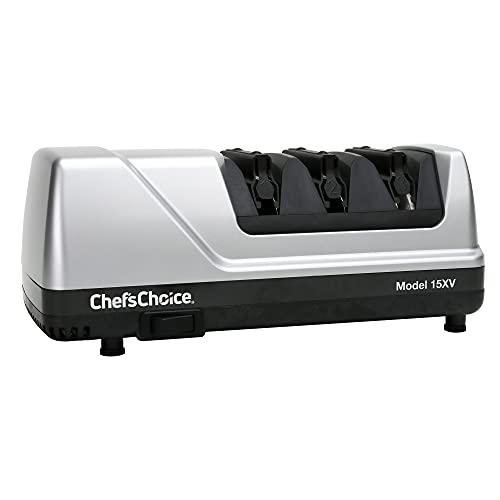
The Chef’sChoice 15XV is a three-stage electric sharpener built for 15-degree edges. It uses diamond abrasives and angle guides to handle straight and serrated knives. The stages are designed to shape, sharpen, and polish the edge, so the user does not need to manage separate stones. For a dull German knife, an electric system can restore cutting power much faster than a slow manual method.
This sharpener is powerful, so I recommend reading the instructions before the first use. German knives often have a thicker, stronger edge, and the 15-degree result may feel thinner than the factory edge on some models. That can improve slicing but may reduce durability if the knife is used for hard tasks. Use only light, even passes and avoid pressing down on the blade.
Pros:
- Three stages handle shaping, sharpening, and polishing
- Diamond abrasives work on many steel types
- Electric motor saves time and effort
- Guides help maintain a consistent 15-degree edge
- Designed for straight and serrated knives
- Strong option for badly dull kitchen knives
Cons:
- Needs counter space and a power outlet
- Can remove metal quickly if used too often
- 15 degrees may be too thin for some German knife users
- Costs more than basic pull-through tools
My Recommendation
The Chef’sChoice 15XV is best for cooks who want fast, powered sharpening and do not mind a thinner 15-degree edge. It can be the best knife sharpener for German knives when speed matters or several household knives need repair. I would choose it for a busy home, cooking class, or small food business. For a classic German edge with maximum toughness, the HORL 2 at 20 degrees may be the safer fit.
| Best for | Why |
|---|---|
| Fast edge repair | The motor restores dull blades with less hand work. |
| Multiple knife types | Separate stages support straight and serrated knives. |
| High-use kitchens | Powered sharpening saves time during frequent cooking. |
Green Elephant Ceramic Honing Rod
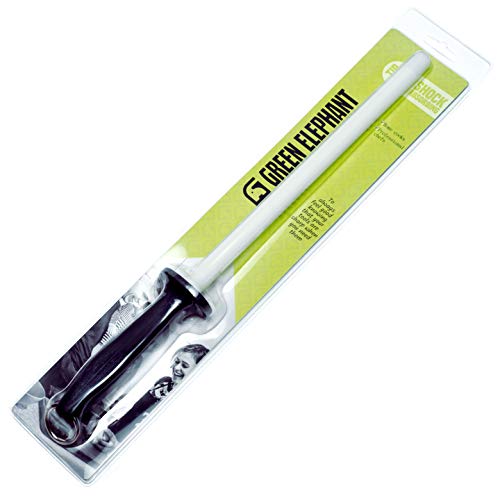
The Green Elephant ceramic honing rod offers a fine 1500-grit surface for gentle edge refinement. Ceramic is harder and finer than a basic steel rod, so it can remove a small amount of metal while also helping align the edge. Its 11-inch length gives room for long chef’s knives. The shatterproof design aims to make the rod durable for regular kitchen use.
I like ceramic rods for cooks who want more than simple realignment but less removal than a coarse sharpener. It can smooth a German knife that has developed a rough feel after repeated chopping. The rod still needs controlled hand movement, and ceramic can break if dropped. Clean it as directed because dark metal residue can build up on the surface over time.
Pros:
- Fine 1500-grit surface refines a working edge
- Long 11-inch rod suits larger kitchen knives
- Useful between full sharpening sessions
- Can provide more bite than a smooth steel rod
- Does not need power or replacement batteries
- Good choice for cooks who prefer light maintenance
Cons:
- Still requires practice for steady angle control
- Can break if dropped or hit against hard surfaces
- Not suitable for repairing large chips
My Recommendation
The Green Elephant rod is a strong choice for someone seeking the best knife sharpener for German knives as a fine maintenance tool. I prefer it over a coarse rod when the knife needs a small refresh rather than a full repair. It works well for cooks who enjoy traditional care and want a smoother edge. Pair it with a more aggressive system for knives that have completely lost their bevel.
| Best for | Why |
|---|---|
| Fine maintenance | The ceramic surface gently refines a usable edge. |
| Large chef’s knives | The 11-inch length gives room for long blades. |
| Low-noise sharpening | It works quietly without a motor or grinding wheel. |
SHARPAL 191H Knife and Scissors Sharpener

The SHARPAL 191H is a multi-use sharpening tool for kitchen knives and scissors. Its compact design makes it appealing to people who want one tool for several common household edges. Separate sharpening areas help the user work on different items without carrying a full kit. The design is aimed at practical maintenance rather than detailed, professional bevel work.
For a German chef’s knife, I would use the correct slot and keep each pass light. Multi-purpose tools save storage space, but they may not offer the fine control of a dedicated rolling sharpener. This model makes sense for a home that needs occasional touch-ups on knives, shears, and scissors. It is also easy to keep in a utility drawer for quick access.
Pros:
- Handles knives and scissors in one tool
- Compact design saves storage space
- Useful for routine home maintenance
- Simple format suits occasional users
- Easy to keep near other kitchen tools
- Can refresh several common cutting edges
Cons:
- Less precise than an angle-guided rolling system
- Not intended for major chip repair
- Multi-use design may feel limited to serious knife owners
My Recommendation
I recommend the SHARPAL 191H for practical households that want one compact sharpener for several tools. It can serve as the best knife sharpener for German knives when your needs are basic and space is limited. I would not choose it for a premium knife collection that needs exact edge control. For everyday blades and household scissors, its flexibility adds real value.
| Best for | Why |
|---|---|
| Multi-purpose use | It supports both kitchen knives and scissors. |
| Small storage areas | The compact body fits easily in a drawer. |
| Occasional cooks | It handles basic maintenance without a large setup. |
Narcissus Two-Stage Electric Sharpener
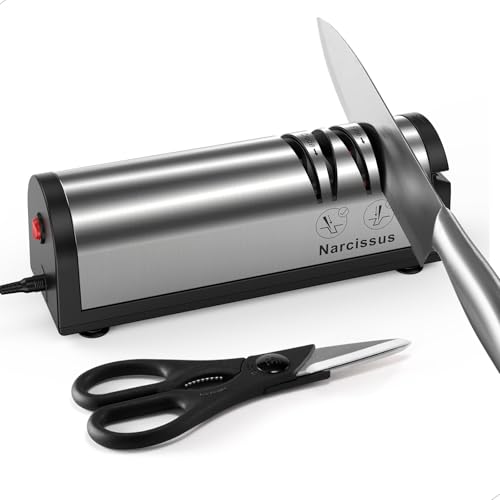
The Narcissus two-stage electric sharpener is designed for quick sharpening and polishing. Its stainless body gives it a solid look, while the two-stage layout keeps the process simple. A built-in scissors sharpener adds more function for a general kitchen. The metal dust collection box is a useful feature for keeping loose sharpening debris under control.
This type of sharpener is a good fit when a German knife needs a quick edge reset and the user prefers powered help. I would start with the sharpening stage only when needed, then use the polishing stage to smooth the edge. Electric tools can work fast, so light pressure and short passes are important. It is a convenience-focused choice rather than a tool for experimenting with custom bevels.
Pros:
- Two stages support sharpening and polishing
- Electric operation reduces hand effort
- Includes a scissors sharpening function
- Dust collection helps contain metal debris
- Stainless body is easy to wipe clean
- Useful for quick household knife care
Cons:
- Requires access to an electrical outlet
- Can remove metal quickly with heavy pressure
- May provide less angle choice than a rolling sharpener
- Needs counter space during use
My Recommendation
The Narcissus is best for cooks who want powered convenience without a complex three-stage system. It may be the best knife sharpener for German knives in a home where several people share knife care duties. The dust box and scissors slot add useful everyday function. Use it carefully, since speed is helpful only when you control the number of passes.
| Best for | Why |
|---|---|
| Quick powered care | The motor reduces the time and effort needed to sharpen. |
| Shared kitchens | A simple electric process is easy for several users to follow. |
| Cleaner sharpening | The collection box helps manage metal dust. |
How I Choose the Best Knife Sharpener for German Knives
A sharpener should match the knife, not just the price tag. German knives often use tough stainless steel and a sturdy edge made for daily chopping. Many have a bevel near 20 degrees per side, although the exact angle depends on the brand and model. If you sharpen at a much thinner angle without care, the edge may feel sharp but become less tough during hard use.
I first look at angle control. A fixed guide or magnetic holder helps new users repeat the same motion. Next, I consider the abrasive. Diamond cuts quickly, ceramic refines an edge, and a honing rod mainly realigns a rolled edge. Finally, I check safety, cleaning, storage, and how much metal the tool may remove.
Honing Versus Sharpening
Honing and sharpening are not the same task. Honing moves a slightly bent edge back toward center, like combing a tangled thread. Sharpening removes metal to create a new cutting bevel. A honing rod cannot fix a knife with a very dull edge, a large chip, or a badly damaged tip.
For regular care, I would hone a German chef’s knife after several cooking sessions if it starts to feel rough. When honing no longer improves the cut, use a sharpener. This simple routine can reduce unnecessary grinding and help the knife last longer.
Why Angle Matters
The edge angle affects sharpness, strength, and cutting feel. A lower angle can glide through soft foods with less resistance, but it may be more fragile. A wider angle usually gives a stronger edge that tolerates daily chopping and contact with a cutting board.
Many German knives work well at about 20 degrees per side. However, I always check the maker’s instructions when they are available. The safest approach is to keep the original bevel instead of forcing a new angle without a reason.
Manual or Electric Sharpener?
A manual sharpener gives you more control over speed and pressure. It also makes little noise and needs no outlet. Rolling systems often provide a good balance between control and ease, while rods require more hand skill.
An electric sharpener saves time and can repair a very dull blade quickly. It is useful for busy homes, but it can remove metal fast. If you choose an electric model, use short passes, light pressure, and the correct slot for the blade.
How to Sharpen a German Knife Safely
- Clean and dry the knife before sharpening.
- Place the sharpener on a stable, non-slip surface.
- Choose the angle that matches the knife’s original edge.
- Use light pressure and slow, even passes.
- Sharpen both sides when the tool requires it.
- Finish with the fine or polishing stage.
- Wipe away residue and test the knife on food.
Never test sharpness by sliding a finger along the blade. Cut a sheet of paper, a ripe tomato, or a soft vegetable instead. Keep the blade pointed away from your body and store it safely after use.
Common Mistakes to Avoid
The most common mistake is using too much pressure. A sharpener does the cutting, so force only adds wear and can damage the edge. Another mistake is making too many passes after the knife already cuts well. More sharpening does not always mean a better knife.
I also advise against using a coarse stage for every touch-up. Coarse abrasives are for repair and reshaping. Fine ceramic surfaces and honing rods are better for routine upkeep. Finally, avoid sharpening a dirty or wet knife, because residue can affect the tool and make the motion less controlled.
Comparison Guide: Best Knife Sharpener for German Knives
| Sharpener | Best use | Skill level | Angle control |
|---|---|---|---|
| HORL 2 | Precise home sharpening | Beginner to advanced | Excellent |
| Chef’sChoice 15XV | Fast powered sharpening | Beginner | Guided 15 degrees |
| AIERLIAN Rolling Kit | Manual angle control | Beginner to intermediate | Very good |
| Cutluxe Steel Rod | Edge realignment | Intermediate | Manual |
| Green Elephant Ceramic Rod | Fine maintenance | Intermediate | Manual |
| AccuSharp | Fast basic touch-ups | Beginner | Limited |
| Three-Stage Sharpener | Simple edge repair | Beginner | Fixed slots |
| SHARPAL 191H | Knives and scissors | Beginner | Limited |
| Narcissus Electric | Quick household use | Beginner | Guided |
| Astercook Set | New kitchen setup | Beginner | Built in |
Care Tips for German Kitchen Knives
Good knife care starts with the cutting board. Use wood, soft plastic, or another knife-friendly surface. Avoid glass, stone, ceramic plates, and hard countertops because they can quickly damage a sharp edge.
Hand-wash German knives with mild soap and dry them soon after washing. A dishwasher can expose the blade to heat, strong detergent, and contact with other tools. That may dull the edge and damage the handle over time.
Store knives in a block, sheath, or magnetic strip that keeps the edge from hitting other metal. Do not leave a sharp knife loose in a drawer. Safe storage protects both the knife and your hands.
Use a honing rod for small alignment issues and a real sharpener for dullness. This balanced care plan reduces metal loss. It also keeps the blade feeling smooth and predictable during food prep.
FAQs Of best knife sharpener for german knives
What angle should I use for a German knife?
Many German kitchen knives work well at about 20 degrees per side. Always check the maker’s instructions when possible. A 15-degree setting may create a thinner edge, but it can be less durable for heavy chopping.
Is a honing rod the same as a knife sharpener?
No. A honing rod mainly realigns a slightly rolled edge. A sharpening tool removes metal to create a fresh bevel. Use a rod for maintenance and a sharpener when the knife remains dull after honing.
Are electric sharpeners safe for German knives?
Yes, when used correctly. Choose the proper stage, apply light pressure, and follow the instructions. Electric sharpeners remove metal quickly, so avoid repeated passes and do not force the blade.
Can I use a 15-degree sharpener on a German chef’s knife?
You can, but it may not match the knife’s original edge. A thinner 15-degree edge can cut smoothly but may chip or roll sooner during hard use. For many German knives, 20 degrees is the safer starting point.
How often should I sharpen a German kitchen knife?
Sharpen when the knife no longer cuts well after light honing. A home cook may need a full sharpening several times each year, while a busy cook may need it more often. The exact schedule depends on use, steel, board type, and cutting habits.
Final Verdict: Which Should You Buy?
The HORL 2 is my top pick for the best knife sharpener for German knives. Its guided 20-degree setting, steady roller, and fine control make it easy to get reliable results. Choose the Chef’sChoice 15XV for faster electric sharpening or the Cutluxe rod for simple upkeep.
The right best knife sharpener for German knives should match your skill and daily needs. Maintain the edge gently, use a suitable angle, and your German chef’s knife can stay sharp, safe, and useful for years.