
The best knife sharpener made in USA is the DMT Dia-Sharp, thanks to its flat diamond surface and lasting edge control.
A dull knife can turn a simple dinner into a slow, tiring job. I have felt that drag when a tomato tears instead of slicing, or when a chef’s knife slips on an onion. The right sharpener fixes that problem without forcing you to buy a new knife. In this guide, I compare manual tools, diamond stones, guided sharpeners, and electric models. I also explain which options are truly made in the USA, which are best for new users, and which one offers the best value for your kitchen, workshop, or field kit.
How I Chose the Best Knife Sharpener Made in USA
A knife sharpener should do more than remove metal. It should help you create a clean, even edge while keeping the blade safe. I looked at the sharpener type, abrasive quality, angle control, ease of use, size, safety, and long-term value.
I also checked the product claims shown by the brands and sellers. “Made in the USA” can mean different things. Some products are made and crafted in the United States. Others use American manufacturing but may include imported parts. A few products in this review are included as useful comparisons, even though they are not clearly USA-made.
That difference matters. If American production is your main goal, focus first on DMT products and other brands that clearly state where the tool is made. If ease matters more than origin, a guided or electric sharpener may suit you better.
Diamond, Ceramic, or Whetstone?
Diamond sharpeners cut steel fast. They work well on hard blades and dull knives. A diamond bench stone also stays flat, which helps you maintain a straight edge.
Ceramic sharpeners remove less metal. They work best for light honing and final polishing. They are gentle, but they may feel slow on a very dull knife.
Whetstones use water and skill. They can produce a fine, polished edge, but you must learn to hold the correct angle. For many home cooks, a 1,000/6,000-grit stone gives a useful mix of repair and polish.
Manual or Electric?
A manual sharpener gives you more control and costs less. It also takes more practice. An electric sharpener saves time and guides the blade, but it can remove metal quickly if you use too much pressure.
I prefer a manual diamond sharpener for most knife owners. It offers a clear feel during each pass. For users who want speed and repeatable angles, the Chef’sChoice electric model is a strong option.
4-in-1 Kitchen Knife Accessories Sharpener
4-in-1 Kitchen Knife Sharpener
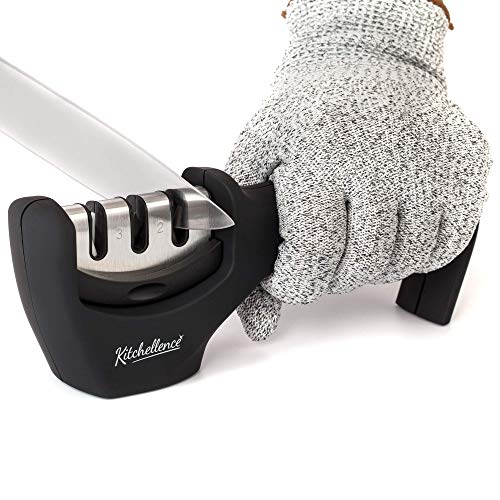
This 4-in-1 kitchen sharpener aims to cover the basic needs of a home cook. Its three sharpening stages help repair a damaged edge, restore sharpness, and polish the blade. The included cut-resistant glove adds a useful layer of hand protection for new users. Its compact shape also makes it easy to keep in a drawer.
I see this as a simple starter kit rather than a professional sharpening system. The preset slots can help a beginner avoid wild angle changes. Still, you should use light pressure and short passes. The glove is helpful, but it does not replace safe handling or a stable work surface.
Pros:
- Three stages cover repair, sharpening, and polishing
- Includes a cut-resistant glove
- Simple design for new users
- Compact size suits small kitchens
- Useful for routine home knife care
Cons:
- Preset slots offer less control than a bench stone
- May not suit premium or very thin blades
- Not clearly identified as made in the USA
DMT D8C Dia-Sharp Coarse Bench Stone
DMT D8C Dia-Sharp Coarse Stone

The DMT D8C Dia-Sharp is a flat diamond bench stone with a coarse 325-grit surface. I like this format because it gives the whole blade a broad, even contact area. The diamond surface can repair dull edges much faster than a fine stone. DMT identifies this model as made in the USA, which makes it a leading choice for shoppers seeking the best knife sharpener made in USA.
The stone works well on kitchen knives, tools, outdoor blades, and workshop edges. It does not need soaking, oil, or a long setup. Use it with a finer stone when you want a smoother edge. Since the coarse surface removes metal quickly, I use gentle strokes and stop as soon as the damaged edge is gone.
Pros:
- Flat surface supports even sharpening
- Coarse grit repairs dull and tired edges
- Diamond abrasive cuts hard steel well
- No soaking or oil is needed
- Made in the USA
- Works in kitchens, shops, and job sites
Cons:
- Coarse grit needs a finer stone for polishing
- Requires manual angle control
- Can remove too much metal with heavy pressure
DMT D8E Dia-Sharp Extra Fine Stone
DMT D8E Extra Fine Diamond Stone

The DMT D8E uses an extra-fine diamond surface for final honing and edge refinement. It has the same broad, flat bench-stone style as the coarse model. DMT lists it as made in the USA. For a sharpener buyer who wants American production and a polished cutting edge, this model is one of the strongest finishing tools in the group.
This stone is not the best first choice for a badly damaged knife. It shines after a coarse or medium abrasive has formed the edge. I use light passes to remove the rough feel left by a coarser stone. It can also refresh an already sharp knife without the aggressive bite of a repair stone.
Pros:
- Extra-fine surface improves edge smoothness
- Flat design helps maintain a straight bevel
- Diamond surface needs little maintenance
- Works without water or oil
- Made in the USA
- Useful for final honing and touch-ups
Cons:
- Too fine for major edge repair
- Manual angle skill is required
- Costs more when purchased with other grit stones
Sharp Pebble 1,000/6,000-Grit Whetstone
Sharp Pebble 1,000/6,000 Whetstone

The Sharp Pebble whetstone combines a 1,000-grit side with a 6,000-grit side. The 1,000 side can restore a dull kitchen knife, while the 6,000 side helps create a smoother finish. This type of stone gives you direct control over the edge. It also teaches the user how sharpening really works.
You need to prepare the stone with water and keep the blade angle steady. That learning curve may feel slow at first, but the result can be excellent. I suggest practicing on an inexpensive knife before using it on a favorite chef’s knife. This model is not a USA-made sharpener, but it is a useful value comparison for people who care most about a traditional whetstone method.
Pros:
- Two grits handle repair and polishing
- Provides strong control over the sharpening angle
- Can create a refined kitchen-knife edge
- Quiet and simple to use
- Good learning tool for sharpening skills
Cons:
- Requires water and setup time
- Needs practice for consistent results
- Not made in the USA
AccuSharp Ergonomic Knife Sharpener
AccuSharp Ergonomic Knife Sharpener

AccuSharp has long focused on compact, pull-through knife sharpeners, and this ergonomic model follows that practical path. The handle gives the user a firm grip during short sharpening passes. The design is made to restore and hone both straight and serrated knives. Its small footprint makes it a convenient choice for a busy kitchen or a camping box.
I would choose this style for someone who wants a quick touch-up without learning whetstone technique. It can make a tired blade feel useful again in only a short time. However, pull-through tools are not ideal for every high-end knife because the fixed angle and abrasive action may be too aggressive. Check the package details for current USA manufacturing claims before treating it as the best knife sharpener made in USA.
Pros:
- Easy grip supports steady use
- Compact and simple to store
- Can sharpen straight and serrated edges
- Works well for quick home touch-ups
- Simple choice for beginners
Cons:
- Fixed angles limit user control
- May remove more steel than careful honing
- Current country-of-origin details should be checked
Longzon 5-in-1 Manual Sharpener
Longzon 5-in-1 Knife Sharpener

The Longzon 5-in-1 sharpener adds several functions to one countertop tool. Its four sharpening stages aim to repair, sharpen, and polish different blade types. The set also includes a cut-resistant glove. This can appeal to families who want a broad kitchen kit rather than a single-purpose stone.
The wide base and pull-through format make it less demanding than freehand sharpening. I would still place it on a dry, stable counter before use. It is designed for common home knives and scissors, but I would avoid using it on delicate Japanese edges unless the instructions clearly approve it. Like the other imported comparison models here, it should not be labeled the best knife sharpener made in USA.
Pros:
- Multiple stages support different sharpening tasks
- Includes a protective glove
- Can work with many common kitchen knives
- May sharpen scissors as well as knives
- Beginner-friendly pull-through design
- Useful for general household maintenance
Cons:
- Not made in the USA
- May be too aggressive for thin premium blades
- Extra stages can confuse users who want a simple tool
Work Sharp Guided Field Sharpener
Work Sharp Guided Field Sharpener

The Work Sharp Guided Field Sharpener is built for outdoor use, travel, and quick blade care away from the kitchen. Its compact body combines guided diamond surfaces, ceramic elements, and a honing option. The angle guides help reduce guesswork. That makes it more controlled than a plain pocket stone.
I find this design useful for hunting knives, camping tools, fishing blades, and everyday carry knives. It is small enough to fit in a pack but still offers more than a basic pull-through tool. It may take a few sessions to learn each surface. Work Sharp has strong American brand roots, but buyers should confirm the exact manufacturing details for the current version before calling it the best knife sharpener made in USA.
Pros:
- Compact size suits field and travel use
- Built-in guides support common sharpening angles
- Multiple abrasives handle repair and honing
- Works well for outdoor and utility blades
- Does not need a large workbench
- More versatile than a simple pocket sharpener
Cons:
- Small surfaces may feel slow on large kitchen knives
- Requires practice with its different sections
- Country of origin can vary by component or model
DMT D8X Extra-Coarse Diamond Stone
DMT D8X Extra-Coarse Stone

The DMT D8X uses an extra-coarse 220-grit diamond surface for serious repair work. It can reshape a blunt edge, fix small chips, and remove metal when a standard stone feels too slow. Its flat 8-by-3-inch format gives the blade a broad path. DMT states that this Dia-Sharp stone is made and crafted in the USA.
This is a specialist tool, not a casual polishing stone. I use it only when a knife needs major correction, then move to a medium or fine abrasive. Heavy pressure is not needed because the diamond surface does the cutting. For workshop users, knife makers, and serious sharpeners, this model may be the best knife sharpener made in USA for fast edge repair.
Pros:
- Very fast on severely dull edges
- Useful for chips and major edge damage
- Flat surface supports accurate bevel work
- Works on knives and many metal tools
- Made and crafted in the USA
- Needs no soaking or messy sharpening oil
Cons:
- Too aggressive for routine touch-ups
- Leaves a rough edge without follow-up grits
- Requires careful pressure control
Chef’sChoice 15XV Electric Sharpener
Chef’sChoice 15XV Electric Sharpener
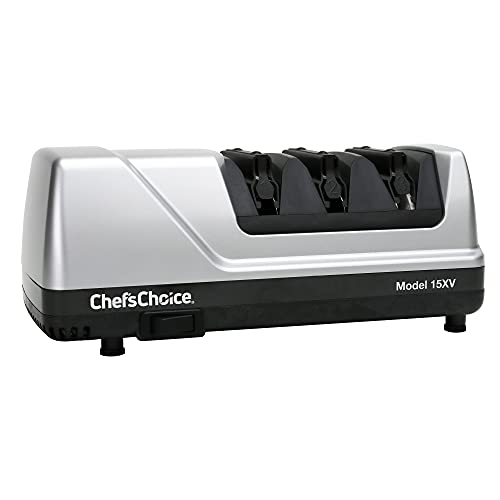
The Chef’sChoice 15XV EdgeSelect is a three-stage electric sharpener designed for 15-degree knife edges. It uses diamond abrasives and guides the blade through each stage. The system supports both straight and serrated knives. For busy cooks, it offers a fast path from dull to sharp without the hand skill required by a whetstone.
The motor does the work, but you still need to follow the instructions. I use slow, smooth passes and avoid pressing down on the blade. The 15-degree format suits many modern kitchen knives, especially thinner Western and Asian-style edges. Chef’sChoice is an American brand with models associated with USA manufacturing, but verify the current unit’s label if domestic production is essential.
Pros:
- Electric operation saves time
- Guides help keep the sharpening angle steady
- Diamond abrasives cut efficiently
- Three stages support repair, sharpening, and polishing
- Works with straight and serrated knives
- Good choice for frequent kitchen use
Cons:
- Costs more than a basic manual sharpener
- Uses power and takes counter space
- Can remove excess metal if used with pressure
- Manufacturing details should be checked by the buyer
SHARPAL 156N Double-Sided Diamond Stone
SHARPAL 156N Diamond Sharpening Stone

The SHARPAL 156N is a double-sided diamond sharpening stone measuring six inches by 2.5 inches. Its two surfaces let you move from a more abrasive side to a finer side during one sharpening session. The compact format works for kitchen knives, pocket knives, tools, and outdoor blades. It gives users a portable alternative to a large bench stone.
I like a double-sided stone when storage space matters. It does not require soaking, and diamond plates are easy to clean after use. The smaller size can make long chef’s knives less comfortable to sharpen than on an eight-inch stone. This is not clearly a USA-made product, so choose it for portability and function rather than domestic origin.
Pros:
- Two diamond grits offer useful flexibility
- Compact size suits travel and small drawers
- Works on knives and general tools
- No water soaking is required
- Diamond surface cuts many steel types
- Good option for field or emergency sharpening
Cons:
- Shorter surface gives less room for long blades
- Requires manual angle control
- Not made in the USA
My Recommendation
After comparing these products, I would choose the DMT D8C Dia-Sharp as the best all-around knife sharpener made in USA for shoppers who value American production, durable construction, and strong repair power. Its coarse 325-grit surface handles dull kitchen knives without the extreme bite of an extra-coarse plate. Pair it with the DMT D8E when you want a smoother final edge.
The DMT D8X is better for deep repairs, chips, and workshop work. The Chef’sChoice 15XV is better for people who want speed and guided electric sharpening. A beginner may prefer the 4-in-1 or Longzon design, while an outdoor user may get the most value from the Work Sharp Guided Field Sharpener. The right choice depends on your blade, skill, and sharpening habits.
| Best for | Why |
|---|---|
| USA-made bench sharpening | DMT Dia-Sharp stones offer flat diamond surfaces and clear domestic manufacturing claims |
| Fast home kitchen sharpening | Chef’sChoice 15XV provides guided electric sharpening with three stages |
| Camping and field use | Work Sharp Guided Field Sharpener is compact and offers several sharpening surfaces |
How to Use a Bench Diamond Sharpener
Start with a clean blade and a stable bench. Place the sharpener on a non-slip mat or secure it so it cannot slide. A moving stone can cause a poor edge and can also create a safety risk.
Find the existing bevel before you begin. Most kitchen knives use an angle near 15 to 20 degrees per side, but the exact angle varies by blade. Lay the knife at the chosen angle, then move it across the stone as if you were trying to slice a thin layer from its surface.
Use light pressure. Let the diamond do the work. Make the same number of passes on each side, and check for a small burr along the edge. That burr shows that you reached the apex. Once the full edge has a burr, switch to a finer abrasive or reduce pressure for a few finishing passes.
Do not scrub back and forth without a plan. A steady motion from heel to tip creates a more even bevel. Keep your fingers behind the cutting edge, and wipe the blade carefully before testing it.
How to Use a Pull-Through Sharpener
Set the sharpener on a solid, dry surface. Hold the handle firmly and keep your other hand away from the blade path. Pull the knife through the correct slot from heel to tip. Do not push the blade forward and backward unless the instructions specifically allow it.
Use the repair slot only when the knife is truly dull or damaged. Use the fine slot for normal maintenance. Too many passes can shorten the useful life of a blade. After sharpening, wash and dry the knife to remove fine metal particles.
A pull-through tool can help a busy cook, but it does not offer the same control as a flat stone. I would not use one on a hand-finished blade without checking the knife maker’s guidance.
How to Use a Whetstone
Soak or wet the stone according to its instructions. Place it on a stable base or damp towel. Start with the coarser side when the knife feels dull. Use the finer side only after you have formed a complete edge.
Angle control matters more than speed. I tell new users to imagine they are holding a small coin between the spine of the knife and the stone. Keep that angle steady as you move from heel to tip. Practice makes this motion feel natural.
Rinse the stone after use and let it dry fully. Some stones need flattening over time. A hollow stone can change the bevel and make sharpening harder. Proper care helps a whetstone deliver reliable results for years.
What Makes a Sharpener Safe?
A safe sharpener gives you control. A stable base matters because the tool should not slide as you work. A handle or guide can help new users keep their hands in a safer position. Good lighting also helps you see the edge and avoid awkward movements.
Never test sharpness by sliding your finger along the blade. I use a sheet of paper, a soft food item, or a careful visual check instead. Keep the knife pointed away from your body. Store the sharpener and knife where children cannot reach them.
A cut-resistant glove can reduce some risks, but no glove stops every injury. Treat the blade as sharp during the entire process. Wipe metal dust from the work area when you finish.
How Often Should You Sharpen a Kitchen Knife?
The answer depends on use, steel, cutting boards, and storage. A home cook may need a full sharpening every few months. A professional cook may sharpen more often. Light honing can refresh the edge between full sharpening sessions.
Do not wait until the knife feels dangerous or useless. If the blade crushes food, needs extra force, or slips across the surface, it likely needs attention. Early maintenance removes less metal and keeps the original shape longer.
Use a honing rod only when the edge needs alignment, not when the edge has become fully dull. Honing cannot replace sharpening. A diamond or whetstone must remove a small amount of steel to create a new apex.
Can These Sharpeners Handle Serrated Knives?
Serrated knives need special care. The teeth have separate bevels, so a flat bench stone may not reach each groove. An electric model with a serrated setting or a narrow ceramic tool may work better.
Do not drag a serrated blade through a standard coarse slot unless the maker says it is safe. That action can flatten the teeth. Instead, sharpen each scallop with a tool that matches its size. Many bread knives need sharpening less often than smooth-edge kitchen knives.
Does a USA-Made Sharpener Last Longer?
Country of origin alone does not guarantee longer life. Abrasive quality, build, storage, and use also matter. Still, USA-made tools such as DMT Dia-Sharp stones have a strong appeal because their flat diamond plates offer a simple design with few parts to fail.
A bench stone can last for many years when you use light pressure and clean it correctly. Electric sharpeners have motors and moving parts, so their service life depends on care and use. Pull-through tools may be affordable, but their abrasive inserts can wear with regular sharpening.
For the best long-term value, match the sharpener to your habits. Buying a complex tool you rarely use is not a saving. A simple stone that you understand may serve you better.
FAQs Of best knife sharpener made in usa
What is the best knife sharpener made in USA?
The DMT Dia-Sharp bench stone is a leading choice. It has a flat diamond surface, cuts steel quickly, and is identified as made in the USA. Choose the coarse D8C for dull edges or the extra-coarse D8X for heavy repair.
Is a diamond stone better than a whetstone?
Neither is best for every user. A diamond stone needs little setup and cuts fast. A whetstone can create a very refined edge but requires water, angle control, and practice.
Can beginners use the DMT Dia-Sharp?
Yes, but beginners should start slowly. Use a light touch, choose a consistent angle, and practice on an inexpensive knife. A guide can help until your hand learns the correct position.
Is an electric sharpener safe for expensive knives?
It can be safe when you follow the instructions and use light pressure. However, electric sharpeners remove metal quickly. Check the knife maker’s recommended angle and avoid repeated passes.
How do I know when a knife is sharp?
A sharp knife should cut food with little force. It should slice paper or a soft food item cleanly instead of tearing. Never test sharpness by touching or sliding a finger along the edge.
Final Verdict: Which Should You Buy?
The DMT D8C Dia-Sharp is my top pick for the best knife sharpener made in USA. It is flat, durable, fast, and useful for kitchen or workshop blades.
Choose the DMT D8E for finishing, the D8X for heavy repairs, or Chef’sChoice for easy electric sharpening. Match the tool to your skill and knife type for the best value.