
Learning Blender 3D becomes easier with a clear path, small projects, and steady daily practice.
You may open Blender, see many buttons, and wonder where to begin. That feeling is normal. Blender can model, sculpt, animate, render, simulate, and draw in one free program. The best learning guide helps you focus on one skill at a time. I reviewed these Blender books for clear lessons, useful projects, and beginner value. This guide explains how to learn Blender 3D without wasting time or feeling lost.
Low Poly Modeling in Blender

Low Poly 3D Modeling in Blender is a focused choice for learners who want to make simple assets fast. Low poly art uses fewer polygons, so beginners can understand shape, scale, and form without facing a heavy technical load. The book centers on building assets and scenes from the ground up. That makes it a useful starting point for games, concept art, and simple animation.
I like the narrow focus because it gives new users a clear target. Instead of opening every Blender tool at once, you can practice modeling with a small set of commands. The lessons can also help you build a first portfolio piece. If you want to understand how to learn Blender 3D through practical work, this book offers a direct route.
Pros:
- Clear focus on low poly modeling
- Good starting point for new Blender users
- Encourages hands-on asset creation
- Useful for game art and simple scenes
- Helps explain shape and form in a simple way
- Supports portfolio practice through finished projects
Cons:
- Does not cover every major Blender feature
- Low poly methods may feel limited for advanced sculpting
- Readers seeking animation may need a second guide
My Recommendation
I recommend this book for beginners who learn best by making things. It is especially suited to game artists, hobbyists, and visual learners who want quick progress. The low poly style keeps projects manageable and helps you see how basic shapes become useful objects. It is also a smart option for anyone who feels overwhelmed by Blender’s large interface.
Use this book as your first step, then add animation, materials, or sculpting lessons later. Its value comes from focus rather than size. For people asking how to learn Blender 3D with less confusion, this is one of the most approachable project-based choices in the list.
How to Use Blender 4.5

How to Use Blender 4.5 is a broad guide for readers who want one book to cover modern 3D work. Its topic range includes modeling, animation, and rendering. That mix helps you understand the full path from an empty scene to a finished image. It may suit a learner who wants to explore several parts of Blender before choosing a specialty.
A broad guide works like a map. It may not take you as deep as a specialist book, but it shows where each tool fits. I find that useful for beginners who do not yet know whether they prefer animation, product design, or visual effects. It can also support a steady study plan because you can return to one topic as your skills grow.
Pros:
- Covers several important Blender skills
- Useful for learners who want a broad overview
- Connects modeling, animation, and rendering
- May reduce the need to buy several beginner books
- Good reference for returning to basic tasks
- Supports exploration before choosing a 3D specialty
Cons:
- A broad scope may feel less detailed in some topics
- Beginners may need extra practice after each lesson
- Readers using a different Blender version should check menus
My Recommendation
I recommend this guide for beginners who want a wide view of Blender 3D. It is a good fit for students, hobby creators, and career explorers who want to test several creative paths. The combination of modeling, animation, and rendering gives you a better sense of a complete production process. It can also work well as a desk reference.
This is not the narrowest choice, but that is its strength. If you are still deciding what to study, it gives you room to explore. For anyone researching how to learn Blender 3D in a modern and flexible way, this guide is a practical starting point when used with regular projects.
Learn Blender Simulations

Learn Blender Simulations the Right Way targets a more specific area of Blender: realistic motion and physical effects. Simulations can include cloth, fluids, smoke, particles, soft bodies, and rigid bodies. These tools often confuse new users because small settings can change the final result. A focused guide can make those ideas easier to test in a calm, ordered way.
This book is best viewed as a next step rather than a first Blender lesson. You should understand basic objects, transforms, materials, and the timeline before spending much time on simulation settings. I value this type of guide because it turns trial and error into a repeatable process. It may help artists create effects that would be hard to animate by hand.
Pros:
- Focuses on realistic Blender simulations
- Useful for visual effects and motion design
- Can help explain complex physical behavior
- Encourages controlled testing of settings
- Supports more advanced creative projects
- Useful for artists who want smoke, cloth, or fluid effects
Cons:
- May be too advanced for a complete beginner
- Simulation results can require strong computer hardware
- Some effects may take time to calculate and refine
My Recommendation
I recommend this book for Blender users who already know the basic interface and want more dramatic results. It suits visual effects artists, motion designers, and curious intermediate learners. Simulation work rewards patience, so it is best for people who enjoy testing settings and studying cause and effect. It can also add life to otherwise simple scenes.
Do not choose it as your only book if you are opening Blender for the first time. Pair it with a basic modeling guide first. Once you understand the foundation, it becomes a strong resource for learning how to learn Blender 3D through motion, force, and realistic behavior.
3D Printers Beginner’s Guide

This 3D Printers beginner guide is not a pure Blender manual, but it can support Blender learners who want to make physical objects. It explains core printer ideas, data files, and software. That wider view matters because a digital model must meet real-world limits before it can print well. You learn to think about walls, supports, scale, and file preparation.
I see this book as a bridge between the screen and the workbench. Blender can make beautiful shapes, but a printer needs a usable mesh. The guide may help you understand why clean geometry and correct export settings matter. It is a useful companion for makers who want their Blender practice to end with a physical object.
Pros:
- Connects digital modeling with physical printing
- Useful for makers and home workshop users
- Introduces data files and printer software
- Encourages practical thinking about scale and structure
- Helps explain the steps after Blender modeling
- Useful for product prototypes and hobby projects
Cons:
- It does not teach Blender in full detail
- Printer technology and software can change over time
- Readers focused only on animation may not need it
My Recommendation
I recommend this guide for Blender learners who want to print models. It suits makers, product designers, teachers, and families exploring 3D printing. The book adds useful context that a standard Blender guide may skip. It can help you design with the final object in mind rather than treating printing as an afterthought.
Choose it as a companion, not as your main Blender course. Start with basic modeling, then use this guide when you want to export and print. For people learning how to learn Blender 3D with a practical goal, it adds real value by linking virtual design to a physical result.
How to Draw Cool Stuff
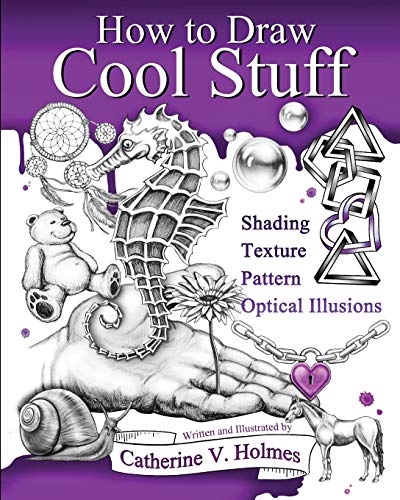
How to Draw Cool Stuff is a traditional drawing book about shading, texture, and optical effects. It does not teach Blender buttons, but it can improve the artistic skills behind strong 3D work. A model needs more than correct geometry. It also needs good light, clear value changes, and surfaces that look believable.
I often suggest drawing practice to new 3D artists because it trains the eye. You learn to notice where light falls, how edges turn, and why a flat shape can appear round. Those skills transfer well to Blender materials, sculpting, lighting, and camera work. This book can make your digital practice more thoughtful and less dependent on random settings.
Pros:
- Builds strong observation skills
- Explains shading and texture in a visual way
- Supports better Blender lighting decisions
- Useful for beginners who feel weak at art basics
- Can improve sculpting and material work
- Works without special software or hardware
Cons:
- Does not provide Blender software lessons
- Traditional drawing practice requires extra time
- Some optical illusion topics may not fit every 3D goal
My Recommendation
I recommend this book for Blender users who want stronger visual judgment. It is especially useful for beginners who can operate software but struggle with light, form, or texture. Artists, illustrators, sculptors, and future animators can all gain from these basic lessons. The book helps you build the eye that makes technical Blender skills look professional.
Buy it alongside a Blender manual if you want a balanced learning plan. It will not show you how to learn Blender 3D step by step inside the program. However, it can improve the creative thinking that separates a plain render from a convincing one.
Blender Grease Pencil User Guide

The Blender Grease Pencil User Guide focuses on digital drawing, 2D animation, storyboards, and production workflows. Grease Pencil gives Blender a different feel from normal 3D modeling. You can draw lines, create flat art, and mix 2D work with 3D cameras and scenes. This makes the guide appealing to artists who think in sketches and frames.
Grease Pencil can feel like a bridge between a notebook and a full 3D studio. It supports story ideas before you build complex assets. It may also help animators block scenes and test movement. If you want to learn how to learn Blender 3D while keeping a strong 2D voice, this guide offers a creative path that many general books do not cover.
Pros:
- Focused on Grease Pencil workflows
- Useful for digital drawing and 2D animation
- Supports storyboarding and visual planning
- Can combine 2D art with 3D scenes
- Helpful for artists who prefer drawing to modeling
- Encourages fast idea testing before full production
Cons:
- Not the best first book for standard 3D modeling
- Grease Pencil tools may change between Blender releases
- Readers need drawing interest to gain the most value
My Recommendation
I recommend this guide for illustrators, storyboard artists, animators, and comic creators. It is also a good pick for Blender users who want to mix hand-drawn lines with 3D space. The workflow can make early story planning feel quick and natural. It gives creative people a way to use Blender without starting with complex mesh work.
Choose it after you decide that 2D animation or drawn art matters to your goals. It is not a complete guide to every Blender feature, but it has a clear identity. For the right learner, it offers one of the most enjoyable answers to how to learn Blender 3D through drawing and motion.
Blender 5.0 User Guide for Beginners

Blender 5.0 User Guide for Beginners aims to cover the main parts of a modern Blender workflow. The listed topics include modeling, animation, sculpting, materials, lighting, and rendering. Hands-on projects can make these subjects easier to connect. Instead of studying tools as separate islands, you can see how they work together in a scene.
This broad beginner format is useful when you want a single learning path. You still need to practice, save versions, and repeat steps without copying blindly. Blender changes over time, so always compare commands with the current Blender manual and your installed version. As a 2026 learning choice, this guide is attractive for users who want current-version direction and simple project work.
Pros:
- Covers many core Blender subjects
- Designed around beginner-friendly projects
- Includes modeling, animation, and rendering topics
- Also introduces sculpting, materials, and lighting
- Useful as a broad desk reference
- Can support a complete first learning plan
Cons:
- Wide coverage may limit depth in advanced areas
- New users may need to repeat lessons more than once
- Version changes can affect menu names and workflows
My Recommendation
I recommend this book as the strongest general starting point in this list. It suits complete beginners, students, and hobbyists who want to study several Blender skills in one place. The hands-on format can help you move from reading to making. It also gives you a better base before you choose a specialty such as character art or effects.
Keep the official Blender manual nearby for updated tool details. With that small habit, this guide can remain useful as your skills grow. If someone asks me how to learn Blender 3D from the beginning in 2026, this is the book I would place near the top for broad coverage and practical structure.
Blender 5.0 Simplified Spanish Guide

Blender 5.0 Simplified is a Spanish edition for beginners who prefer to study in Spanish. It covers 3D modeling, animation, and creative projects. Language can make a major difference when software already feels complex. Clear instructions in a familiar language may help learners stay focused on the idea instead of translating every sentence.
This guide can also support Spanish-speaking families, schools, and study groups. The best book is often the one you will actually read and use. If English tutorials slow you down, a Spanish guide can make practice feel less like a wall and more like a door. The main goal remains the same: build small projects, review mistakes, and repeat useful steps.
Pros:
- Written for Spanish-speaking beginners
- Covers modeling, animation, and creative projects
- May make technical ideas easier to understand
- Useful for home study and classroom use
- Supports practical project-based learning
- Can reduce language barriers during early practice
Cons:
- Not the right choice for readers who need English text
- Blender menus may still appear in a different language
- Readers may need extra resources for advanced topics
My Recommendation
I recommend this edition for Spanish-speaking beginners who want a friendlier start. It is a good fit for students, families, and independent learners who find English software books tiring. Familiar language can improve confidence and help you keep a steady practice routine. That matters because Blender skill grows through repetition, not one long reading session.
Choose it when language support is your top need. It may not replace every English reference, but it can give you a clear base. For Spanish-speaking readers asking how to learn Blender 3D, this version offers a more comfortable and practical first step.
Best Blender Book by Learning Goal
| Best for | Why |
|---|---|
| Complete beginners | Blender 5.0 User Guide offers broad topics and hands-on projects. |
| Focused modeling practice | Low Poly 3D Modeling keeps lessons simple and project-based. |
| Special skills and creative workflows | Simulation, Grease Pencil, drawing, and 3D printing guides support clear goals. |
How to Learn Blender 3D: A Simple Study Plan
The best way to learn Blender is to follow a small plan. Do not try to master the whole program in one week. Blender is more like a large workshop than a single tool. You need time to learn where each tool belongs and when to use it.
1. Learn the interface first
Start with the 3D Viewport, Outliner, Properties editor, Timeline, and File menu. Learn how to orbit, pan, zoom, select, move, rotate, and scale. These actions form the grammar of Blender. If you know them well, later lessons feel much easier.
Save your file often. Use clear names such as “chair practice 01” or “low poly room 02.” Saving versions lets you test bold ideas without fear. It also teaches a real production habit used in studios.
2. Practice with simple objects
Begin with cubes, cylinders, spheres, and planes. Turn them into a mug, table, lamp, crate, or small room. Simple forms teach more than they seem to teach. You learn how edges, faces, proportions, and modifiers shape a model.
Do not chase perfect art at first. Your first model may look like a box with a handle. That is fine. Each small object is a brick in the path of how to learn Blender 3D.
3. Study basic modeling tools
Focus on Edit Mode, loop cuts, extrude, inset, bevel, merge, and proportional editing. Learn the difference between vertices, edges, and faces. These parts are the bones of a mesh. Clean topology matters because it helps models deform, shade, and export more reliably.
Use reference images when possible. A reference keeps your eyes honest. Without one, beginners often accept shapes that feel close but look wrong. Even a simple photo can improve your work.
4. Add materials and lights
Once you can build a basic model, learn materials. Start with color, roughness, and metallic value. Then add a simple light setup. A model can have good shape but still look flat if the light does not show its form.
Try one large area light, a soft fill light, and a small rim light. Change one setting at a time. This method helps you understand cause and effect instead of guessing.
5. Learn the camera and render process
A camera turns your scene into an image. Practice focal length, framing, and camera position. Render small previews while you work. You do not need a large final image during study.
Blender includes different render options and settings. The official Blender manual explains current features, while your chosen book can provide a guided path. Check both when a command or panel looks different from the page.
6. Try animation after the basics
Animation begins with keyframes. You can animate a cube before you animate a character. Move the cube at frame one, set a keyframe, move it at frame forty, and set another. Blender fills the movement between those points.
This simple exercise teaches timing, spacing, and the timeline. Later, you can study the Graph Editor, armatures, constraints, and camera animation. Small tests are better than a giant film that never gets finished.
7. Choose one specialty
After a few weeks, notice what holds your attention. You may enjoy modeling, sculpting, motion graphics, character work, simulations, drawing, or 3D printing. Choose one main path for a month. Keep other areas as side interests.
This focus prevents random tutorial hopping. It also gives you a better portfolio. Three finished projects in one area often show more skill than ten unfinished experiments.
Common Mistakes New Blender Users Make
Watching too many tutorials
Tutorials help, but passive watching does not build strong skill. Pause often and copy the idea with your own object. Change the color, shape, or camera. If you can make a variation without help, you learned something real.
Ignoring keyboard shortcuts
Blender shortcuts can feel strange at first. Learn a few at a time, such as G for move, R for rotate, S for scale, Tab for Edit Mode, and Ctrl+Z for undo. Shortcuts save time and keep your attention on the model.
Starting with a huge project
A full animated character or detailed city can become too much. Begin with a small scene. A desk, toy, room, or simple vehicle gives you a complete win. Finished small work builds confidence like steps build a staircase.
Skipping cleanup
Delete unused objects. Name important items. Check normals and scale. Keep your Outliner organized. Good habits make later changes faster and help prevent confusing errors.
Comparing early work with expert art
Expert artists have years of practice behind their images. Compare your current model with your last model instead. Look for one improvement. Maybe the shape is cleaner, the light is softer, or the camera is stronger. That steady view keeps learning enjoyable.
What Equipment Do You Need to Learn Blender?
You can start with a normal computer, a mouse, and a keyboard. A dedicated graphics card can help with large scenes and fast rendering, but it is not required for basic lessons. Keep early projects small if your computer feels slow.
A drawing tablet can help with sculpting and Grease Pencil work. It is optional for modeling. A second monitor can make tutorials easier to follow, but it is also optional. The most important tool is a routine that gives you regular practice.
Blender is free and open source, which makes it accessible to students and hobbyists. Before installing a new release, check the official Blender website for system needs and current documentation. Books can guide you, but current software notes help confirm updated menus and features.
How Long Does It Take to Learn Blender 3D?
You can learn the basic interface in a few days. You may make simple objects within a week or two. Strong modeling, animation, or sculpting skills take much longer. Progress depends on practice time, project size, and your creative background.
A useful schedule is twenty to thirty minutes on most days. Spend five minutes reviewing, fifteen minutes making, and five minutes writing down what confused you. This small routine is easier to keep than a rare four-hour session.
Do not measure success by how much of Blender you know. Measure it by what you can finish. One useful scene proves more than a long list of watched lessons.
FAQs Of how to learn blender 3d
Is Blender hard for complete beginners?
Blender can look hard because it has many tools. Start with navigation, simple objects, and short projects. The interface becomes easier when you use the same core tools each day.
What is the best book for learning Blender 3D?
The Blender 5.0 User Guide for Beginners is the best broad choice here. Low Poly 3D Modeling in Blender is better for focused modeling practice. Your best pick depends on your goal and current skill.
Can I learn Blender without an art background?
Yes. Technical skills and art skills grow together. Begin with simple shapes, use references, and study light and form. Drawing practice can help, but it is not a requirement.
Should I learn modeling or animation first?
Learn basic modeling and navigation first. Then try simple animation with keyframes. This order gives you a stable base without delaying creative practice.
Is Blender useful for 3D printing?
Yes. Blender can create models for printing, but you must prepare clean, usable geometry. Learn about scale, wall thickness, file export, and your printer’s limits before printing complex designs.
Final Verdict: Which Should You Buy?
The Blender 5.0 User Guide for Beginners is the best overall choice for most new users. Choose Low Poly Modeling for focused practice, or a specialty book for simulations, drawing, or printing.
The best way to learn Blender 3D is to read, practice, and finish small projects. Pick one guide, open Blender often, and let steady work build your skill.