
For most households in the United States, a 5- to 6-quart slow cooker is the best all-purpose size. It can make dinner for about 4 to 6 people and still leave room for leftovers.
Choose a 1- to 2-quart slow cooker for dips, sauces, and meals for one or two people. Choose a 3- to 4-quart model for small families. A 7- to 8-quart slow cooker works best for large families, big cuts of meat, parties, and batch cooking.
The right size depends on more than the number of people you feed. Your recipes, counter space, storage space, and need for leftovers all matter.

Slow Cooker Size Chart
The table below gives a practical starting point. Serving counts are estimates because foods vary in volume, and many recipes include leftovers.
| Slow cooker size | Best for | Typical servings | Common uses |
|---|---|---|---|
| 1 to 2 quarts | One or two people | 1 to 2 | Dips, sauces, oatmeal, small meals |
| 3 to 4 quarts | Two to four people | 2 to 4 | Small roasts, soups, chili |
| 5 to 6 quarts | Four to six people | 4 to 6 | Family dinners, whole chicken, pulled pork |
| 7 to 8 quarts | Six or more people | 6 to 10 | Large roasts, parties, meal prep |
| 8 quarts or more | Large groups or batch cooking | 8 or more | Holiday meals and large food batches |
These ranges are not strict limits. A 6-quart cooker may feed two people if you want several days of leftovers. A 4-quart cooker may feed four people if the meal contains a filling side dish.
Capacity also depends on the shape. A wide, shallow cooker may hold the same volume as a tall cooker but work better for a flat roast. A tall cooker may suit soups, stews, and layered dishes.
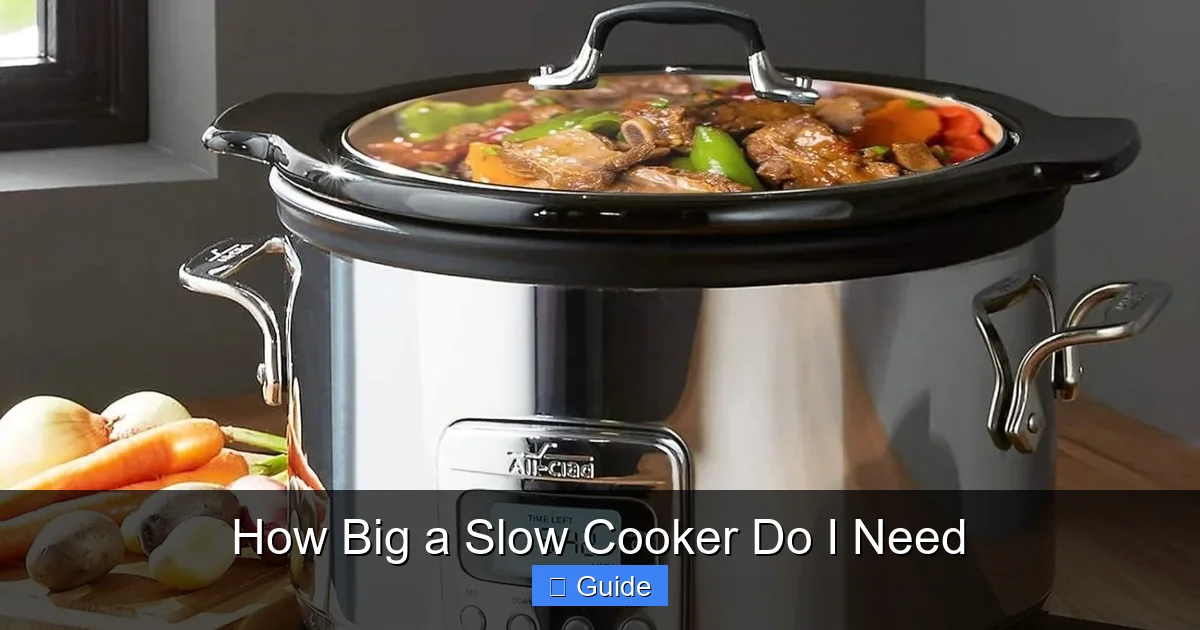
How to Choose a Slow Cooker by Household Size
Use the number of people you feed as your first filter, then adjust for leftovers and recipe size.
For one or two people
A 1.5- to 3-quart slow cooker usually works well for one or two people. It can handle:
- Small portions of soup or chili
- Oatmeal and breakfast dishes
- Dips and warm sauces
- Small chicken breasts or pork portions
- Side dishes
A 1-quart cooker is useful for dips and very small portions, but it may be too limited for regular dinners. If you want lunch leftovers, a 2- to 3-quart model gives you more flexibility.
For three or four people
Choose a 3- to 4-quart slow cooker for a small family or a couple that wants leftovers. This size suits many everyday meals, including:
- Chili
- Stew
- Beans
- Chicken and vegetables
- Macaroni and cheese
- Small pot roasts
A 4-quart model may be a better long-term choice than a 3-quart model if you often cook full meals rather than side dishes.
For four to six people
A 5- to 6-quart slow cooker is the most useful general-purpose choice for many U.S. households. It gives you space for family meals without taking up as much room as a very large cooker.
This size is often suitable for:
- A whole chicken
- A medium pork shoulder
- Beef stew
- Large batches of chili
- Soups and casseroles
- Meals with several vegetables
If you are unsure which size to buy, choose a 6-quart model when your kitchen and storage space allow it. It offers more recipe flexibility than a small cooker.
For six or more people
Choose a 7- to 8-quart slow cooker for a large family, frequent guests, or batch cooking. This size is helpful for:
- Large cuts of meat
- Big batches of pulled pork
- Party dips
- Holiday side dishes
- Several meals for freezing
- Recipes that use a large amount of liquid or vegetables
A large cooker is not always better. Small food portions can spread too thinly in a large crock. That may affect cooking time and food texture.

How Much Food Fits in a Slow Cooker?
A slow cooker should usually be filled between one-half and two-thirds full, unless the manufacturer gives different instructions. This range helps the food heat at a steady rate and reduces the risk of uneven cooking.
Do not use the listed capacity as the amount of food you can safely cook. A 6-quart cooker holds 24 U.S. cups when filled to the top, but you should not normally fill it that far.
A simple estimate is:
Usable cooking volume = stated capacity × 0.5 to 0.67
For example:
- A 4-quart cooker has about 2 to 2.7 quarts of useful cooking space.
- A 6-quart cooker has about 3 to 4 quarts of useful cooking space.
- An 8-quart cooker has about 4 to 5.3 quarts of useful cooking space.
This is a planning estimate, not a replacement for the manual. Some recipes need more room because they bubble, expand, or contain large pieces of meat.
The one-quart-per-person rule
Some cooks use about 1 quart of slow cooker capacity per person. This rule can help with a first estimate, but it is not a cooking requirement.
It may work for a main dish with normal portions. It can overestimate the size you need for soup or side dishes and underestimate the size needed for large cuts of meat.
Use this rule only as a starting point. Check the recipe volume and the cooker’s recommended fill range before making a final choice.

Match the Slow Cooker to Your Recipes
Your recipes may matter more than your household size. A cooker that fits one type of food may not fit another.
For soups, chili, and stews
A 5- to 6-quart slow cooker is a flexible choice for family-size soups, stews, and chili. These foods need enough space for liquid, meat, beans, and vegetables.
If you often cook small batches, a 3- to 4-quart cooker may be more practical. Too much empty space can make portion control harder.
For roasts and whole poultry
Choose a cooker based on the size and shape of the meat. A large roast may need a 6- to 8-quart cooker even when you are feeding only four people.
Measure the interior if possible. Some roasts are too wide for a narrow oval crock, even when the total quart capacity seems large enough. An oval shape often gives more room for long cuts of meat and whole poultry.
For dips and party food
A 1- to 3-quart slow cooker is often enough for dips, queso, sauces, and small appetizers. A smaller crock also makes it easier to serve food at a party without using a large amount of counter space.
For a large gathering, several small cookers may work better than one very large cooker. You can offer different foods and keep each portion at a suitable depth.
For meal prep and freezer meals
Choose a 6- to 8-quart cooker if you want several portions from one batch. Before buying, check whether your storage containers and freezer space can handle the extra food.
A larger model may save cooking time across the week, but it can also create more leftovers than you can safely store or use.

Slow Cooker Shape and Features Matter
Capacity tells you how much the cooker holds, but shape affects how well it handles certain foods.
Oval versus round
An oval slow cooker is often useful for:
- Whole chickens
- Pork shoulders
- Brisket
- Longer cuts of meat
- Large vegetables
A round slow cooker may be more convenient for:
- Soups
- Dips
- Beans
- Small stews
- Compact storage
Neither shape is always better. Pick the shape that matches the foods you cook most often.
Removable insert
A removable ceramic or metal insert can make serving and cleaning easier. Check the manual before placing the insert in an oven, dishwasher, or on a stovetop. Not every insert supports every use.
Programmable controls
Programmable settings can switch the cooker to a warm mode after cooking. This may be useful when your schedule changes, but warm mode is not a substitute for proper food storage.
The U.S. Department of Agriculture advises refrigerating perishable leftovers within two hours, or within one hour when the surrounding temperature is above 90°F. Follow the appliance instructions and food-safety guidance for your meal.

Slow Cooker Safety and Fill Limits
Food must reach a safe temperature, and the slow cooker must have enough food to heat properly.
Follow these basic rules:
- Read the manufacturer’s manual before first use.
- Keep the cooker on a stable, heat-safe surface.
- Do not fill the crock to the rim.
- Do not use frozen meat in a slow cooker unless the manufacturer and recipe specifically allow it.
- Thaw meat in the refrigerator before slow cooking.
- Cut large pieces into smaller pieces when the recipe calls for it.
- Keep the lid on during cooking.
- Use a food thermometer to check meat when the recipe or food type requires it.
- Refrigerate leftovers promptly in shallow containers.
The USDA recommends that poultry reach 165°F. Ground meats should also reach the safe temperature listed by the USDA for that food. Use the USDA’s current safe-temperature chart when you need a precise target.
A slow cooker is not a pressure cooker. It cooks at a lower temperature over a longer time. Do not assume that a recipe designed for a pressure cooker or oven will work without changes.
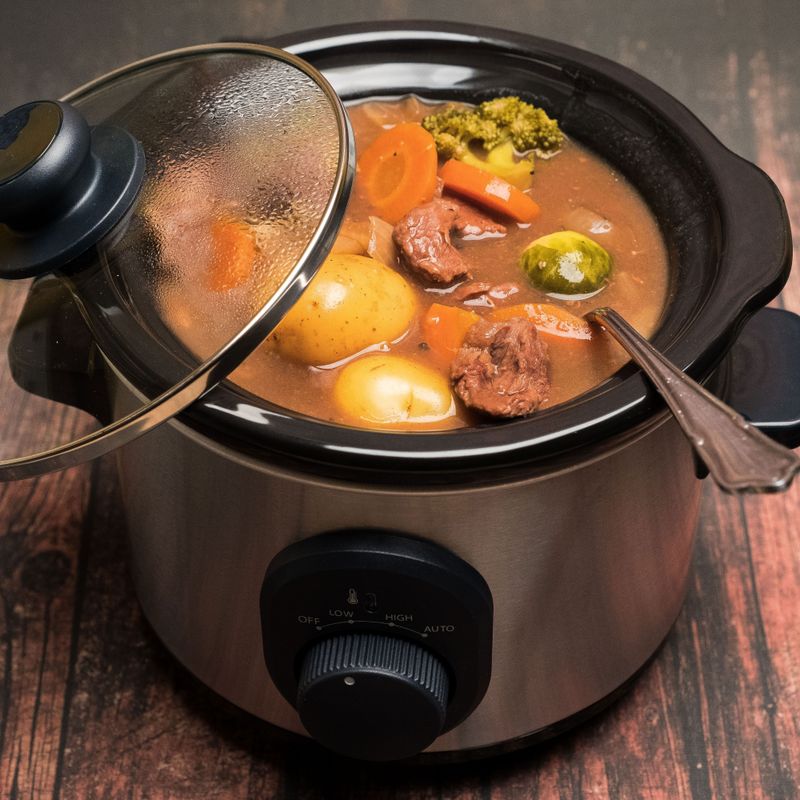
Common Slow Cooker Size Mistakes
The most common mistake is buying a cooker based only on the number of people in the home.
Buying too small
A small cooker may fail when:
- The recipe contains a large roast.
- You want leftovers.
- The food needs several layers.
- The ingredients reach the lid.
- The cooker must be filled above the recommended level.
If your recipes often feel crowded, move up one size rather than adding more food.
Buying too large
A large cooker may be a poor fit when:
- You mainly cook for one or two people.
- Most recipes are small.
- Food spreads in a thin layer.
- The crock is hard to lift or wash.
- Storage space is limited.
A big cooker can be useful for parties, but it is not automatically better for daily meals.
Ignoring recipe instructions
Some slow cooker recipes are written for a specific size. Changing from a 4-quart cooker to an 8-quart cooker can change the food depth and cooking time.
If the recipe gives a fill level, follow it. If it does not, keep the food within the manufacturer’s recommended range and verify doneness with a thermometer where appropriate.

The Best Slow Cooker Size for Different Needs
Use this quick decision guide:
- Cooking for one: Choose 1.5 to 2 quarts.
- Cooking for two with leftovers: Choose 2.5 to 3 quarts.
- Cooking for three or four: Choose 3.5 to 4 quarts.
- Cooking for four to six: Choose 5 to 6 quarts.
- Cooking for a large family: Choose 7 to 8 quarts.
- Cooking large roasts: Choose based on the meat’s shape and weight, often 6 to 8 quarts.
- Making party dips: Choose 1 to 3 quarts.
- Batch cooking: Choose 6 to 8 quarts, if you have enough refrigerator and freezer space.
When two sizes seem suitable, choose the smaller one for daily meals and the larger one for large cuts, parties, and planned leftovers.
Frequently Asked Questions
Is a 6-quart slow cooker too big for two people?
Not always. A 6-quart slow cooker can work for two people who want leftovers, freeze meals, or cook large cuts of meat. It may be inefficient for small portions that spread across the bottom.
What size slow cooker is best for a family of four?
A 4- to 6-quart slow cooker is usually suitable. Choose 4 quarts for normal portions and 6 quarts if you want leftovers or cook large recipes.
Can I use a 6-quart recipe in a 4-quart slow cooker?
Only if the food fits within the recommended fill range. Do not simply pour the full recipe into a smaller crock. Reduce the ingredients or use a larger cooker.
Can a slow cooker be filled to the top?
No. Most slow cookers work best when filled about one-half to two-thirds full. Check the manual because fill guidance can vary by model and recipe.
Is an oval slow cooker better than a round one?
An oval model may fit whole poultry and long roasts more easily. A round model can suit soups, dips, and small meals. The better shape depends on what you cook.
How long can leftovers stay in a slow cooker?
Do not treat a slow cooker as long-term food storage. Refrigerate perishable leftovers within the time limits given by the USDA, and use shallow containers to help them cool.
Conclusion: Choosing the Right Size
For most U.S. homes, a 5- to 6-quart slow cooker is the safest general recommendation. Choose smaller when you cook small portions, and choose larger when you prepare big roasts, party food, or several meals at once.
Before buying, check three things: the size of your usual recipes, the amount of food you want to make, and the space available for storage. Then choose a cooker that allows proper food depth without crowding.
If you are replacing an old model, measure its insert and compare that capacity with your most-used recipes. That simple check often gives a better answer than household size alone.