
The best meat thermometer for smoking combines fast readings, steady wireless range, and accurate temperature control.
Long cooks can test your patience. You may check the smoker at midnight, lift the lid, lose heat, and still wonder if the brisket is ready. A good thermometer removes that guesswork. I tested these options by looking at probe design, display clarity, wireless use, speed, cooking range, and daily value. Whether you smoke ribs on weekends or cook pork shoulder for a crowd, the right tool helps protect your food, your time, and your hard-earned fuel.
ThermoMaven Sub-1G Smart Wireless Thermometer

The ThermoMaven Sub-1G stands out for cooks who want wireless monitoring without depending on a phone all the time. Its standalone base gives you a local way to view cooking information while the wireless design lets you step away from the smoker. That matters during a long brisket cook, when opening the lid can slow the cook and dry the bark. I like this setup because it feels more like a dedicated cooking tool than a small gadget that needs constant app attention.
The wireless link is a useful fit for large patios, garages, and kitchens near the smoker. A probe-based system can help you watch food temperature while the smoker maintains its heat, but you should still confirm the probe sits in the thickest part of the meat. As with any digital thermometer, clean the probe after every cook and check accuracy from time to time. For many pitmasters, this is a strong candidate for the best meat thermometer for smoking when independent monitoring and simple access matter most.
Pros:
- Standalone base makes readings easy to see
- Wireless design supports long smoking sessions
- Useful for cooks who want to avoid opening the lid
- Good fit for brisket, pork shoulder, and turkey
- Dedicated display can reduce phone dependence
- Convenient for indoor and outdoor movement
Cons:
- Wireless systems need charging or battery care
- More parts require careful storage
- Signal strength can vary with walls and metal smokers
My Recommendation
I recommend the ThermoMaven Sub-1G to serious home smokers who want a modern wireless thermometer with a dedicated base. It is especially helpful for cooks who move between the patio, kitchen, and living room during a long session. The local display is a practical touch for anyone who does not want to unlock a phone each time they check the meat. If you want the best meat thermometer for smoking with a strong focus on wireless convenience, this model deserves a close look.
TempPro TempSync 1000FT Wireless Thermometer

The TempPro TempSync focuses on freedom of movement. Its advertised 1000-foot wireless range gives you room to handle other tasks while your food cooks. In real use, range depends on walls, appliances, metal surfaces, and the layout of your home, so I would treat the number as an outdoor estimate rather than a promise in every setting. Still, a long-range design can be valuable when your smoker sits far from the kitchen.
This thermometer suits people who cook large cuts and do not want to stand beside the smoker for hours. It can help you track progress from a porch, workshop, or living room, which makes long cooks feel less demanding. I would place the probe in the center of the thickest section and avoid touching bone or the cooking grate. If you value distance above all else, this may be the best meat thermometer for smoking in a busy home.
Pros:
- Long advertised wireless range for outdoor use
- Lets you move away from the smoker
- Helpful for long brisket and pork cooks
- Reduces the need to lift the smoker lid
- Useful for grilling as well as smoking
- Good choice for large yards or detached cooking areas
Cons:
- Actual range may drop near walls or metal
- Wireless units need regular battery checks
- More distance does not replace a reliable pit thermometer
My Recommendation
The TempPro TempSync is best for people who need to walk away from the smoker without losing awareness of the cook. It fits large outdoor spaces, family gatherings, and cooks who manage several tasks at once. I see it as a strong choice for wireless range, not just a basic instant check. For shoppers seeking the best meat thermometer for smoking across a wide yard or home, its long-range design offers useful freedom.
TempPro TempTrack Large LCD Thermometer
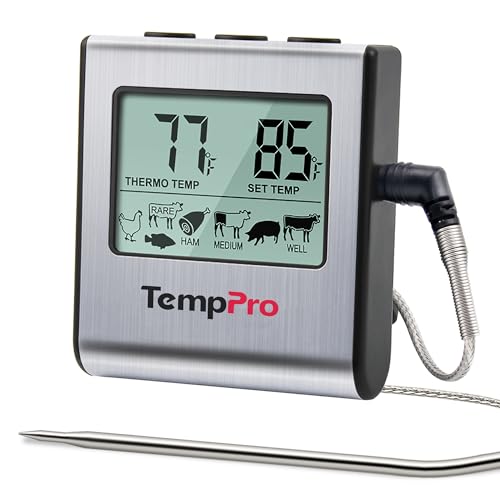
The TempPro TempTrack Large LCD is made for cooks who want a clear screen and a straightforward workflow. Large numbers are easier to read when your hands are wet, your glasses are fogged, or the smoker sits several steps away. A clear display may sound simple, but it can prevent mistakes during a busy cook. I prefer a thermometer that shows useful data at a glance instead of making me squint or press several buttons.
This model is a practical option for smoking, roasting, baking, and general kitchen work. It works well for cooks who want digital accuracy without a complex smart system. You still need to place the probe correctly and allow the reading to settle before making a decision. For many families, the best meat thermometer for smoking is not the most advanced model; it is the one that is easy to read and easy to use.
Pros:
- Large LCD display improves readability
- Simple format suits new and experienced cooks
- Useful for smoking and everyday cooking
- Easy to check during low-light cooking
- Less distracting than a phone-based system
- Good match for basic temperature monitoring
Cons:
- Large displays can take more storage space
- May offer fewer smart features than wireless models
- Users must remain within viewing or probe range
My Recommendation
I recommend the TempTrack Large LCD to beginners, older cooks, and anyone who values clear numbers over extra features. It is a sensible choice for a backyard smoker that stays close to the kitchen. The simple design also makes it a good family thermometer because several people can understand the display quickly. If your idea of the best meat thermometer for smoking is clear, direct, and dependable monitoring, this model is worth considering.
Alpha Grillers Instant-Read Thermometer

The Alpha Grillers Instant-Read thermometer takes a different approach from wireless probe systems. You insert it when you want a quick internal reading, then remove it before closing the smoker. This method works well for checking ribs, steaks, chicken, and smaller cuts without setting up a receiver. It also makes the thermometer useful beyond barbecue, from candy and oil to bread and roast chicken.
An instant-read tool cannot track a brisket every minute, but it offers excellent flexibility. I use this type of thermometer near the end of a cook, when a few degrees can separate tender meat from meat that still needs time. Insert the tip into several spots because one area may cook faster than another. For shoppers who want the best meat thermometer for smoking at a simple price, this is a useful and versatile choice.
Pros:
- Fast point-in-time temperature checks
- Useful for grilling, baking, frying, and smoking
- No receiver or wireless pairing is needed
- Easy to carry and store
- Helpful for checking several areas of one cut
- Good backup for a leave-in thermometer
Cons:
- Does not monitor food while you are away
- Opening the smoker can release heat
- Requires repeated insertion during a long cook
My Recommendation
The Alpha Grillers Instant-Read thermometer is best for cooks who want one compact tool for many jobs. It suits beginners, apartment grillers, and anyone who dislikes pairing devices or charging receivers. I also like it as a backup for a wireless probe system because it lets you compare readings from different spots. If you want the best meat thermometer for smoking for quick checks and broad kitchen use, this model makes practical sense.
TempPro TempTrack Dual-Probe Thermometer

The TempPro TempTrack Dual-Probe model is built for cooks who want to watch more than one temperature. One probe can track the meat while another checks the cooking environment or a second cut. That setup is useful because the air near the food may not match the number shown on the smoker lid. It also helps when you cook two different meats at the same time.
Dual-probe monitoring can make a long cook more controlled, but probe placement still matters. Keep the food probe in the thickest part and position the pit probe so it does not touch metal or sit too close to a hot wall. I would use this thermometer for ribs, pork shoulder, turkey, and mixed grill sessions. For a cook who wants the best meat thermometer for smoking with flexible monitoring, two probes add real value.
Pros:
- Two probes support meat and pit monitoring
- Useful for cooking two foods at once
- Helps reveal differences between lid and grate temperature
- Good fit for large cuts and full smokers
- Reduces the need to open the smoker
- Supports more controlled low-and-slow cooking
Cons:
- Two probe wires need careful placement
- More parts require cleaning and storage
- Probe cords may be less convenient than wireless models
My Recommendation
The TempTrack Dual-Probe thermometer is best for pitmasters who want to monitor both the meat and the smoker environment. It is also a smart pick for family cooks who prepare multiple cuts at once. I would choose it over a single-probe tool when pit temperature matters as much as internal temperature. If your search for the best meat thermometer for smoking centers on control and flexibility, this dual-probe design is a strong value.
How I Choose the Best Meat Thermometer for Smoking
A smoker thermometer must do more than show a number. It should help you make a good choice without forcing you to open the lid every few minutes. I look at reading speed, probe quality, display design, range, and ease of cleaning. I also consider whether the tool fits a real cooking routine, not just a product box.
Accuracy comes first. A reading that is off by several degrees can change the result, especially with chicken, turkey, and large roasts. The USDA advises using a food thermometer to confirm safe internal temperatures, and I follow that advice rather than relying on color, time, or the feel of the meat alone. Time guides help, but temperature gives you better evidence.
Probe Placement
Correct placement matters as much as the thermometer itself. Put the tip in the thickest part of the meat, away from bone, fat pockets, and the pan. With a thin cut, insert the probe from the side so the tip reaches the center. For a large roast, check more than one area before you pull it from the smoker.
When measuring smoker temperature, keep the ambient probe near the food. Do not let it touch the grate, wall, water pan, or a large piece of meat. Metal can transfer heat and create a reading that does not reflect the air around the food. This small step can make a major difference during a long cook.
Wireless Range and Signal
Wireless range looks impressive on a product page, but actual distance depends on the home and the smoker. Brick, concrete, metal, appliances, and closed doors can weaken a signal. I treat the advertised range as a best-case figure in an open area. Before starting a long cook, I test the receiver from the place where I plan to sit.
A wireless thermometer earns its keep by helping you keep the lid closed. Each lid opening releases heat and smoke. One quick check will not ruin dinner, but repeated checks can extend the cook and soften the bark. Wireless monitoring gives you information without making the smoker pay the price.
Instant-Read Versus Leave-In Models
An instant-read thermometer is ideal for quick checks. It is compact, simple, and useful in nearly every kitchen. However, you must open the smoker and insert it each time. A leave-in or wireless thermometer stays in the food and gives you a steady view during the cook.
I often suggest owning one of each if your budget allows. The leave-in probe handles the long middle part of the cook. The instant-read model checks several spots near the finish line. Together, they act like a map and a compass for barbecue.
Display and Controls
A bright, readable display is not a luxury. Smoke, darkness, gloves, and wet hands can make small numbers hard to read. Large digits and simple controls reduce errors. If a device requires several menus to view the meat temperature, it may frustrate you when dinner is on the line.
Look for controls that you can understand without reading the manual each time. A clear alarm can help, but do not depend on an alarm alone. Confirm that the probe is in the right spot and that the displayed number makes sense for the stage of the cook.
Accuracy Checks and Calibration
Even a quality thermometer deserves an accuracy check. The ice-water method can test whether a thermometer reads close to the freezing point. Use a container filled with ice and a little water, stir it, and place the probe in the center without touching the sides. A boiling-water test can also help, but altitude changes the boiling point, so the result needs context.
These tests do not replace the product instructions. Some digital thermometers allow adjustment, while others do not. If a reading seems wrong, compare it with a second trusted thermometer. A small check before barbecue season can prevent a large disappointment at the dinner table.
Cleaning and Food Safety
Wash the probe with warm, soapy water after each use. Do not submerge the display or transmitter unless the manual says it is waterproof. Wipe away grease before it hardens around the probe cable or connector. Clean tools help prevent cross-contamination from raw meat.
Use separate plates and utensils for raw and cooked food. Wash your hands after handling raw meat. Also remember that carryover cooking can raise the internal temperature after you remove the food from the smoker. Resting time improves texture, but it does not mean you should pull meat far below a safe target without a clear plan.
Temperature Tips for Smoking Meat
Smoking is not just about reaching one number. Tender cuts such as brisket and pork shoulder often need time for connective tissue to soften. A roast can reach a high internal temperature and still feel tough if it has not cooked long enough. Use temperature as a guide, then check tenderness with a probe or skewer when the meat is near your target.
For poultry, safety comes first. The USDA lists 165°F as the safe minimum internal temperature for poultry. Ground meats also require careful temperature control, while whole cuts of beef, pork, veal, and lamb have different recommended targets. Check current government food safety guidance for the exact food you are cooking.
For ribs, temperature can help, but tenderness often gives the better answer. A probe should slide between the bones with little resistance. For brisket and pork shoulder, many cooks wrap or rest the meat after it reaches a certain stage. Those steps are personal choices, but a reliable thermometer helps you know when to begin checking.
Do not chase a perfect number at the cost of texture. A brisket may finish at a slightly different temperature from another brisket of the same weight. Fat content, meat shape, smoker airflow, and rest time all play a part. The best meat thermometer for smoking gives you facts, but your eyes, hands, and experience still complete the picture.
Best Uses for Each Thermometer
| Best for | Why |
|---|---|
| Wireless monitoring from far away | TempPro TempSync offers a long advertised range for large yards and remote smokers. |
| Clear, simple temperature viewing | TempPro TempTrack Large LCD uses a large display that is easy to read. |
| Checking meat and pit temperature | TempPro TempTrack Dual-Probe supports two readings during one cook. |
The table shows how different designs solve different problems. A long-range wireless unit helps when you leave the patio. A large LCD model helps when you want simple viewing. A dual-probe thermometer helps when pit temperature and meat temperature need equal attention.
Common Smoking Mistakes a Thermometer Can Prevent
The first mistake is trusting the smoker lid gauge. That gauge may sit far from the food, and its reading may not match the grate. A probe near the meat gives you a more useful picture of the cooking zone. This is one reason dual-probe models can be so helpful.
The second mistake is opening the lid too often. Many cooks check the meat because they feel nervous, not because the cook needs attention. A wireless thermometer can calm that urge. You can watch the temperature rise without turning every check into a heat loss.
The third mistake is checking only one spot. Large cuts cook unevenly. The end near the fire may cook faster than the center, while a fat pocket can give a false reading. Test multiple spots near the end and use the lowest sensible reading as part of your decision.
The fourth mistake is ignoring rest time. Meat continues to cook after it leaves the smoker. Resting also lets juices settle, which can improve slicing and moisture. A thermometer helps you track the cook, but patience remains one of the best barbecue tools.
Buying Advice for Different Smokers
For a small kettle grill, an instant-read model may be enough. You can check the meat quickly and avoid buying a large wireless kit. For a large offset smoker, I prefer a dual-probe or wireless model because the cooking zone can vary from one side to another. The larger the smoker, the more useful live monitoring becomes.
For an electric or pellet smoker, wireless monitoring can add comfort. These cookers often hold a steady temperature, but food still needs internal checks. A wireless thermometer lets you watch the meat while the smoker handles the heat. You can spend less time standing outside in cold or rain.
For a kamado grill, probe wires need thoughtful placement around the lid seal. Avoid pinching the cable. Make sure the probe sits where food cooks, not directly over a hot deflector or flame path. A compact instant-read thermometer can also work well for quick checks when cable routing becomes annoying.
Care Tips to Extend Thermometer Life
Store probes clean and dry. Coil cables loosely instead of bending them sharply near the probe. Heat damage often begins at that small connection point. Keep the receiver and base away from rain unless they carry a clear water-resistance rating.
Replace batteries before a major holiday cook. A weak battery can create a false sense of security when the screen dims or the wireless signal drops. Keep spare batteries in your barbecue drawer. For rechargeable units, charge them before you light the smoker, not after the guests arrive.
Never leave a probe where direct flame can reach it unless the manufacturer allows that use. High heat can damage the cable and alter readings. When in doubt, follow the temperature limits in the manual. A little care can keep a thermometer useful for many seasons.
FAQs Of best meat thermometer for smoking
What is the best meat thermometer for smoking?
The best choice depends on your cooking style. The ThermoMaven Sub-1G is a strong wireless option with a standalone base. The TempPro Dual-Probe model is useful when you want to watch meat and pit temperature together. For quick checks, the Alpha Grillers instant-read thermometer is the simplest choice.
Is a wireless thermometer better than an instant-read thermometer?
Neither style wins for every cook. Wireless models monitor food while you stay away from the smoker. Instant-read models are smaller, simple to use, and often more flexible for many kitchen tasks. Many serious cooks keep both types.
How accurate should a smoking thermometer be?
A thermometer should give consistent readings and match a basic ice-water or boiling-water check within the limits stated by its maker. Proper probe placement also affects accuracy. If a reading seems unusual, compare it with a second trusted thermometer.
Can I leave a meat probe in the smoker?
Yes, if the probe and cable are rated for that cooking environment. Keep the probe away from direct flame, hot metal, and sharp bends. Always follow the product manual for heat limits and cleaning instructions.
Should I measure the smoker temperature too?
Yes. The air near the meat may differ from the temperature shown on the smoker lid. An ambient probe near the food can show the real cooking zone. A dual-probe thermometer makes this easy during long cooks.
Final Verdict: Which Should You Buy?
For most home pitmasters, the ThermoMaven Sub-1G is the best meat thermometer for smoking because it blends wireless use with a standalone base. Choose the TempSync for long range, the Dual-Probe for two readings, or Alpha Grillers for quick checks.
Use the right probe spot, check accuracy, and follow safe cooking guidance. The best meat thermometer for smoking turns a stressful cook into a calmer, more controlled meal.