
The best stainless steel cheese grater should be sharp, stable, easy to clean, and useful for more than cheese.
Dinner is almost ready, but the cheese is still in one hard block. A weak grater slips, bends, or leaves half the food stuck in its holes. I know that small kitchen tools can make a big difference, so I looked at stainless steel box graters, rotary shredders, and models with containers. This guide compares their strengths, limits, and best uses. Whether you grate Parmesan for pasta, shred potatoes for hash browns, or zest a lemon, the right tool can make prep feel smooth instead of tiring.
Spring Chef XL Stainless Steel Cheese Grater

The Spring Chef XL stainless steel cheese grater is made for cooks who want a classic box grater with extra working room. Its tall shape gives you space to grate a larger amount of cheese, vegetables, or chocolate without stopping often. The black frame also gives the tool a clean look that fits most kitchens. I like this style because it feels familiar and works without switches, cords, or extra parts.
The stainless steel grating surfaces support several common prep jobs. I would use the larger holes for cheddar and mozzarella, the finer side for Parmesan or zest, and the slicing side for simple vegetable cuts. The broad body can make the grater easier to hold than a small handheld model. Still, I would place it on a stable cutting board and use slow, firm strokes near the end of each piece.
Pros:
- Large size helps handle bigger blocks of food
- Stainless steel surfaces suit cheese and vegetables
- Box shape offers several grating options
- Black exterior gives it a neat kitchen look
- Useful for cheese, potatoes, carrots, and citrus zest
- Simple design needs no special setup
Cons:
- Tall shape may need more storage space
- Food can collect inside the box during use
- Sharp surfaces require careful hand placement
My Recommendation
I recommend this model for families, home cooks, and anyone who often prepares shredded cheese for several servings. Its XL body is useful when a small handheld grater feels too slow. It is also a good fit for cooks who want one tool for cheese, vegetables, and zest. As a leading best stainless steel cheese grater option, it gives you a practical mix of size, flexibility, and simple use.
| Best for | Why |
|---|---|
| Large family meals | The taller body lets you grate more food with fewer pauses. |
| Everyday kitchen prep | Multiple sides handle cheese, vegetables, and zest. |
| Simple tool lovers | The classic design works without extra parts or settings. |
Spring Chef Large Stainless Steel Box Grater

This Spring Chef large box grater takes the traditional route and focuses on useful kitchen basics. The large stainless steel body gives you room to work with cheese, root vegetables, and other firm foods. I find box graters helpful because they stand on their own while you work. That leaves one hand free to steady the food and guide each stroke.
The different sides let you choose the texture you need. Use a coarse surface for taco cheese, a medium surface for shredded vegetables, and a fine surface for hard cheese or zest. The grater can also sit over a bowl, which helps reduce mess during meal prep. As with any sharp grater, I suggest using a protective food holder or stopping when the food piece becomes too small to grip safely.
Pros:
- Large box design supports steady grating
- Multiple surfaces offer different shred sizes
- Good for cheese, vegetables, and hard foods
- Can work over a bowl or cutting board
- Easy to understand for new cooks
- Suitable for routine meal preparation
Cons:
- Box design may be bulky in a narrow drawer
- Small food pieces can be harder to grate safely
- Residue may remain inside after heavy use
My Recommendation
This is a strong choice for cooks who want a dependable box grater at a practical price. I would choose it for weekly meal prep, family dinners, and recipes that need several cups of shredded food. It offers the broad function most people expect from the best stainless steel cheese grater without adding a complex mechanism. If you want a classic tool that can stay useful for years with proper care, this model deserves a look.
| Best for | Why |
|---|---|
| New home cooks | The box style is easy to learn and simple to control. |
| Shredding cheese | Several hole sizes help create fine, medium, or coarse pieces. |
| Meal prep | The large body helps process more food than a small handheld tool. |
TONMA Rotary Cheese Grater
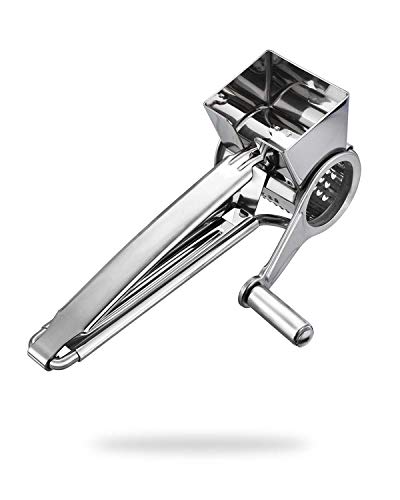
The TONMA rotary cheese grater uses a hand crank instead of the push-and-pull motion found on a box grater. That change can make a big difference for people with tired hands or limited wrist strength. You place food into the chamber, turn the handle, and collect the shreds below. Its multipurpose design is suited to cheese and several firm vegetables.
Rotary graters can also feel safer because your fingers stay farther from the cutting drum during normal use. I still recommend cutting food into pieces that fit well and using care when loading the hopper. The hand crank gives you control over the pace, so you can slow down for hard foods. Clean the parts soon after use, since dried cheese can be harder to remove from small openings.
Pros:
- Hand-crank action reduces repeated wrist strokes
- Fingers stay away from the rotating cutting surface
- Useful for cheese and firm vegetables
- Compact format may suit smaller kitchens
- Good option for users who dislike box graters
- Manual operation needs no batteries or power cord
Cons:
- Requires cutting food to fit the loading chamber
- May need a firm grip while turning the crank
- Small parts can take extra time to clean
My Recommendation
I suggest the TONMA rotary grater for cooks who want a controlled hand-crank tool. It may suit older users, people with sore wrists, or anyone who finds a box grater tiring. It is not the traditional best stainless steel cheese grater for every task, but its rotary action solves a real comfort problem. Choose it when ease of motion matters more than having a large open grating surface.
| Best for | Why |
|---|---|
| Reduced wrist strain | The crank replaces repeated back-and-forth hand motion. |
| Safer cheese prep | The food chamber keeps fingers farther from the drum. |
| Small kitchens | The rotary format can be easier to store than a tall box grater. |
Geedel Rotary Cheese Grater and Slicer

The Geedel rotary cheese grater combines a hand crank with a compact food chamber. It is designed for users who want to shred or slice without holding food directly against an exposed grating panel. I like this style for quick toppings, vegetable prep, and small batches of cheese. The design keeps the motion steady and can feel less tiring than manual box grating.
This type of tool works best when you use firm food and feed it in manageable pieces. Soft cheese may press into the openings instead of forming clean shreds, especially if it is warm. For best results, chill cheese briefly and avoid overfilling the chamber. The rotary format is useful, but it does not replace the broad texture choices of a full four-sided box grater.
Pros:
- Hand crank offers smooth manual control
- Food chamber helps protect fingers
- Can shred or slice several firm foods
- Useful for fast toppings and small batches
- Compact design may save drawer space
- No electricity or batteries are required
Cons:
- Soft or warm cheese may clog the openings
- Food must fit the chamber before grating
- Rotary tools offer fewer open work surfaces
My Recommendation
The Geedel is best for people who want a compact rotary tool for cheese and vegetables. I would pick it for apartment kitchens, quick meals, and users who prefer a protected loading area. It offers a useful alternative to the best stainless steel cheese grater box style, especially when hand comfort is important. Buyers should simply remember that firm, chilled ingredients tend to give the cleanest results.
| Best for | Why |
|---|---|
| Quick toppings | The crank makes small amounts of shredded food fast. |
| Apartment kitchens | The compact body may store more easily than a large box grater. |
| Finger-conscious cooks | The chamber limits direct contact with the cutting surface. |
Cambom Rotary Cheese Shredder

The Cambom rotary cheese shredder offers another hand-crank answer to the common problem of tiring grating work. Its black design looks modern, while the rotary mechanism keeps the process simple. Instead of pushing food across a flat surface, you turn the handle and guide food through the chamber. This makes it a handy option for cheese, vegetables, and other firm ingredients.
I would use this grater for tacos, salads, pizza toppings, and quick vegetable prep. Rotary shredders work best when the food is cut to a suitable size and pressed evenly into the feed area. They can be less messy than open graters because the food moves through a contained path. However, you should rinse the cutting parts soon after use and follow the care directions for the specific model.
Pros:
- Rotary action can feel easier than flat grating
- Contained design helps guide the food
- Hand crank needs no electricity
- Useful for cheese and firm produce
- Black finish has a clean modern appearance
- Good for toppings, salads, and side dishes
Cons:
- May not suit very soft or sticky cheese
- Small feed areas require ingredient preparation
- More parts may mean more cleaning work
My Recommendation
I recommend the Cambom for cooks who want a manual rotary shredder with a modern look. It is a practical choice for quick meals and users who do not enjoy the pressure needed with a flat grater. While a classic model may remain the best stainless steel cheese grater for broad texture control, Cambom offers comfort and contained operation. It can be a useful addition when you often grate modest amounts at a time.
| Best for | Why |
|---|---|
| Pizza and taco toppings | The rotary action handles quick batches with less hand travel. |
| Modern kitchens | The black body has a simple, updated look. |
| Manual prep | The tool works without batteries, cords, or motor noise. |
Martha Stewart Sprucedale Box Grater

The Martha Stewart Sprucedale is a 9.5-inch stainless steel four-sided box grater. Its height gives you a useful work area without making the tool feel oversized. Four sides allow you to switch between coarse shredding, finer grating, slicing, and other common prep tasks. I appreciate this type of design because it can replace several small tools in a busy kitchen.
The stainless steel construction is well suited to hard and firm ingredients. You can use it for cheese, potatoes, carrots, zucchini, chocolate, and citrus zest. I would hold the top handle firmly and place the base on a stable surface before starting. The grater is a strong all-purpose choice, though the open sides can allow some food to fall onto the counter if you do not place a bowl below it.
Pros:
- Four sides provide several texture choices
- 9.5-inch height gives useful working space
- Stainless steel suits many kitchen ingredients
- Can replace several single-purpose tools
- Helpful for cheese, vegetables, chocolate, and zest
- Classic box shape stands securely on a surface
Cons:
- Open design may create some countertop mess
- Tall shape may need careful storage planning
- Sharp edges require focused handling
My Recommendation
This model is a great fit for cooks who want one versatile grater for many recipes. I would choose it for families, baking fans, and anyone who uses different shred sizes often. It has the broad function I expect from a best stainless steel cheese grater, while the four-sided layout keeps the tool easy to understand. Its main value comes from versatility rather than a special mechanism or unusual feature.
| Best for | Why |
|---|---|
| Multi-purpose prep | Four sides provide different grating and slicing options. |
| Baking projects | Fine surfaces work well for zest, chocolate, and hard cheese. |
| Family kitchens | The taller body supports larger amounts of food. |
Airpro Rotary Grater With Suction Base

The Airpro rotary grater stands out with three stainless steel blades and a suction base. The base is designed to help hold the tool in place while you turn the handle. That can be useful when you want both hands involved in loading and turning food. It also works as a shredder, slicer, and food chopper for several kitchen tasks.
I see this design as a strong option for cooks who value stability. A suction base works best on a smooth, clean, dry surface, so placement matters. The three blades can help you switch textures without buying a second grater. As with other rotary models, firm ingredients and sensible portion sizes will make the process smoother and reduce clogging.
Pros:
- Suction base is designed for added stability
- Three stainless steel blades offer texture choices
- Rotary action can reduce repeated wrist movement
- Useful for shredding, slicing, and chopping
- Contained design helps guide ingredients
- Good fit for cooks who want a steady tool
Cons:
- Suction may work poorly on rough or wet counters
- Requires more setup than a basic box grater
- Parts need careful cleaning after use
My Recommendation
I recommend Airpro for cooks who want a rotary grater with extra stability and blade choice. It may help users who find it hard to steady a traditional box grater while working. It is not the smallest option, but it can be a strong alternative to the best stainless steel cheese grater for controlled rotary prep. Place it on a smooth surface and check the base before applying pressure.
| Best for | Why |
|---|---|
| Stable countertop prep | The suction base is designed to reduce unwanted movement. |
| Different textures | Three blades offer more than one cutting style. |
| Users with tired wrists | The crank can feel easier than repeated flat grating. |
Stainless Steel Cheese Grater With Container

This stainless steel cheese grater includes a container that can catch shredded food as you work. That feature helps solve one of the most common box grater problems: cheese sliding across the counter. The black design gives it a tidy appearance, while the container can also help with portion control. I would find this useful when I want to grate first and add the food later.
A container is helpful for meal prep because it keeps shreds together between steps. You can grate cheese, cover or move the container, and then use it for a recipe when needed. The box format still gives you the familiar feel of a standard grater. Before buying, check how the container fits and clean both pieces soon after use to prevent food from drying in the corners.
Pros:
- Container catches shreds and helps reduce mess
- Stainless steel body suits daily kitchen use
- Black design looks neat on the counter
- Useful for storing grated ingredients briefly
- Box style is easy for most cooks to use
- Good for cheese, vegetables, and meal prep
Cons:
- Container adds another part to wash
- Storage may require space for both pieces
- Food can collect around the container edges
My Recommendation
This model is best for cooks who want cleaner prep and fewer loose shreds on the counter. I would choose it for small kitchens, meal prep, and recipes that call for measured grated cheese. It may be the best stainless steel cheese grater for users who value a built-in catch container more than a rotary design. Its practical strength is simple: grate, catch, and use the food when ready.
| Best for | Why |
|---|---|
| Low-mess prep | The container catches food as it falls from the grating surface. |
| Meal planning | Grated ingredients stay together for the next cooking step. |
| Small counters | The catch box helps keep loose shreds off the work surface. |
How to Choose the Best Stainless Steel Cheese Grater
Choosing a grater is easier when you start with the foods you prepare most. If you make pizza, tacos, casseroles, or slaw, a large box grater may be the most useful fit. If you grate only small amounts, a handheld or rotary model may take less space. I always suggest matching the tool to your habits rather than choosing the one with the most features.
Box Grater or Rotary Grater?
A box grater gives you open access to several surfaces. It is fast for large blocks of cheese and offers many texture choices. A rotary grater uses a crank and chamber, so it can feel easier on the wrist and keep fingers farther from the cutting drum. The tradeoff is that you must cut food to fit the chamber, and the tool may take longer to clean.
Why Stainless Steel Matters
Stainless steel is popular because it is strong, smooth, and suited to regular food contact when the product is made and cared for correctly. It also resists many common kitchen stains better than some other metals. Still, stainless steel is not maintenance-free. Food acids, salt, and moisture can leave marks if you allow residue to sit for a long time.
For that reason, I rinse a grater soon after use. I use a soft brush to reach the inside and the small holes. I dry the tool fully before putting it away. These simple steps help keep the surface clean and reduce the chance of lingering odors.
Hole Size and Food Texture
Coarse holes create larger shreds. They work well for cheddar, mozzarella, potatoes, and carrots. Fine holes create a smaller texture for Parmesan, ginger, garlic, chocolate, or citrus zest. Slicing surfaces can make thin cuts, but they need extra care because the exposed edge is sharp.
Fresh cheese can sometimes feel soft and sticky. Chilling it for a short time may make it easier to grate. Hard cheese tends to produce fine, dry shreds. Avoid forcing food through a grater, since strong pressure can cause the tool or food to slip.
Stability and Comfort
A stable base matters more than many shoppers expect. A box grater should sit flat on a cutting board or bowl. A rotary model should stay firm while you turn the handle. Suction bases work best on clean, smooth surfaces, but no base should be treated as a substitute for careful handling.
Handle shape also affects comfort. A top handle can help you press the grater down while you work. A crank can reduce the long strokes of a box grater. If you have hand pain, limited grip, or wrist fatigue, compare the motion of each style before deciding.
Cleaning and Food Safety Tips
Food safety agencies commonly stress clean tools, clean hands, and quick refrigeration for perishable foods. A grater can hold tiny food bits in its holes, so cleaning matters. Rinse it soon after use, wash it with dish soap, and use a brush for trapped residue. Let it dry fully before storage.
Check the care label before using a dishwasher. Some stainless steel tools tolerate dishwasher cleaning, while handles, coatings, or containers may need hand washing. I also avoid using a worn grater with loose parts or damaged edges. A sharp tool should cut food cleanly, not force you to push harder than normal.
What I Would Not Ignore
I would not choose a grater only because it looks large or has many parts. A tool that is hard to wash may stay in the drawer. A model that slides may feel unsafe even if its blades are sharp. The best purchase balances cutting performance, comfort, stability, storage, and care.
Price also matters, but a low price is not the only measure of value. A durable grater that you use each week can be worth more than a cheaper tool that bends or frustrates you. Read the current listing details, check the dimensions, and review the care instructions before ordering. Product features and availability can change, so confirm those details on the retailer page.
FAQs Of best stainless steel cheese grater
What is the best stainless steel cheese grater for most homes?
A large four-sided box grater is the best general choice for many homes. It offers several hole sizes and works for cheese, vegetables, chocolate, and zest. The Spring Chef XL and Martha Stewart Sprucedale models are strong options for broad kitchen use.
Are rotary cheese graters safer than box graters?
Rotary graters can keep fingers farther from the cutting drum during normal use. They may feel safer for some users, but careful loading and cleaning still matter. No grater should be used without reading its care and handling instructions.
Can I put a stainless steel cheese grater in the dishwasher?
It depends on the product. Check the current care directions before using a dishwasher. Even when dishwasher use is allowed, prompt rinsing and full drying can help prevent trapped food and water spots.
How do I stop cheese from sticking to a grater?
Use firm, cold cheese and choose the correct hole size. Avoid pressing too hard, since pressure can smear soft cheese across the surface. Rinse the grater soon after use to prevent residue from drying.
What can I grate besides cheese?
You can grate potatoes, carrots, zucchini, cabbage, chocolate, ginger, garlic, and citrus zest. Use firm ingredients and select the surface that matches the texture you want. Always use extra care with small pieces.
Final Verdict: Which Should You Buy?
For most kitchens, I would choose the Spring Chef XL as the best stainless steel cheese grater. It offers useful size, several surfaces, and simple box-grater control. Choose a rotary model if wrist comfort or finger distance matters more.
The right stainless steel cheese grater makes daily prep faster and less messy. Match the style to your recipes, counter space, and cleaning habits for the best long-term value.