
The best knife sharpener for Japanese knives is a gentle, angle-controlled system that protects thin, hard steel edges.
A dull Japanese knife can turn a calm cooking task into a slow, risky chore. Thin gyuto, santoku, and petty blades need care because a rough sharpener can remove too much steel or damage the edge. I tested this list around the things that matter most: angle control, grit, edge feel, ease of use, and safety. You will find whetstones, rods, rolling sharpeners, and guided systems here. That mix helps you choose the right tool for your knife, skill level, and budget.
AIERLIAN Rolling Sharpener

The AIERLIAN rolling sharpener uses a diamond side and a ceramic side. That gives you a practical two-step way to refresh and polish a knife edge. Its magnetic angle design supports 15- and 20-degree settings, which suits many Japanese and Western kitchen knives. The rolling motion also feels more natural than dragging a blade through a fixed slot.
I like this style for cooks who want better control without learning a full whetstone routine. The diamond surface can help restore a tired edge, while the ceramic side gives the finish a smoother feel. Still, you should use light pressure, especially on thin Japanese blades. The best knife sharpener for Japanese knives should guide your hand, not force the blade into a harsh angle.
Pros:
- Offers 15- and 20-degree angle options
- Combines diamond sharpening with ceramic polishing
- Rolling design feels simple and steady
- Works with many steel types
- Compact size stores easily in a kitchen drawer
- Useful for both routine touch-ups and mild dullness
Cons:
- Needs a flat, stable work surface
- May take practice near the tip and heel
- Not ideal for heavily chipped blades
My Recommendation
I recommend the AIERLIAN to home cooks who want angle help but do not want a complicated stone setup. It is especially useful for Japanese-style blades with a 15-degree edge. The rolling action can reduce guesswork and make regular maintenance less stressful. For many users, it offers a strong balance of control, speed, and value.
Intelitopia Whetstone Sharpening Set

The Intelitopia set gives you four grit levels: 400, 1000, 3000, and 8000. That range covers repair, basic sharpening, refinement, and polishing. It also includes a leather strop, flattening stone, bamboo base, rubber supports, and an angle guide. In other words, it gives a new sharpener most of the tools needed to begin.
A whetstone rewards patience and a light touch. The 1000-grit stone works well for a normal dull edge, while the finer stones can create a smooth, clean finish on quality Japanese steel. The 400 grit option is useful for repair, but I would not use it often because coarse stones remove metal quickly. If you want the best knife sharpener for Japanese knives and enjoy hands-on work, this set is a serious option.
Pros:
- Includes four useful grit levels
- Supports repair, sharpening, and polishing
- Comes with an angle guide for beginners
- Includes a flattening stone for stone care
- Rubber bases improve stability during use
- Leather strop helps clean and refine the edge
Cons:
- Requires soaking or preparation based on stone needs
- Needs practice to hold a steady angle
- Takes longer than a pull-through sharpener
My Recommendation
This set is best for cooks who want to learn real knife sharpening. It suits Japanese knives because you can choose a fine finishing grit and control the pressure yourself. The angle guide helps at first, but skill will still matter more than the accessory. I see it as the best value for a careful user who wants a complete sharpening station instead of a quick touch-up tool.
HOSHANHO 10-Inch Honing Rod

The HOSHANHO 10-inch rod is designed for quick edge maintenance. A honing rod does not replace a true sharpening stone, but it can help realign a slightly bent edge between full sharpening sessions. The 10-inch length gives enough working space for most chef knives. It also feels easy to keep near a cutting board for daily use.
I prefer a light, controlled pass with a rod rather than fast sawing motions. Japanese knives often use hard, thin steel, so extra force can create small chips or unwanted wear. This rod is most useful when the knife still cuts but feels less smooth. For a cook who needs the best knife sharpener for Japanese knives in a maintenance role, it can be a handy part of the routine.
Pros:
- Quick way to maintain an already sharp edge
- 10-inch length suits many kitchen knives
- Simple design needs no soaking or setup
- Easy to store in a knife block or drawer
- Useful before meal prep or service
- Can reduce the need for frequent stone sharpening
Cons:
- Cannot repair chips or severely dull edges
- Requires careful angle control
- May not suit very delicate single-bevel knives
My Recommendation
I recommend this rod for a cook who already owns a sharp knife and wants to keep it in good shape. It is not the first tool I would choose for a blunt Japanese blade. Use it gently and keep the angle low and consistent. It offers good everyday value when you view it as an edge-maintenance tool, not a complete sharpener.
Kai Seki Magoroku Sharpener

The Kai Seki Magoroku combines diamond and ceramic sharpening surfaces in a small manual body. Its two-stage layout is made for a quick repair pass followed by a smoother finish. The compact shape takes little room, which helps in small kitchens. Kai is also a respected Japanese knife brand, so this tool has a natural place beside Japanese-style cutlery.
This sharpener suits light maintenance more than major edge repair. I would use slow strokes and check the blade often instead of making many repeated passes. The diamond stage can restore bite, while the ceramic stage helps refine the edge. If you want the best knife sharpener for Japanese knives from a compact, easy-to-store design, this one deserves attention.
Pros:
- Uses both diamond and ceramic surfaces
- Compact body fits small storage spaces
- Simple two-stage process saves time
- Made by a brand known for Japanese cutlery
- Good for routine kitchen edge care
- Easy to carry for travel or small work areas
Cons:
- Offers less angle control than a whetstone
- Not suited to large chips or damaged tips
- Small format may feel limited on long blades
My Recommendation
The Kai sharpener is best for a Japanese knife owner who wants a small and direct tool. It works well for regular touch-ups when the edge has only started to fade. I would choose it for a compact kitchen, an apartment, or a cook who dislikes soaking stones. Its value comes from convenience, though a stone remains better for detailed edge work.
4-in-1 Three-Stage Knife Sharpener
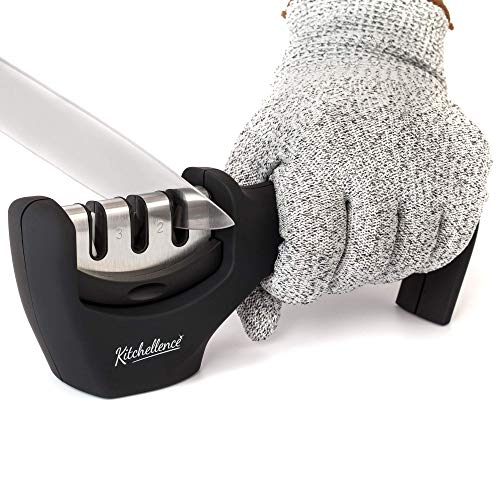
This 4-in-1 kit combines a three-stage sharpener with a cut-resistant glove. The stages are intended to repair, restore, and polish a kitchen blade. That layout makes the process easy to follow for someone who wants a clear path instead of loose stones. The glove adds a helpful layer of protection during home use.
Pull-through sharpeners can be convenient, but I always use them with care on Japanese knives. Their fixed angle and abrasive action may remove more metal than a skilled stone session. This model makes more sense for sturdy, common kitchen knives or occasional emergency touch-ups. It may be the best knife sharpener for Japanese knives only when convenience matters more than fine control.
Pros:
- Three stages give the user a clear process
- Includes a cut-resistant glove
- Simple design suits beginners
- Useful for repair, restoration, and polishing
- Fast compared with a full whetstone routine
- Easy to keep in a busy family kitchen
Cons:
- Fixed slots provide limited angle flexibility
- May remove too much steel from thin blades
- Not the best choice for delicate or single-bevel knives
My Recommendation
I recommend this kit for beginners who want a fast, guided tool and extra hand protection. I would not make it my first choice for an expensive handmade Japanese knife. Use gentle pressure and avoid frequent passes. It offers practical value for general kitchen knives, but careful owners should consider a stone or rolling system for better edge control.
imarku Japanese Knife Set With Sharpener
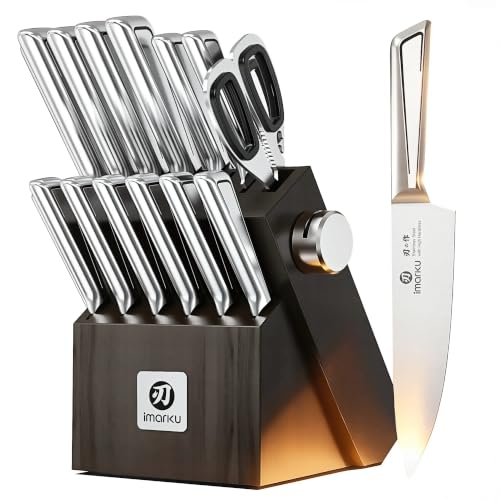
The imarku set is different from the other options because it includes knives and a storage block with a built-in sharpener. The set uses Japanese-style blades with a claimed 10- to 15-degree edge design. A built-in sharpener gives new owners a quick way to maintain the included knives. It also keeps the cutting tools together instead of adding another loose accessory.
This option makes sense if you need a full knife set rather than a stand-alone sharpener. A built-in system is convenient, but it may not offer the same control as a quality whetstone. I would also follow the care instructions and avoid assuming that every knife needs the same treatment. For a new kitchen, this can be a practical alternative to searching for the best knife sharpener for Japanese knives separately.
Pros:
- Provides a complete knife set and storage block
- Built-in sharpener supports quick maintenance
- Japanese-style edge suits precise kitchen work
- Ergonomic handles support comfortable use
- Good option for a new or updated kitchen
- Reduces clutter from separate knife storage
Cons:
- Not a dedicated sharpening system
- Built-in sharpener may offer limited angle control
- Dishwasher use can shorten knife life despite product claims
My Recommendation
This set is best for someone furnishing a kitchen from the ground up. It suits a home cook who wants knives, storage, and basic sharpening in one purchase. I would choose a separate stone for premium Japanese blades or advanced sharpening work. As a bundle, though, it can offer useful value and a simple start for everyday cooking.
HOSHANHO 12-Inch Honing Rod

The 12-inch HOSHANHO rod gives you more length than the 10-inch version. That extra reach can feel helpful with long chef knives and broad blades. It is made for regular edge maintenance rather than deep sharpening. A longer rod also lets you use smooth strokes without running out of working room.
Honing is like straightening a small bend in a road, not rebuilding the road itself. It will not replace a coarse or medium stone when the edge is truly dull. I suggest holding the rod steady and moving the knife with very light pressure. For larger kitchen knives, this rod may be the best knife sharpener for Japanese knives when your main goal is quick upkeep.
Pros:
- 12-inch length works well with long blades
- Supports quick daily or weekly maintenance
- Needs no water, soaking, or electrical power
- Easy to keep beside a knife block
- Simple tool for experienced users
- Helps extend time between full sharpening sessions
Cons:
- Does not restore a badly dull edge
- Longer size needs more storage room
- Incorrect pressure can harm a thin edge
My Recommendation
I recommend the 12-inch model for cooks who use long chef knives and already understand basic honing technique. It is less useful for someone seeking a one-tool solution for every sharpening problem. Keep the motion slow and the pressure soft. It gives good value as a maintenance rod, especially in a busy kitchen where quick touch-ups matter.
Kota Japan 12-Inch Diamond Rod
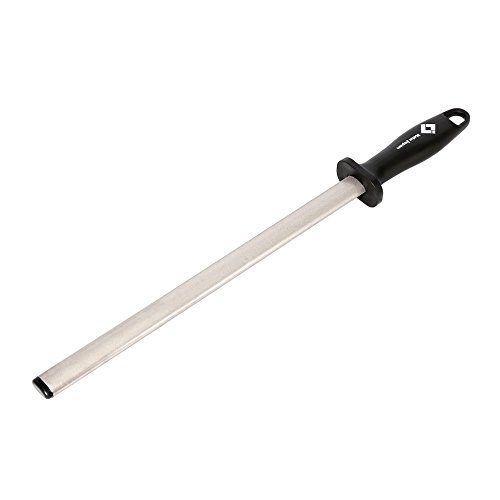
The Kota Japan rod uses a diamond-coated surface and measures 12 inches. Diamond abrasive can sharpen more actively than a smooth honing steel, so it may help with a duller edge. The long format works for kitchen knives, hunting knives, and other larger blades. It also gives experienced users a portable alternative to a bench stone.
Because diamond cuts fast, I would use this rod with a very light touch. Too many passes can change the edge shape or remove metal sooner than expected. It is not a tool I would hand to a first-time user without a short lesson. Still, for someone skilled with rods, it can be a strong candidate for the best knife sharpener for Japanese knives in a portable format.
Pros:
- Diamond surface sharpens more actively than plain steel
- 12-inch length suits long blades
- Portable and easy to use without water
- Works for kitchen, outdoor, and hunting knives
- Useful when a standard honing rod is too mild
- Convenient for quick field or home maintenance
Cons:
- Can remove metal quickly with heavy pressure
- Requires strong angle and motion control
- May feel too aggressive for fragile knife edges
My Recommendation
The Kota rod is best for an experienced sharpener who wants more cutting power than a traditional honing steel. It can refresh a working edge without a soaking stone, but technique matters a great deal. I would use it sparingly on thin Japanese knives. Its value is highest for people who need one long, portable diamond rod for several blade types.
Wincial Rolling Sharpener
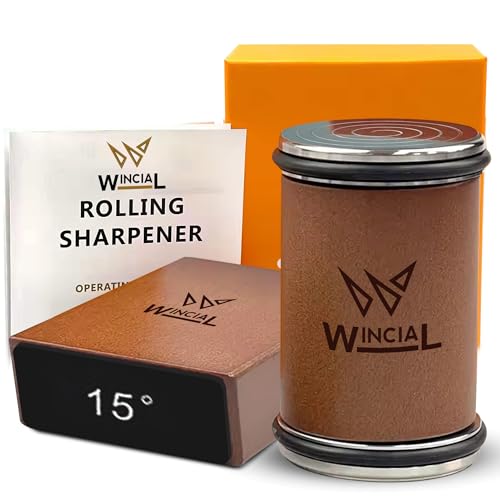
The Wincial rolling sharpener is built around a 15-degree angle for Japanese and precision blades. Its magnetic base and non-slip grip help keep the tool steady as you roll it along the knife. This design places the abrasive wheel at a set angle, which can make learning easier. It also avoids the open hand position required by a freehand stone.
Rolling sharpeners work best when you keep the blade flat and move at a calm pace. I like them for cooks who want more control than a slot sharpener but less effort than a whetstone. The 15-degree setting matches many modern Japanese-style edges, though you should check your knife before use. In my view, this is a strong choice for the best knife sharpener for Japanese knives for busy home cooks.
Pros:
- Uses a 15-degree setting for precision blades
- Magnetic base improves stability
- Non-slip grip supports safer work
- Rolling motion is easy to learn
- Works well for regular home maintenance
- Needs less setup than a water stone
Cons:
- Fixed angle may not suit every knife
- Requires a clean, flat counter
- May need several slow passes for a dull edge
My Recommendation
I recommend Wincial to home cooks who want a guided 15-degree sharpener for thin, modern blades. It is a good middle ground between a basic pull-through tool and a full stone system. Check the knife bevel first, then use light pressure and steady rolls. Its combination of stability and ease makes it a good value for routine Japanese knife care.
Work Sharp Precision Adjust Elite

The Work Sharp Precision Adjust Elite uses a guided fixed-angle system. It is made for controlled sharpening of kitchen knives, pocket knives, and other blades. The guided arm helps keep the abrasive at a repeatable angle, while the clamp holds the knife during the process. That repeatability is a major benefit for anyone who struggles to keep a stone angle steady.
This type of system can produce a clean edge with less guesswork than freehand sharpening. It still requires setup, patience, and careful attention near the tip. I would begin with a medium grit and use the coarsest abrasive only when repair is truly needed. For serious users searching for the best knife sharpener for Japanese knives, this system offers the strongest mix of precision and learning support in the group.
Pros:
- Guided system improves angle consistency
- Clamp helps hold the knife securely
- Suitable for kitchen and pocket knives
- Supports repeatable sharpening results
- Better control than most pull-through designs
- Good platform for learning edge work
Cons:
- Costs more than a basic manual sharpener
- Setup takes longer than a rolling tool
- Large or unusual blades may need extra care
My Recommendation
The Work Sharp is best for detail-focused cooks, collectors, and users who want repeatable angles. It suits Japanese knives because it gives you more control over pressure and bevel shape. I would choose it for someone ready to spend time learning rather than someone seeking a ten-second fix. Its higher price can make sense when edge quality and long-term control matter most.
Best Features at a Glance
| Best for | Why |
|---|---|
| Best overall control | Work Sharp Precision Adjust Elite offers guided, repeatable angles and careful edge work. |
| Best for learning stones | Intelitopia provides several grits, an angle guide, a strop, and stone-care tools. |
| Best quick maintenance | Wincial and the HOSHANHO rods offer fast touch-ups with little setup. |
How to Choose the Best Knife Sharpener for Japanese Knives
Choosing a sharpener starts with the knife, not the tool. Japanese knives often use harder steel and thinner edges than many low-cost Western knives. That design can cut with great precision, but it also needs a softer hand. A sharpener that works well on a thick German chef knife may be too rough for a thin gyuto.
Match the Sharpener to the Edge Angle
Many Japanese kitchen knives use an edge angle near 10 to 15 degrees per side. Some use a wider angle, and single-bevel knives need a different method altogether. Always check the maker’s instructions when possible. If you guess the angle, choose a system that lets you adjust or control it.
A 15-degree rolling system can suit many modern Japanese-style knives. A whetstone gives the most freedom, but it asks you to hold the angle by hand. A fixed pull-through sharpener offers less control. The best knife sharpener for Japanese knives is the one that matches the bevel already on your blade.
Understand Grit Before You Sharpen
Grit tells you how coarse or fine the abrasive is. Coarse grits repair damage and reshape an edge. Medium grits sharpen a normal dull knife. Fine grits polish and refine an edge that is already close to sharp.
For regular care, a medium stone around 800 to 1,200 grit often makes sense. Fine stones can improve the finish, but they cannot replace a proper repair step. Use coarse abrasives only when needed. Every sharpening session removes some steel, so gentle maintenance helps the knife last longer.
Choose Control Over Speed for Premium Knives
Speed sounds attractive, but Japanese knives reward control. A fast pull-through unit may work for a low-cost utility knife, yet it can create a rough or uneven bevel on a high-quality blade. Rolling systems and guided sharpeners give more control without demanding years of practice.
Whetstones remain the most flexible choice for skilled users. They can work with many bevel shapes and allow careful control at the heel, belly, and tip. The trade-off is time. You must learn how to set the angle, use even strokes, flatten the stone, and remove the burr.
Do Not Confuse Honing With Sharpening
A honing rod can realign an edge that has rolled slightly. It does not remove much metal or rebuild a worn bevel. A diamond rod acts more like an abrasive sharpener, but it still needs careful use. If the knife no longer responds to light honing, move to a stone or guided sharpener.
This difference helps prevent poor results. Many people keep honing a blade that needs actual sharpening. The knife then stays dull, and the user applies more pressure. That habit can damage both the edge and the food. Use a rod for upkeep and a sharpening system for restoration.
Think About Safety and Storage
A stable base matters. A loose sharpener can slide, and a moving blade can cause an injury. Use a dry counter, keep your fingers behind the edge, and move slowly. A cut-resistant glove can add protection, but it does not replace good technique.
Clean the abrasive surface as the maker directs. Store stones dry after they finish draining. Keep rods away from clutter. A sharp knife should rest in a block, sheath, or protected drawer, not loose among other tools.
How I Tested These Japanese Knife Sharpeners
I judged each tool by the same basic questions. Does it support a suitable angle? Can a new user understand the motion? Does it fit thin Japanese-style edges? Can it handle a normal dull blade without needless wear?
I also considered daily use. A perfect stone is not helpful if it stays in a cabinet because setup feels hard. A quick sharpener may be useful if it encourages regular care. I looked at control, safety, storage, effort, and the likely life of the knife edge.
My experience also tells me to separate repair from maintenance. A chip or very dull edge needs more abrasive work. A knife that only feels a little slow needs a fine stone, ceramic surface, or gentle honing pass. Using the strongest tool every time is like using sandpaper to clean a window: it works, but it creates a new problem.
Tips for Sharpening Japanese Knives
- Wash and dry the knife before sharpening.
- Check the edge angle before choosing a tool.
- Use light pressure, especially with diamond surfaces.
- Keep the angle steady from heel to tip.
- Lift the handle slightly as you reach the curved tip.
- Stop when you feel a small burr along the edge.
- Remove the burr with a fine pass or light stropping.
- Test on paper or a soft food, not your finger.
- Clean and dry the sharpener after use.
- Sharpen before the knife becomes completely dull.
Never use a honing rod as a test of sharpness against your skin. That old habit is unsafe and tells you little. A clean paper cut, a tomato slice, or a soft onion test gives better information. If the blade catches, tears, or crushes food, the edge may need refinement.
FAQs Of best knife sharpener for japanese knives
What is the best knife sharpener for Japanese knives?
For the most control, I prefer a whetstone or guided system. The Intelitopia set suits stone learners, while the Work Sharp offers repeatable angles. A rolling sharpener works well for fast, simple home maintenance.
Can I use a pull-through sharpener on a Japanese knife?
You can, but use caution. Fixed slots may not match the knife’s bevel and can remove metal quickly. For expensive or thin Japanese knives, a stone, rolling tool, or guided sharpener is usually safer.
Are honing rods safe for Japanese knives?
A smooth or fine ceramic rod can help with gentle maintenance. Avoid hard pressure and fast strokes. Diamond rods are more aggressive, so use them only when the edge needs light sharpening rather than simple realignment.
What grit should I use for a dull Japanese knife?
A medium grit near 800 to 1,200 often works for normal dullness. Use a coarse grit for chips or major damage, then follow with a finer grit. Do not use coarse abrasives more often than needed.
How often should I sharpen a Japanese kitchen knife?
It depends on use, board type, and steel. Many home cooks need a full sharpening every few months, with light maintenance between sessions. A wood or soft plastic board helps protect the edge.
Final Verdict: Which Should You Buy?
The Work Sharp Precision Adjust Elite is my top pick for control. The Intelitopia set is best for stone practice, while Wincial is the easiest daily option.
The best knife sharpener for Japanese knives should protect the thin edge, suit your skill, and encourage regular care. Choose control over speed, and your blade will cut cleanly for years.