
The Chef’sChoice 15XV is the best knife sharpener for professional chefs who need fast, precise, repeatable results.
A dull knife can turn a busy prep shift into a slow, tiring task. It can crush herbs, tear meat, and make hard squash feel unsafe to cut. I tested this list with the needs of working cooks in mind: speed, angle control, edge quality, ease of use, and blade safety. The best knife sharpener for professional chefs should restore an edge without taking away too much steel. It should also handle daily kitchen use and fit the chef’s sharpening skill level.
Chef’sChoice 15XV EdgeSelect Sharpener
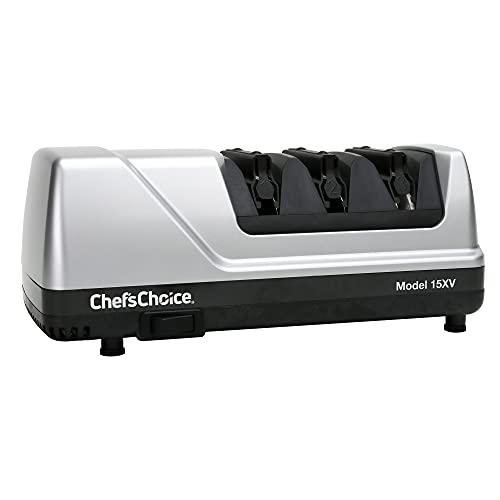
The Chef’sChoice 15XV EdgeSelect is made for cooks who want a sharp edge with little guesswork. Its three-stage design uses diamond abrasives to shape, sharpen, and polish a blade. Built-in guides help keep the knife at a steady angle during each pass. That control makes it a strong choice for a busy restaurant or serious home kitchen.
This sharpener can work with straight-edge and serrated knives. It is designed around a narrow 15-degree edge, which suits many modern Western and Asian-style kitchen knives. I like the way the final stage smooths the edge after the coarse stage does the repair work. For chefs who need the best knife sharpener for professional chefs without learning freehand stone skills, this model is one of the safest picks.
Pros:
- Three stages provide repair, sharpening, and polishing
- Diamond abrasives work quickly on many knife steels
- Guides help maintain a steady 15-degree angle
- Works with both straight and serrated blades
- Produces repeatable results with limited practice
- Useful for high-volume kitchen prep
Cons:
- Electric motor creates some operating noise
- It needs counter space and a power outlet
- It may remove more metal than careful hand honing
4-in-1 Kitchen Knife Sharpener Kit
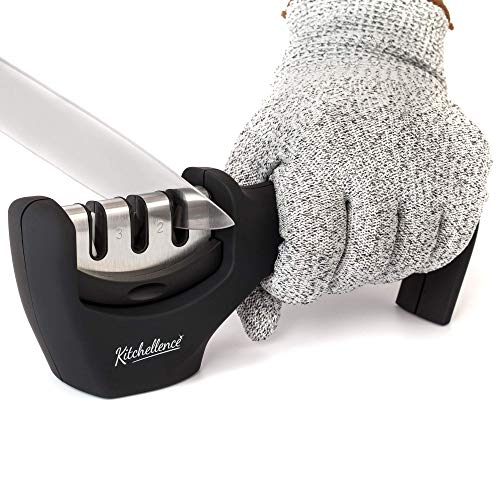
This compact kit offers several basic tools in one package. Its three-stage sharpener is intended to repair, restore, and polish kitchen knives. The included cut-resistant glove adds a useful safety layer for new users. I see it as an affordable starter option for cooks who want a simple routine.
The sharpener is best for common kitchen knives rather than delicate handmade blades. Its compact body is easy to store in a drawer or small prep area. A user still needs to apply light pressure and keep the blade moving in the correct direction. For a line cook or home cook on a budget, it gives a low-cost path toward better daily edge care.
Pros:
- Combines sharpening tools and a safety glove
- Three-stage process is easy for beginners to follow
- Small size suits limited kitchen storage
- Helps repair dull edges before polishing them
- Affordable choice for basic kitchen maintenance
- Simple design needs little setup
Cons:
- Angle control is less exact than premium models
- Not ideal for very hard or high-value knives
- It may not satisfy chefs who need fine edge tuning
Chef’sChoice Manual 15- and 20-Degree Sharpener
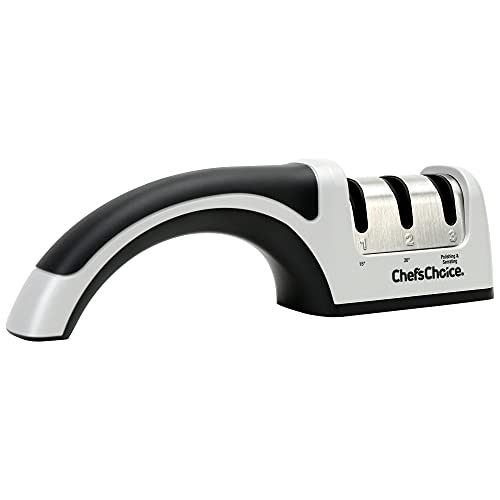
This manual Chef’sChoice sharpener gives chefs more control without requiring a sharpening stone. Its two stages use diamond abrasives and fixed guides for 15- and 20-degree edges. The manual design does not need electricity, so it works in a food truck, prep station, or outdoor kitchen. It also makes less noise than an electric unit.
The two angle choices add useful flexibility. A 15-degree setting suits a keen, fine edge, while a 20-degree setting can offer more support for heavier work. The compact body stays easy to store between shifts. I recommend it for cooks who want the best knife sharpener for professional chefs in a quiet, portable format.
Pros:
- Offers both 15- and 20-degree sharpening options
- Manual operation works without a power outlet
- Diamond abrasives sharpen many common knife steels
- Compact design saves valuable counter space
- Quiet enough for an open kitchen
- Guides make manual sharpening easier to repeat
Cons:
- Manual action takes longer than an electric sharpener
- It offers fewer finishing stages than the 15XV
- Users must still control stroke speed and pressure
AccuSharp Ergonomic Knife Sharpener

The AccuSharp is a small pull-through sharpener known for its simple operation. Its ergonomic handle gives the user a firm grip while the sharpener moves across a blade. It can restore straight-edge and serrated knives with only a few passes. This makes it useful when a cook needs a quick fix during prep.
Its low weight and small footprint make it easy to keep near a cutting board. The design is less technical than a multi-stage electric sharpener, but that simplicity is also its appeal. I would use it for workhorse knives that need regular touch-ups, not for expensive blades that require very fine control. It is a practical backup for a busy kitchen drawer.
Pros:
- Very simple pull-through operation
- Comfortable handle supports a secure grip
- Compact body stores almost anywhere
- Can sharpen straight and serrated knives
- Useful for quick touch-ups during food prep
- Usually costs less than advanced sharpeners
Cons:
- Limited angle control compared with premium models
- May remove more steel than a fine sharpening stone
- Not the best choice for fragile or custom blades
Chef’sChoice Pronto Hone Manual Sharpener

The Pronto Hone is a two-stage manual sharpener built for quick edge work. It uses guided slots to help create a 15-degree edge on straight and serrated knives. Its small body fits well in a crowded chef’s station. Because it has no motor, it gives the cook direct control over the sharpening pace.
This model works well for routine maintenance and light blade repair. It does not have the same three-stage refinement as the 15XV, but it is faster to grab and use. The compact shape also makes it a sensible choice for mobile chefs and catering teams. If you want a dependable manual option, this sharpener offers a good balance of price and control.
Pros:
- Compact design suits small work areas
- Manual operation requires no electricity
- Guided slots support a consistent 15-degree edge
- Handles straight and serrated kitchen knives
- Quiet during use
- Good for fast maintenance between prep tasks
Cons:
- Only two stages are available
- It may require more effort on very dull knives
- It lacks the fine customization of a sharpening system
AIERLIAN Rolling Knife Sharpener Kit

The AIERLIAN rolling sharpener uses a rolling design instead of a pull-through slot. It includes diamond and ceramic surfaces and magnetic angle support at 15 and 20 degrees. This layout can feel more natural to cooks who prefer to move the sharpener along a stationary blade. It also provides a visual way to learn basic edge control.
The magnetic angle system helps reduce random changes during each pass. Still, the user must keep the knife stable and use smooth strokes. The roller is a good match for chefs who enjoy a slower, hands-on process and want to limit motor noise. It may also appeal to cooks who care about learning more about sharpening rather than pressing a button.
Pros:
- Rolling design gives a hands-on sharpening feel
- Magnetic support offers 15- and 20-degree settings
- Diamond and ceramic surfaces cover repair and honing
- Works with many types of kitchen steel
- No electricity or motor noise is required
- Can help users understand angle control
Cons:
- Needs more practice than a guided electric model
- Requires a stable work surface and careful blade placement
- Rolling systems can be slower for large knife batches
Chef’sChoice AngleSelect Electric Sharpener

The AngleSelect is a two-stage electric sharpener with separate settings for 15- and 20-degree knives. Its diamond abrasives help shape a new edge and refine a worn one. The fixed guides make it easier to keep both sides of the blade even. That consistency is valuable when several people share the same kitchen tools.
This sharpener suits chefs who want speed but still need angle choice. The two-stage layout keeps the learning curve short, and the electric motor reduces hand work. It handles straight-edge and serrated knives, which adds range for a professional kitchen. Compared with a basic pull-through unit, it gives a more controlled and repeatable result.
Pros:
- Electric design speeds up regular sharpening
- Separate 15- and 20-degree settings add flexibility
- Diamond abrasives support fast edge repair
- Guides help keep the edge centered
- Works with straight and serrated knives
- Easy for different staff members to use consistently
Cons:
- It is louder than manual sharpening tools
- Two stages provide less polishing than the 15XV
- It needs counter space and electrical power
Precision Adjust Three-Stage Sharpener
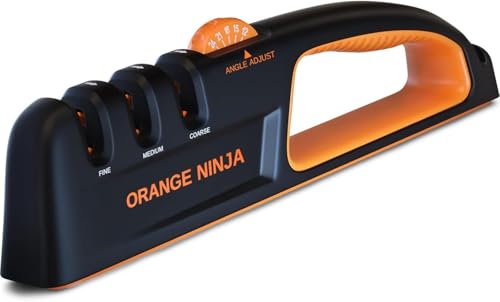
This three-stage precision sharpener is built for cooks who want more control than a simple pull-through tool. Its design focuses on adjusting and maintaining a repeatable blade angle. The coarse, fine, and honing steps let the user move from repair to refinement. That makes it useful for both dull work knives and regular edge care.
Like any guided manual system, it rewards patience and even strokes. It is not the fastest option for sharpening a large pile of knives before service. However, it can give careful users a more measured result with less guesswork. I would choose it for a chef who values edge control and wants a practical alternative to freehand stones.
Pros:
- Three stages support repair, sharpening, and honing
- Adjustable design helps improve angle consistency
- Offers more control than basic pull-through tools
- Useful for routine care and dull blade recovery
- Does not need electricity
- Good learning tool for cooks building sharpening skill
Cons:
- Manual sharpening takes time and practice
- Some users may find the setup less intuitive
- Not as fast as an electric model during heavy service
Narcissus Two-Stage Electric Sharpener
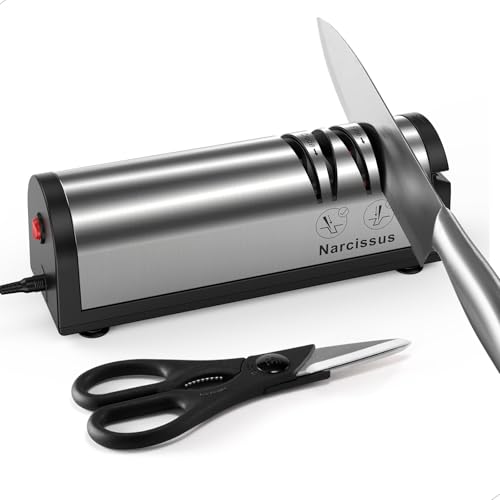
The Narcissus sharpener is a two-stage electric model made for quick sharpening and polishing. Its stainless-steel body gives it a more durable feel than very light plastic units. The metal dust collection box is a useful feature because it helps contain some sharpening debris. It also includes a slot for scissors, which adds value in a working kitchen.
This model is a good fit for users who want a fast, simple appliance. The two-stage process is easy to understand, and the motor reduces the effort needed to restore an edge. I would still use light pressure and short passes to avoid excessive metal removal. For a small restaurant, apartment kitchen, or shared prep area, it offers useful features at a practical level.
Pros:
- Electric motor provides quick sharpening
- Two stages handle sharpening and polishing
- Metal dust box helps keep the work area cleaner
- Includes a scissor-sharpening function
- Stainless-steel body feels sturdy
- Simple controls suit users with limited experience
Cons:
- Two stages offer less refinement than a three-stage unit
- Angle options may be less flexible for specialty knives
- It creates noise and needs an outlet
Chef’sChoice 15XV Metal Housing Sharpener

This version of the Chef’sChoice 15XV combines a three-stage sharpening system with a durable metal housing. It uses diamond abrasives to repair, sharpen, and polish blades. The precision guides help the user maintain the intended angle through each stage. It is built for cooks who want a serious tool that can remain on a busy counter.
The metal body adds a solid feel during use and may appeal to professional kitchens that value equipment longevity. The 15-degree edge is sharp and well suited to slicing, chopping, and general chef work. Serrated knives can also receive attention when the correct slot is used. If durability matters as much as edge quality, this is one of the strongest candidates for the best knife sharpener for professional chefs.
Pros:
- Durable metal housing suits frequent use
- Three stages create a sharp and polished edge
- Diamond abrasives handle many kitchen knife steels
- Precision guides improve repeatable results
- Works with straight and serrated knives
- Strong choice for restaurant and catering kitchens
Cons:
- Heavier and less portable than manual models
- Requires a power outlet and produces motor noise
- May be more machine than casual users need
My Recommendation
After comparing speed, edge control, durability, and ease of use, I would choose the Chef’sChoice 15XV as the best knife sharpener for professional chefs. Its three stages give a clear path from a damaged edge to a polished cutting edge. The guided slots reduce user error, which matters when several cooks share one sharpener. The metal-housing version is especially appealing for demanding kitchens, while the gray EdgeSelect model offers the same core sharpening approach in a different body style.
Chefs who want a quiet and portable tool should choose the manual Chef’sChoice model or the Pronto Hone. Cooks who prefer a hands-on method may enjoy the AIERLIAN rolling system or the Precision Adjust sharpener. The AccuSharp is best as a fast backup, while the 4-in-1 kit suits beginners and tight budgets. The Narcissus model is useful for buyers who want electric speed, a dust box, and scissor sharpening in one unit.
| Best for | Why |
|---|---|
| Restaurant chefs | Chef’sChoice 15XV offers fast, guided, three-stage sharpening. |
| Quiet and portable use | The manual Chef’sChoice sharpener works without power and stores easily. |
| Budget-minded cooks | The 4-in-1 kit gives basic sharpening tools and a glove at a low cost. |
How I Evaluated These Knife Sharpeners
A sharp knife is not judged only by how quickly it cuts paper. In a professional kitchen, the edge must work on onions, herbs, meat, fish, squash, and other foods. It must also hold up through repeated prep. I looked at how each sharpener approaches edge repair, angle control, polishing, safety, and daily convenience.
I gave extra weight to guided designs because a stable angle is one of the most important parts of sharpening. A knife that changes angle on every pass may become uneven or lose too much steel. I also considered whether a model works with serrated knives, since many chefs keep bread knives and specialty blades in the same kitchen.
Electric sharpeners win on speed, but speed must not become an excuse for heavy pressure. Manual models often give better feedback and make less noise. Rolling systems can teach useful skills, yet they ask more from the user. The right choice depends on the chef’s workload, knife collection, and comfort with sharpening.
Electric vs. Manual Knife Sharpeners
Electric sharpeners are the easiest choice for a busy service. They use a motor to move the abrasive, so the cook only needs to insert the blade and follow the guide. This saves time and helps staff members get similar results. A three-stage electric model can also restore a very dull knife faster than a small handheld tool.
Manual sharpeners have their own strengths. They are quiet, portable, and useful in places without a power outlet. They also let the cook control the speed of each pass. This can help when working with a valuable knife or when only a light touch-up is needed.
Neither type is automatically better for every chef. A large restaurant may prefer an electric model for speed. A private chef may value a small manual sharpener that fits in a travel case. When choosing the best knife sharpener for professional chefs, match the sharpener to the work, not just the product rating.
What Angle Should a Chef Use?
Many kitchen knives use an edge angle near 15 or 20 degrees per side. A 15-degree edge can feel very sharp and precise. It is useful for slicing, trimming, and delicate prep. A 20-degree edge has more support behind it and may suit heavier chopping or rougher use.
The correct angle depends on the knife maker and the blade style. Do not force a knife into an angle that conflicts with its existing edge without a good reason. A sharpener with 15- and 20-degree guides gives more flexibility for a mixed knife collection. Always check the care instructions when the knife is expensive, handmade, or made from unusual steel.
Angle is only one part of the result. Pressure, stroke speed, and the number of passes also matter. Use light pressure on fine stages, and stop when the edge feels clean and even. More sharpening is not always better; it can shorten the useful life of a blade.
How to Use an Electric Knife Sharpener Safely
Start with a clean, dry knife. Remove food and grease from the blade so it can pass through the guide in a steady way. Place the sharpener on a flat surface and keep your fingers away from the blade path. Read the manual before the first use, since slot order and pass count can vary.
Use the coarse stage only when the knife is dull or damaged. For a knife that still cuts but feels less keen, begin with the fine or honing stage if the design allows it. Draw the blade from heel to tip in one smooth motion. Do not saw back and forth or press down hard.
After sharpening, wipe the blade with a damp cloth and dry it. Small metal particles can remain on the edge after sharpening. Test the knife on a soft food, such as a tomato or a piece of paper, rather than on your finger. Store the sharp knife safely after cleaning.
How to Care for a Sharp Knife
Use a cutting board made from wood, soft composite, or another knife-friendly material. Glass, stone, and hard ceramic boards can damage an edge quickly. Do not use the knife to pry, twist, or cut through bones unless it is designed for that task. These habits protect the edge and reduce how often you need a sharpener.
Honing and sharpening are not the same. A honing rod can realign a slightly bent edge, while a sharpener removes steel to create a new edge. Use a honing tool between sharpening sessions when it suits the knife. Sharpen only when honing no longer restores the cutting feel.
Hand-wash quality kitchen knives and dry them soon after washing. A dishwasher can expose the blade to heat, strong detergent, and contact with other tools. Good storage also matters. A knife block, sheath, or magnetic strip can protect the edge from knocks in a drawer.
Common Buying Mistakes to Avoid
The first mistake is choosing the fastest tool without checking its angle. A sharpener can make a blade feel sharp while creating an edge that does not match the knife. Look for clear angle information and use a setting that suits the blade.
The second mistake is using too much pressure. Many users think extra force will speed up the job, but it can remove excess metal and create an uneven edge. Let the abrasive do the work. Smooth passes usually give a better result than hard, rushed passes.
The third mistake is using the coarse stage every time. Coarse abrasives are for repair and major dullness. They are not needed for every touch-up. A fine stage or honing stage can maintain an edge while preserving more of the blade.
Another mistake is ignoring serrated knives. A flat sharpening slot may not properly reach the teeth of a serrated blade. If your kitchen uses bread knives or serrated utility knives, choose a model that states it can handle them. This small detail can make a major difference in real use.
FAQs Of best knife sharpener for professional chefs
What is the best knife sharpener for professional chefs?
The Chef’sChoice 15XV is the best overall pick for many professional chefs. It offers three stages, diamond abrasives, guided angles, and support for straight and serrated knives. It also gives quick, repeatable results with limited training.
Are electric knife sharpeners safe for expensive knives?
They can be safe when the chef uses the correct angle, light pressure, and proper stage. Always follow the knife and sharpener instructions. For very expensive or unusual blades, a skilled professional or whetstone system may offer more control.
Is a 15-degree or 20-degree edge better?
A 15-degree edge is often sharper and suits fine slicing. A 20-degree edge usually offers more strength for harder work. The best angle depends on the knife design, steel, and task.
Can these sharpeners handle serrated knives?
Several models in this guide are designed for serrated knives, including the Chef’sChoice models and the AccuSharp. Use the slot made for serrations when one is provided. Never force a serrated blade through a slot that is not designed for it.
How often should a professional chef sharpen a knife?
There is no single schedule. A chef may need a light honing session daily and a full sharpening session every few weeks or months. The correct timing depends on knife use, board material, food type, and the edge’s cutting performance.
Final Verdict: Which Should You Buy?
The Chef’sChoice 15XV is my top pick and the best knife sharpener for professional chefs who need speed, control, and a polished edge. Its three-stage system and guided angles make daily sharpening simple.
Choose a manual model for quiet use or a budget tool for basic touch-ups. Whichever you buy, use light pressure and the correct angle to protect your knives and improve every prep shift.