
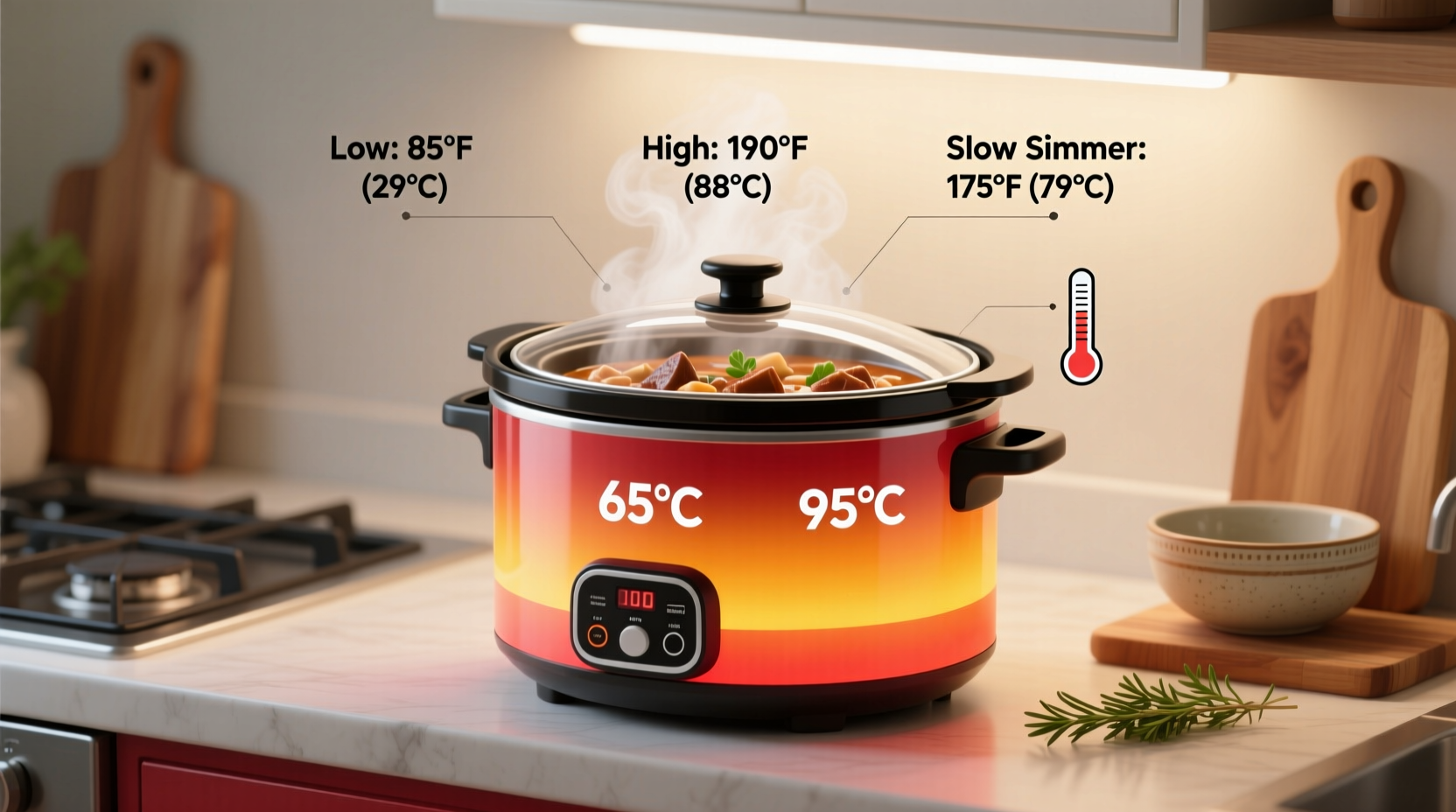
The low setting on most slow cookers heats food to about 190°F to 200°F (88°C to 93°C) after the cooker reaches a steady cooking temperature. However, the exact temperature varies by brand, model, food amount, lid fit, and room temperature.
A slow cooker’s LOW setting is not a precise temperature control. It turns the heating element on and off to cook food slowly. For food safety, the key temperatures are different: keep cold food at 40°F or below, cook poultry to 165°F, and keep cooked food at 140°F or above when holding it hot.

What temperature does “low” mean on a slow cooker?
The low setting usually keeps food below a full boil while gradually bringing it to a safe cooking temperature. In many models, the food settles near 190°F to 200°F, though the actual temperature may be lower or higher during parts of the cooking cycle.
The slow cooker does not heat every part of the pot to the same temperature at once. The area near the heating base may be hotter than the food near the top. As the food warms, the cooker cycles its heat to maintain a slow, steady cook.
Typical slow cooker temperature ranges
| Slow cooker setting | Common food temperature range | Practical use |
|---|---|---|
| Low | About 190°F–200°F | Long cooking, tough meats, stews |
| High | Often near 300°F at the heating element; food remains below a rapid boil | Faster cooking |
| Warm | Often about 140°F–165°F | Holding fully cooked food |
These are general ranges, not guaranteed specifications. Some slow cookers use different controls, and older units may heat less evenly than newer ones.
The temperature of the food also depends on its water content. Soups and stews may approach the boiling point of water, while thick sauces and large pieces of meat can heat more slowly in the center.
Is low the same as 200°F?
No. Low does not mean the slow cooker is set to exactly 200°F.
Many slow cookers are designed so that food reaches roughly 190°F to 200°F during normal use. The control may regulate the heat by cycling the element rather than by holding one exact temperature.
This matters because the number printed on the dial is not the same as the temperature of the food. “Low” describes a cooking mode, not a precise degree setting.
At sea level, water boils at about 212°F. A slow cooker on low often produces gentle bubbling rather than a hard boil. At higher elevations, water boils at a lower temperature, so bubbling and cooking times may differ.
How hot does a slow cooker need to be for safe cooking?
A slow cooker must heat food through the food safety danger zone and bring it to a safe internal temperature. The danger zone is generally 40°F to 140°F, where harmful bacteria can grow quickly.
The U.S. Department of Agriculture recommends using a slow cooker correctly and checking meat with a food thermometer. Safe minimum internal temperatures include:
- Poultry: 165°F
- Ground meats: 160°F
- Whole cuts of beef, pork, lamb, and veal: 145°F, followed by a three-minute rest
- Leftovers and casseroles: 165°F
These temperatures measure the center of the food, not the air around it or the temperature of the ceramic insert.
A slow cooker on low should eventually bring food to a safe cooking temperature when used as directed. It may take several hours, especially when the pot is full or the ingredients start very cold.
Why the food can be safe below 212°F
Food does not need to reach the boiling point to become safe. Safety depends on both temperature and time. For example, meat can become safe before it reaches 212°F if it stays at a sufficient internal temperature long enough.
Still, a recipe should not rely on guesswork. Use the recipe’s stated cooking time and check the thickest part of the meat with a food thermometer when needed.
How long does a slow cooker take to reach low temperature?
A slow cooker may take several hours to bring a full load of cold ingredients to a steady low-cooking temperature. The exact time depends on:
- The amount of food
- The starting temperature of the ingredients
- The size and shape of the meat
- The cooker’s wattage and design
- The lid seal
- How often the lid is removed
- The room temperature
- Whether the pot is half full, nearly full, or overfilled
Do not use a slow cooker to slowly warm frozen meat. Frozen food may remain in the danger zone too long. Thaw meat in the refrigerator before placing it in the slow cooker, unless the appliance maker gives specific instructions that support another safe method.
A slow cooker works best when it is filled according to the manufacturer’s instructions. Many recipes work well when the insert is about one-half to two-thirds full, but the exact limit depends on the model.

How can you check the temperature of your slow cooker?
You can check the food temperature with an instant-read food thermometer. This can help you understand how your specific cooker behaves, but one reading does not prove that every part of the food has reached the same temperature.
A practical temperature check
- Fill the slow cooker with water according to the manufacturer’s fill guidance.
- Put the lid on and set the cooker to low.
- Let it heat for several hours without lifting the lid.
- Stir the water carefully before measuring.
- Take readings in the center and near the sides.
- Repeat the check at different times if you suspect uneven heating.
Use the thermometer according to its instructions. Avoid touching the probe to the ceramic insert, because the insert may be hotter than the water.
This test can reveal whether your cooker runs unusually cool or hot. It should not replace the cooking instructions for meat. When preparing food, check the food itself at its thickest point.
Signs that a slow cooker may not heat correctly
A slow cooker may need attention if:
- Food is still lukewarm after several hours
- The cooker never produces heat on low or high
- The lid does not fit
- The insert has cracks
- The food cooks much more slowly than the recipe predicts
- The cooker repeatedly shuts off or smells like overheated wiring
If the appliance cannot bring food to a safe temperature, stop using it for food preparation. Do not eat food that has remained lukewarm for an uncertain length of time.
Is it better to cook on low or high?
Choose low when you have enough time and want a gradual cook. Choose high when the recipe allows a shorter cooking period. The best setting depends on the recipe and the food, not only on the target temperature.
Low often works well for:
- Beef chuck and pork shoulder
- Beans that have been prepared safely
- Soups and stews
- Large cuts of meat
- Dishes that benefit from long cooking
High may work better when:
- The recipe gives a high-setting time
- You need the food ready sooner
- The ingredients are cut into small pieces
- The dish does not require a long tenderizing period
Do not assume that switching from low to high always cuts the cooking time exactly in half. Slow cookers differ, and food texture can change with the setting.
Low versus high cooking time
A recipe may suggest:
- Low: 6 to 8 hours
- High: 3 to 4 hours
This is only a common pattern. Follow the recipe’s instructions and confirm that meat reaches its safe internal temperature.
Opening the lid also slows cooking. Each lift allows heat to escape and may add cooking time.

Can you leave a slow cooker on low overnight?
You can often cook food on low overnight if the appliance is in good condition, the recipe is suitable, and you follow safe handling steps. Place the cooker on a stable, heat-safe surface with space around it.
Before starting:
- Thaw meat in the refrigerator.
- Use fresh ingredients.
- Do not overfill the insert.
- Keep the lid closed.
- Follow the recipe’s liquid instructions.
- Make sure the cooker cord and plug are undamaged.
- Do not use the appliance near water or on an unstable surface.
When the food is done, either serve it promptly or keep it at a safe hot-holding temperature. The USDA advises keeping hot food at 140°F or above. A slow cooker’s warm setting may or may not maintain that temperature evenly, so check with a thermometer if the food will be held for a long period.
Do not place a hot ceramic insert directly into cold water. Sudden temperature changes can crack the insert.
Common mistakes with the low setting
The most common mistake is treating “low” as an exact temperature. The control is a setting, while the food temperature changes over time.
Other mistakes include:
Starting with frozen meat
Frozen meat can take too long to heat through. Thaw it in the refrigerator first.
Overfilling the cooker
An overfilled pot heats slowly and may cook unevenly. Use the fill limit in the owner’s manual.
Removing the lid often
Each lid lift releases heat and moisture. Keep the lid closed unless the recipe requires stirring or checking.
Using too little liquid
Some foods need liquid to cook evenly and prevent scorching. Follow the recipe rather than adding a random amount.
Relying on color
Meat can look done before it reaches a safe internal temperature. Use a food thermometer.
Using warm to cook raw food
Warm is generally for holding already cooked food. It is not a substitute for the low or high cooking setting when starting with raw meat.

What should you do if your slow cooker stays lukewarm?
If food stays lukewarm, first check the outlet, plug, control setting, lid, and power indicator. If the cooker has power but the food remains below safe temperatures after several hours, do not continue eating the food.
Use a clean food thermometer to check the center of the food. If it has been in the danger zone for an unknown amount of time, the safest choice is to discard it.
Do not taste food to decide whether it is safe. Harmful bacteria may not change the food’s smell, appearance, or taste.
If the slow cooker is old, damaged, or inconsistent, replace it or have it assessed according to the manufacturer’s guidance. Do not attempt electrical repairs unless you are qualified to do so.
Frequently asked questions
Does a slow cooker on low simmer?
Often, yes. A slow cooker on low may produce gentle bubbles after the food becomes hot. The amount of bubbling depends on the recipe, liquid level, cooker design, and altitude.
A lack of visible bubbles does not always mean the cooker is too cool. Check the food temperature with a thermometer instead.
Can a slow cooker on low reach 165°F?
Yes. Food in a slow cooker on low can reach and exceed 165°F, although the timing varies. The center of a large roast may take much longer than a thin piece of meat.
Check the thickest part of the food rather than measuring only the liquid.
Is 170°F the low setting on a slow cooker?
Not necessarily. Some sources and models report low temperatures near 170°F, while many slow cookers bring food closer to 190°F to 200°F during steady cooking. The exact result depends on the model and conditions.
The owner’s manual is the best source for a model-specific specification.
Can I use a slow cooker to keep food warm?
Yes, but use the warm setting only for fully cooked food. Keep the food at 140°F or above and avoid holding it for longer than needed.
If the food drops below 140°F for an uncertain period, discard it rather than reheating it by guesswork.
How do I know whether my slow cooker is safe to use?
Check that the cord, plug, lid, and ceramic insert are intact. The appliance should heat consistently and should not produce smoke, sparks, or a burning electrical smell.
Follow the owner’s manual for use, cleaning, and replacement parts. Discontinue use if the cooker is damaged or fails to heat properly.
Bottom line
The low setting on a typical slow cooker brings food to roughly 190°F to 200°F, but it is not an exact temperature control. The real temperature varies by model, load, ingredients, and cooking time.
Use low for longer cooking, thaw meat first, keep the lid closed, and check meat with a food thermometer. For hot holding, keep cooked food at 140°F or above. When in doubt, follow the appliance manual and USDA food-safety guidance rather than relying on the dial alone.