
The best electric kettle for matcha offers precise temperature control, gentle heating, and an easy pour for smooth tea.
Have you ever boiled water for matcha, only to end up with a bitter, flat cup? I have, and the problem often starts with water that is too hot. Matcha needs care because boiling water can dull its fresh taste and make its fine powder taste harsh. A good temperature-control kettle takes the guesswork out of brewing. It heats water quickly, holds the right heat, and helps you prepare a calm bowl of matcha with less mess.
INTASTING Gooseneck Kettle

The INTASTING Gooseneck Electric Kettle is a strong match for anyone who wants careful control over matcha water. Its narrow spout helps me pour slowly and neatly into a bowl or cup. That control matters when I add water to matcha in small amounts and whisk it into a smooth paste. The temperature control also helps prevent the common mistake of using freshly boiling water.
This kettle also suits pour-over coffee and other teas, so it can earn its place on a busy kitchen counter. The gooseneck design feels more like a tool for careful brewing than a basic hot-water pot. I like that it can support repeatable results from one bowl to the next. For many home users, it has the main traits expected from the best electric kettle for matcha without adding needless steps.
Pros:
- Precise temperature control for matcha and tea
- Gooseneck spout supports slow, steady pouring
- Useful for coffee, green tea, and hot water
- Helps reduce the risk of bitter, overheated matcha
- Compact design fits well in small kitchens
- Good choice for users who value measured brewing
Cons:
- Gooseneck pouring takes longer than a wide-spout kettle
- Small capacity may not suit large families
- Extra controls may feel less simple than a one-button kettle
HIYAKOI Gooseneck Kettle

The HIYAKOI Gooseneck Electric Kettle stands out for its fine temperature control and useful brewing features. Its listed ±1°F control gives matcha drinkers a narrow range to work with, which can be helpful when they prefer a consistent water temperature. The 0.8-liter capacity is enough for one or two servings without making the kettle bulky. Its 1200-watt heating system is also designed for quick daily use.
A built-in timer and keep-warm function add comfort for slow morning routines. I can heat water, prepare the bowl, and return to warm water without starting over. The long 12-hour keep-warm claim should still be used with care, since I prefer to heat only the amount I need. This kettle is especially appealing to matcha drinkers who also make pour-over coffee and want one focused appliance.
Pros:
- Fine temperature adjustment supports careful matcha brewing
- Fast 1200-watt heating saves time
- 12-hour keep-warm feature supports flexible routines
- Built-in timer helps with repeatable brew steps
- 0.8-liter size works well for one or two people
- Gooseneck spout gives better control near the bowl
Cons:
- Small capacity is not ideal for serving a large group
- Many features may feel complex for casual tea drinkers
- Keep-warm use can consume more power than reheating a small amount
YDDZZM Gooseneck Electric Kettle

The YDDZZM Gooseneck Electric Kettle offers a simple way to bring more control to matcha preparation. It has a 0.9-liter capacity, which gives it a little more room than many compact gooseneck kettles. The stainless steel inner section is a practical feature for people who want the water to touch a durable surface. Its 1000-watt heating system suits normal home brewing and small servings.
I see this model as a useful middle ground for tea drinkers who want control without a very large kettle. The narrow spout can help me pour in a thin stream while I whisk matcha. That slow stream gives the powder time to mix instead of flooding the bowl at once. It also works for coffee and other tea, making it more useful than a kettle made only for one drink.
Pros:
- 0.9-liter capacity offers useful room for daily brewing
- Intelligent temperature control helps protect delicate tea flavor
- Stainless steel inner surface is practical for regular use
- Gooseneck spout supports a measured pour
- 1000-watt heating balances speed and everyday power use
- Works for matcha, coffee, tea, and plain hot water
Cons:
- Heating may be slower than higher-wattage models
- Controls may require a short learning period
- Gooseneck kettles need careful cleaning around the spout
Cosori Gooseneck Kettle
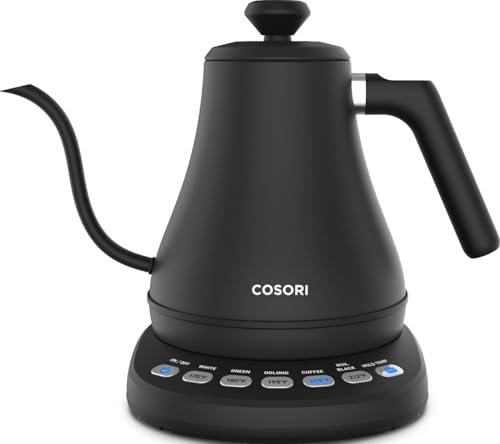
The Cosori Gooseneck Electric Kettle is a well-rounded option for people who want a neat design and controlled pouring. Its 0.8-liter size keeps the kettle easy to handle, especially when I pour into a small matcha bowl. Temperature control helps me choose warm water instead of relying on guesswork. That feature can make a real difference when I want matcha with a bright taste and soft finish.
This kettle also makes sense for coffee fans who use a slow pour-over method. The spout gives a steady flow, so I can avoid splashing the bowl or countertop. Its black finish has a clean look that works in many kitchen styles. If I want the best electric kettle for matcha from a familiar kitchen brand, this model deserves close attention.
Pros:
- Temperature control supports better matcha results
- Compact 0.8-liter body is easy to lift and pour
- Gooseneck spout improves water flow control
- Useful for coffee, tea, and hot water
- Clean black design suits modern kitchens
- Good size for single users and couples
Cons:
- 0.8-liter capacity may feel limited for several guests
- Slow pouring is less convenient when speed matters
- Small spout openings need regular care in hard-water areas
INTASTING 1°F Control Kettle

The INTASTING Gooseneck Electric Kettle with 1°F control is aimed at drinkers who enjoy exact settings. Its 0.9-liter capacity gives me enough water for a few small servings while staying easy to move. Fine temperature steps can help me repeat a matcha recipe with less variation. This is useful when I have found a water temperature that brings out the flavor I like.
The gooseneck spout adds another layer of control during preparation. I can wet the powder first, then add water in short pours while whisking. That method helps reduce dry clumps and gives the matcha a more even texture. For careful home brewers, this could be the best electric kettle for matcha when exact temperature matters more than the lowest price.
Pros:
- 1°F temperature control supports repeatable recipes
- 0.9-liter capacity suits daily home use
- Gooseneck spout allows a calm, controlled pour
- Useful for matcha, green tea, and pour-over coffee
- Helps users avoid water that is too hot
- Good fit for hobby brewers who track details
Cons:
- Precise controls may be more than casual users need
- Gooseneck pouring takes patience
- Users should verify the fill level before each heating cycle
My Recommendation
I recommend the HIYAKOI for matcha drinkers who want fine temperature control, quick heating, and helpful timer features in one kettle. Its 0.8-liter size works well for a solo morning routine or two small bowls. The INTASTING 1°F model is better for users who care most about exact settings and repeatable recipes. The Cosori is a balanced choice for shoppers who want a simple, polished kettle for both matcha and coffee.
The YDDZZM makes sense for buyers who want a little more capacity and a stainless steel inner section. The first INTASTING model is a practical pick for controlled pouring without an oversized body. In my view, the best electric kettle for matcha is not always the one with the most features. It is the one that gives you the right heat, a clean pour, and a size you will use every day.
| Best for | Why |
|---|---|
| Precise matcha recipes | HIYAKOI offers fine temperature control, a timer, and keep-warm support. |
| Exact temperature tracking | INTASTING 1°F Control helps users repeat a favorite brew with less guesswork. |
| Simple daily brewing | Cosori combines controlled pouring, compact size, and broad tea and coffee use. |
How to Choose the Best Electric Kettle for Matcha
Choosing a kettle for matcha is not the same as choosing a kettle only for boiling water. Matcha powder does not steep in a bag. You whisk the powder into the water, so water temperature has a direct effect on the drink. A kettle with useful control can make the process easier and help protect the fresh taste of the tea.
Look for real temperature control
A basic kettle often heats water until it boils. That can work for pasta or black tea, but it is not ideal for matcha. Many matcha drinkers prefer water below the boiling point, often around 160°F to 175°F. The best setting depends on the matcha grade, the recipe, and your taste.
Lower heat may keep delicate notes bright and sweet. A slightly higher setting can create a fuller cup with more body. I suggest starting near 165°F, then adjusting in small steps. A kettle that changes in 1°F or 5°F steps gives more control than one with only a few fixed presets.
Choose a useful kettle size
Most matcha recipes use a small amount of water. A traditional bowl may need only a few ounces, while a larger iced or latte recipe may use more. A huge kettle can waste water and take up space. A compact kettle between 0.8 and 1.0 liter often gives a good balance for one or two people.
Capacity also affects comfort. A full kettle weighs more, and a heavy body can make a slow pour harder. If you live alone, a 0.8-liter model may be enough. If you make tea for family or guests, the 0.9-liter model may feel more useful.
Understand the value of a gooseneck spout
A gooseneck spout is not required to make matcha. You can pour from many regular kettles. Still, the narrow spout can help when you add water slowly to the powder. A controlled stream lets you wet the matcha first and then build the drink in stages.
This method can help reduce splashes and dry pockets. It also gives you more control when making a matcha latte. I like the gooseneck shape for small bowls because it feels calm and precise. The trade-off is speed. A narrow spout pours more slowly than a wide spout.
Check heating speed and power
Wattage gives a rough idea of heating speed, but it does not tell the whole story. A 1200-watt kettle may heat a small amount of water faster than a 1000-watt kettle. Room temperature, water volume, and the kettle design also affect the result.
Fast heating helps on busy mornings. Yet matcha preparation is often a slow ritual, not a race. I would rather have stable temperature control than a kettle that heats very fast but gives me no way to stop below boiling. The best electric kettle for matcha should balance speed with control.
Consider the keep-warm function
A keep-warm setting can help when you prepare several drinks. It may also help if you heat water before setting out your bowl, whisk, and matcha. However, I do not suggest leaving water warm all day without a clear need. Fresh water usually gives a cleaner taste.
Keep-warm times vary by model. Some kettles hold heat for a short period, while others list much longer times. Treat long hold times as a convenience, not a reason to keep the kettle running without pause. Turn the unit off when you finish and follow the care instructions.
Review the inner materials
The inside of the kettle matters because it touches the water. Stainless steel is common and easy to understand. Some models may use plastic parts near the lid, handle, or water level area. That does not automatically make a kettle unsafe, but I still check the product details before buying.
Look for clear care instructions and avoid filling above the maximum line. Do not run an empty kettle. These small habits protect the heating system and improve daily safety. A clean inner surface also helps keep old odors from moving into delicate matcha.
Think about cleaning
Mineral scale can build up inside a kettle, especially in areas with hard water. Scale may affect heating and leave flakes in the water. It can also make the kettle look cloudy or dull. I clean my kettle on a regular schedule based on water hardness and use.
Use the method listed in the manual. Many kettles can be cleaned with a mild descaling solution, but the maker’s directions should come first. Rinse well after cleaning. Never place an electric kettle base in water, and never scrub the heating parts with rough tools.
Check the controls and display
Good controls should feel clear after a few uses. I look for buttons that show the target temperature and a display that is easy to read. A control panel that feels crowded can slow down a simple morning routine.
Memory features can also help. Some kettles remember the last setting, while others return to a default temperature. Neither option is always better. The right choice depends on whether you like a fixed routine or often switch between matcha, coffee, and tea.
What Temperature Is Best for Matcha?
There is no single perfect matcha temperature for every tea. Many people start between 160°F and 175°F. This range is warm enough to blend the powder while staying below a full boil. Water around 212°F can make some matcha taste bitter or harsh.
Temperature also depends on the matcha itself. High-quality ceremonial matcha may show more sweetness at a lower heat. Culinary matcha used in lattes, smoothies, or baking can handle a warmer recipe. I recommend testing one bowl at 165°F, then changing the temperature by 5°F as needed.
Do not confuse water temperature with bowl temperature. A warm bowl can help the drink stay pleasant for longer. Rinse the bowl with warm water, discard that water, and then prepare the matcha. This small step can make the whole experience feel more polished.
How I Prepare Matcha With a Temperature-Control Kettle
I begin with fresh, cool water. Filtered water often works well, but the best choice depends on your local water. I fill the kettle only with the amount needed. This saves time and avoids heating extra water that may sit unused.
Next, I choose a starting temperature near 165°F. I sift the matcha into the bowl to break up small lumps. I add a small splash of warm water and whisk it into a smooth paste. Then I add the rest of the water and whisk with a quick back-and-forth motion.
A gooseneck spout helps during the second pour. I can add water in a thin stream without washing the powder to one side of the bowl. I finish by checking the color, foam, and taste. If the drink tastes sharp, I try cooler water next time.
Common Mistakes to Avoid
Using boiling water
This is the most common mistake. Boiling water can overpower the gentle notes in matcha. It may also make the drink taste dry or bitter. Use a temperature-control kettle, or let boiling water cool before adding it to the bowl.
Adding all the water at once
A fast pour can leave powder stuck at the bottom or sides. Start with a small amount of water first. Whisk that into a paste before adding more. This simple approach supports a smoother texture.
Using too much matcha
More powder does not always mean more flavor. Too much matcha can make the bowl heavy and bitter. Begin with a modest serving and adjust after tasting. Follow the directions on your matcha package when you are unsure.
Ignoring water quality
Water makes up most of the drink, so its taste matters. Strong chlorine or mineral flavors can cover the tea’s natural notes. Filtered water may help if your tap water has a strong taste. I also avoid water that has sat in the kettle overnight.
Leaving the kettle wet
Empty the kettle after use and let the inside dry with the lid open. This can help reduce stale odors. It also makes it easier to notice scale before it becomes a large problem. A dry kettle is a happier kettle.
Electric Kettle Safety Tips
Use the kettle on a dry, stable surface. Keep the cord away from the edge of the counter. Do not touch the metal body soon after heating, since it may remain hot even when the handle feels safe.
Keep water below the maximum line and above the minimum line. Too little water may expose the heating element or trigger poor heating. Too much water may spill during boiling. Always use the lid as directed and keep the base away from sinks and wet counters.
Inspect the cord and plug from time to time. Stop using the kettle if you see damage. Let the appliance cool before cleaning. These basic steps apply to every model, including the best electric kettle for matcha.
Why Temperature Precision Matters for Matcha
Matcha has a fine texture because the whole tea leaf becomes part of the drink. That gives it a rich taste, but it also means heat can stand out. A small change in water temperature may affect sweetness, bitterness, aroma, and mouthfeel.
Precision does not mean you need to chase one perfect number. It means you can repeat a method and make small changes with purpose. If your bowl tastes too bitter, lower the temperature. If it tastes thin, try a little warmer water or more powder.
This is why I value kettles with clear controls. They turn a vague step into a simple choice. Instead of guessing how long boiled water has cooled, I can select a useful target. That makes the morning ritual easier and more consistent.
Gooseneck Kettle Versus Standard Kettle
A standard kettle is often faster for filling a large mug. It may also have a larger capacity. For households that need hot water for oatmeal, soup, and several drinks, a standard shape can be more practical.
A gooseneck kettle offers better flow control. It shines when I need a slow stream for matcha or pour-over coffee. It is also easier to use with small bowls. The choice comes down to your routine, not just the shape.
If you make matcha once a week, a standard temperature-control kettle may be enough. If you make matcha every morning, a gooseneck model may feel worth the extra space and slower pour. All five models reviewed here focus on that controlled brewing style.
Is a Smart Kettle Worth It for Matcha?
Smart features can be useful, but they are not essential. A clear temperature display and simple buttons matter more than a phone app for most matcha drinkers. If an app helps you schedule heating or save settings, it can add comfort.
Still, more technology means more parts to learn and maintain. I prefer a kettle that works quickly when I press a button. For matcha, the key features remain temperature control, safe heating, a clean interior, and a spout that feels easy to guide.
Before paying extra for smart functions, ask how often you will use them. A dependable basic model may offer better value. The best electric kettle for matcha should make your routine smoother, not turn a simple bowl into a gadget project.
Care Tips for Long-Term Use
Clean mineral scale before it becomes thick. Hard water may require more frequent descaling. Follow the manual, rinse the kettle fully, and run a plain-water cycle if the instructions allow it.
Do not use abrasive powder on the inner surface. Avoid soaking the base or placing the electrical parts under a tap. Wipe the outside with a soft, damp cloth. Dry the lid and spout area after cleaning.
Store the kettle with the lid slightly open if the design allows it. This helps air move through the interior. Keep the cord tidy but do not wrap it tightly around a hot kettle. Simple care can help preserve heating speed and flavor quality.
FAQs Of best electric kettle for matcha
What temperature should I use for matcha?
Start around 160°F to 175°F. A setting near 165°F works well for many matcha recipes. Adjust lower if the drink tastes bitter.
Do I need a gooseneck kettle for matcha?
No. You can make matcha with any kettle that heats water safely. A gooseneck spout simply gives you more control during a slow pour.
Can I use a regular boiling kettle for matcha?
Yes, but let boiling water cool first. Boiling water may make matcha taste harsh. A temperature-control kettle makes the process easier and more repeatable.
Is stainless steel safe for heating matcha water?
Stainless steel is a common kettle material. Keep the interior clean, follow the care guide, and use fresh water for the best taste.
What size kettle is best for one person?
A kettle around 0.8 to 0.9 liter is usually convenient for one person. It gives enough room for matcha and other drinks without feeling too heavy.
Final Verdict: Which Should You Buy?
The HIYAKOI is my top choice for the best electric kettle for matcha because it combines fine control, quick heating, a timer, and keep-warm support. Choose the INTASTING 1°F model if exact settings matter most.
For a smooth matcha routine, choose controlled heat and a clean pour. These kettles make daily tea easier, calmer, and more consistent.