
The best electric kettle for an RV should be compact, safe, fast, and gentle on limited campground power.
An RV morning can feel rushed when the coffee maker, microwave, and heater all compete for power. A small electric kettle solves that problem with one simple job: heating water fast. I looked at size, wattage, safety, pouring control, storage, and daily RV use. The picks below cover tiny travel kettles, low-power models, large family options, a gooseneck design, and a collapsible choice. Before buying, always check your RV outlet, inverter, and campground power limits.
WTJMOV 0.6L Small Electric Kettle

The WTJMOV 0.6L kettle is a smart fit for a small RV, camper van, or travel trailer. Its 20-ounce capacity is enough for tea, instant coffee, oatmeal, soup, or one large mug at a time. The compact stainless steel design takes up little counter space, which matters when every inch of an RV kitchen has a job. Its double-wall body also makes it easier to handle than a thin single-wall travel pot.
This kettle uses a 120V connection and includes auto shut-off protection. That feature adds peace of mind if I get distracted while preparing breakfast or answering a campground call. The small tank may not suit a group, but it can help limit wasted water and reduce the temptation to boil more than the RV battery or electrical circuit can handle. For solo travelers and couples, this is one of the most practical small electric kettle options for RV use.
Pros:
- Very compact size for tight RV counters
- 20-ounce capacity suits one or two small servings
- Double-wall design improves handling comfort
- Stainless steel interior supports a clean water taste
- Auto shut-off adds useful safety protection
- Lightweight body is easy to move and store
- Fast boiling can shorten morning wait time
Cons:
- Small capacity may require several boils for a family
- 120V design is not intended for foreign voltage without proper equipment
- Compact kettles can cool faster than larger models
My Recommendation
I recommend this WTJMOV model for solo RV owners, couples, van campers, and anyone who mainly makes one cup at a time. Its small footprint is the main attraction. It fits well beside a sink or under an RV cabinet, and the auto shut-off helps reduce worry in a small living space. If you want the best electric kettle for RV travel and your top concern is saving counter room, this model deserves a close look. Its value is strongest when you do not need to boil water for several people at once.
WTJMOV 0.8L Low-Power Kettle

The WTJMOV 0.8L stainless steel kettle gives RV users a little more room without becoming bulky. Its capacity works well for two mugs of tea or coffee, or a serving of instant noodles and a hot drink. I like this middle size because it avoids the limits of a tiny kettle while still keeping storage simple. It can serve a couple without forcing them to run the kettle again right away.
The low-power design is especially useful in a camper with a modest electrical system. RV outlets, inverters, and campground circuits do not always offer unlimited power, so a lower-demand kettle may be easier to use alongside other appliances. The auto shut-off is another welcome feature for busy mornings. This is a straightforward kettle for camping, office use, travel, and RV life rather than a specialty coffee tool.
Pros:
- 0.8L size balances capacity and portability
- Low-power design may be friendlier to RV circuits
- Stainless steel construction feels suited to regular travel
- Useful capacity for couples and small breakfasts
- Auto shut-off helps prevent prolonged heating
- Compact shape is easier to store than a full-size kettle
- Works for tea, coffee, soup, oatmeal, and hot water bottles
Cons:
- It may still be too small for larger families
- Low-power heating can take longer than a high-wattage kettle
- It may not offer precise temperature controls
My Recommendation
This WTJMOV 0.8L model is best for couples and RV owners who want a useful middle ground. It offers more water than a personal kettle but does not take over the galley. I would choose it for a travel trailer or motorhome where power management matters and the kettle will serve two people often. For many campers, this could be the best electric kettle for RV use because it blends a useful capacity with a low-power approach. Check the product listing for the current electrical specifications before purchase.
Cosori 1.7L Electric Kettle
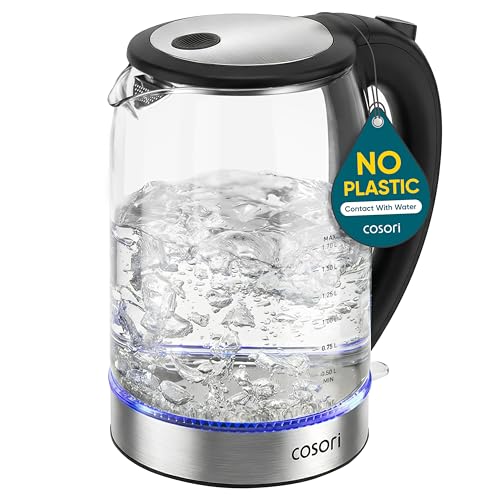
The Cosori 1.7L kettle is the largest option in this group, so it fits a different kind of RV buyer. Its larger tank can provide several cups of hot water in one cycle. That helps families, groups, and campers who serve tea, coffee, cocoa, or instant meals throughout the day. The product is also designed without plastic contact with the water, which may appeal to people who prefer water to touch stainless steel instead.
A large kettle can feel like a small comfort station in an RV. I can boil enough water for several people without standing near the counter for repeated cycles. However, its larger body needs more storage space, and the higher power draw may matter on a 15-amp circuit or when using an inverter. This model is best for a powered campsite or RV kitchen with room for a full-size appliance, not a tiny van with a minimal battery bank.
Pros:
- 1.7L capacity serves several people at once
- No plastic contact with water appeals to many users
- Stainless steel water path supports a clean taste
- Good choice for families and group camping
- Reduces the need for repeated boiling cycles
- Useful for tea, coffee, cocoa, soup, and cooking tasks
- Familiar full-size format feels easy to use
Cons:
- Larger body needs more RV storage and counter space
- May draw more power than a small travel kettle
- Over-sized for one person who only needs one cup
My Recommendation
I recommend the Cosori 1.7L for families, hosted campground breakfasts, and RV owners who have shore power and a generous kitchen area. It is not my first choice for a small camper van or a battery-powered setup. Still, it may be the best electric kettle for RV households that need volume and want to avoid several boiling cycles. Its strongest benefit is simple: one fill can cover many drinks. Confirm the wattage and your RV circuit capacity before using it with other high-draw appliances.
FuseBrew 0.8L Gooseneck Kettle
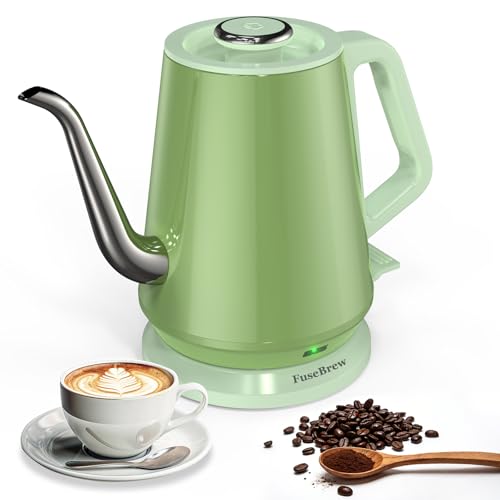
The FuseBrew Gooseneck kettle is made for campers who care about the pour as much as the boil. Its narrow spout offers better control for pour-over coffee and delicate tea. The 0.8L capacity is large enough for a couple of drinks while staying reasonable for an RV counter. Its stainless steel body and green finish also add a bit of style to a small kitchen.
The 1200W heating system aims to bring water to a boil quickly, which can be handy when the campsite day starts early. A gooseneck spout pours like a thin stream instead of a splash, so I can wet coffee grounds in a controlled way. That same design may feel slower when filling a large pot or cooking vessel. Auto shut-off helps make the kettle safer, but users should still place it on a stable surface away from the edge of the counter.
Pros:
- Gooseneck spout gives excellent pour control
- Useful for pour-over coffee and specialty tea
- 0.8L capacity suits one or two coffee drinkers
- 1200W power supports fast boiling
- Stainless steel body suits frequent travel
- Auto shut-off adds a useful safety layer
- Distinct color adds personality to an RV kitchen
Cons:
- Higher wattage may challenge a small inverter
- Gooseneck pouring can take longer for large containers
- It costs more to serve users who do not need pour control
My Recommendation
The FuseBrew is best for RV coffee fans who use a pour-over dripper or enjoy careful tea preparation. I would not select it only for basic hot water, since its special spout may be more feature than some campers need. For a coffee-focused traveler with reliable shore power, it may be the best electric kettle for RV mornings. The controlled stream is its key advantage, while the 1200W demand is the main point to check. Its value depends on whether you will use that precision often.
Foldable 0.6L Dual-Voltage Kettle
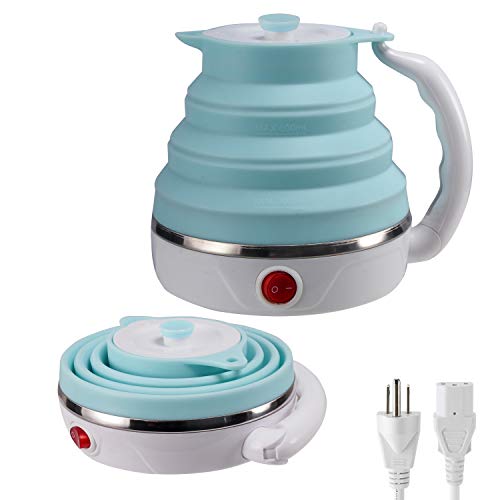
The foldable travel kettle takes a different path to RV convenience. Its food-grade silicone body collapses for storage, which can help when cabinet space is almost nonexistent. The 600ml capacity works for a mug or two, depending on serving size. Its blue finish and small profile make it suitable for RV travel, hotels, dorms, and road trips.
This model supports dual voltage, listed as 110–220V, which can help travelers who use compatible electrical systems outside the United States. The voltage switch or setting must match the outlet before use, and a plug adapter may still be needed in another country. For American RV use, the compact 120V setting is the important one. I like this style for emergency storage because it can flatten down after the kettle cools, but silicone can retain odors if the unit is not rinsed and dried well.
Pros:
- Collapsible body saves valuable cabinet space
- 600ml size works well for personal use
- Dual-voltage design supports international travel
- Food-grade silicone body is flexible for packing
- Lightweight format suits vans and small trailers
- Useful backup kettle for road trips and hotels
- Easy to pack when the RV kitchen is full
Cons:
- Small capacity is not ideal for a group
- Silicone may hold odors without careful cleaning
- Users must set the voltage correctly before operation
My Recommendation
I recommend this foldable kettle for minimalist campers, international RV travelers, and anyone who stores appliances in a narrow cabinet. It is also a good backup when a permanent kettle would sit unused for much of the year. The compact design gives it a strong claim as the best electric kettle for RV owners who value storage above all else. It cannot match a larger stainless steel kettle for capacity, but its ability to collapse can be worth more than extra water. Check the voltage setting every time you use it in a new location.
How I Choose the Best Electric Kettle for RV Use
Shopping for an RV kettle is not the same as buying one for a large home kitchen. In a house, I can focus on speed, color, and style. In an RV, I must also consider outlet limits, inverter size, counter space, storage, water capacity, and the risk of spills while the vehicle is moving.
I use the following points to compare each model.
Power Draw and RV Electrical Limits
Wattage is one of the most important details. A kettle with high wattage may boil water quickly, but it can also use a large part of the available power on a small circuit. If an RV has a 15-amp circuit, the total load from the kettle, refrigerator, microwave, air conditioner, and other devices matters.
A 1200W kettle uses about 10 amps at 120V before considering normal variation. A lower-power kettle may boil more slowly, but it can be easier to run with other devices. I recommend checking the label on the kettle, the RV breaker, and the inverter manual. Never assume that a battery inverter can safely run any appliance just because the plug fits.
Capacity
Capacity should match the number of people and the type of drinks you make. A 0.6L kettle is useful for one or two small servings. An 0.8L model gives couples more breathing room. A 1.7L kettle makes sense for a family or group at a powered campsite.
Do not fill a kettle past its maximum line. Water expands and moves as it heats. Overfilling can cause hot water to escape through the lid or spout. I also avoid boiling much more water than I need. The right fill level saves time, power, and water.
Size and Storage
RV counters are like tiny puzzle boards. A kettle must fit without blocking the sink, stove, or cabinet door. Measure both the counter and storage area before ordering. Include the lid, handle, cord, and spout in your measurements.
A collapsible model has an advantage for occasional users. A compact stainless steel kettle may be better for daily use because it is ready to lift and pour. A large 1.7L model needs a clear storage plan. If you must move it every time you cook, its size may become annoying.
Safety Features
Auto shut-off is a key feature for an RV kettle. It should stop heating when the water reaches a boil or when the tank is empty, depending on the design. Boil-dry protection is also helpful because it reduces the chance of heating an empty kettle.
These features do not replace good habits. I place the kettle on a level, dry surface. I keep the cord away from the sink and stove. I unplug it after use, especially before driving. Hot water can cause serious burns in a moving vehicle, so I never carry a full kettle while the RV is in motion.
Materials and Water Contact
Many buyers prefer stainless steel for the inner tank because it feels sturdy and does not add a plastic taste to water. Some travel kettles use silicone for flexibility. That material can be useful in a foldable body, but it needs regular cleaning and full drying.
I look for clear product details about the water-contact parts. Claims such as “no plastic contact” should be read with care because lids, seals, or small fittings may still use other materials. Always follow the cleaning instructions. Mineral scale can affect taste and performance in any kettle.
Pouring and Handle Design
A balanced handle can make a small kettle safer to use. The handle should give enough room for fingers and should not become too warm during normal operation. A well-shaped spout helps direct water into a mug without sudden splashes.
A gooseneck spout offers the most control, especially for pour-over coffee. A standard spout may pour faster for soup or a cooking pot. I choose the spout based on the job, not just looks. In an RV, a controlled pour is helpful because the counter is often close to electronics and bedding.
Which Kettle Size Works Best in an RV?
The best size depends on your routine. Solo campers often prefer 0.5L to 0.7L. These kettles heat only the water needed for one drink and store with little fuss. They can also reduce the load on a small inverter.
Couples usually benefit from 0.8L to 1.0L. This range can handle two drinks without taking the space of a full home kettle. It gives a good balance between speed, water use, and storage.
Families may prefer 1.5L to 1.7L. The larger tank is convenient when several people want hot drinks at the same time. However, the kettle may draw more power and occupy a larger section of the kitchen. A big kettle only helps if the RV can support it safely.
RV Kettle Power Tips for 2026
RV electrical systems still reward careful planning in 2026. Modern appliances may add useful features, but the power rules remain simple. The outlet, breaker, shore connection, generator, and inverter each have limits.
I suggest these habits:
- Check the kettle wattage before connecting it.
- Do not run several high-wattage appliances at once.
- Use the correct inverter type and capacity.
- Keep the kettle away from wet areas.
- Fill only the amount of water you need.
- Unplug the kettle before travel.
- Let the kettle cool before storing it.
- Inspect the cord and plug for heat or damage.
If a plug, outlet, or cord feels hot, stop using the appliance. A warm plug can point to an overloaded circuit, a loose connection, or a damaged component. Electrical safety matters more than a fast cup of coffee.
How to Clean an Electric Kettle in an RV
Mineral scale builds faster in hard water. It may appear as white flakes or a rough layer on the heating plate. Scale can slow boiling and affect the taste of tea.
I start by unplugging the kettle and letting it cool. I follow the care instructions, then use an approved descaling method when needed. Many people use a mild vinegar-and-water solution, but the product manual should guide the exact method. I rinse several times after descaling so no smell remains.
I never submerge the electrical base, plug, or cord. I also avoid abrasive pads that can scratch the inner surface. After cleaning, I leave the lid open so the tank can dry fully. This simple routine keeps the kettle fresher during long RV trips.
Best Uses for an RV Electric Kettle
An electric kettle does more than make tea. It can heat water for instant coffee, oatmeal, noodles, cocoa, broth, and some dehydrated meals. It can also provide hot water for a quick wash when the campsite setup makes a full shower inconvenient.
A kettle can save the RV stove from small tasks. That matters on hot days when I do not want to add heat to the interior. It also helps when the stove is busy cooking breakfast. Still, it is not a replacement for a cooking pot, and I would not use it to heat milk unless the manual allows that use.
For coffee drinkers, a gooseneck kettle can make a big difference. For basic meals, a wider standard spout may be easier. For storage, a foldable kettle wins. There is no single design that fits every traveler, so the best electric kettle for RV use is the one that matches your daily pattern.
Best For Comparison
| Best for | Why |
|---|---|
| Solo campers and tight spaces | The WTJMOV 0.6L model uses little counter and storage space. |
| Couples and lower-power RV setups | The WTJMOV 0.8L model offers useful capacity with a compact design. |
| Families and coffee specialists | The Cosori offers volume, while the FuseBrew provides precise pouring control. |
What to Check Before Ordering
Before I buy any RV kettle, I check five details. First, I confirm the voltage and plug type. Most US RVs use 120V outlets, but dual-voltage travel models require the correct setting.
Second, I compare wattage with the RV electrical system. A kettle that works well at a powered campsite may not work through a small inverter. Third, I measure storage space. Product photos can make a kettle look smaller than it feels in a real RV cabinet.
Fourth, I check the capacity. A large tank is useful for a family but wasteful for one traveler. Finally, I read the current Amazon listing for dimensions, safety details, warranty information, and customer updates. Product specifications can change, and the live listing is the best place to confirm current data.
FAQs Of best electric kettle for rv
What wattage is best for an RV electric kettle?
A lower-wattage kettle is often easier for a small RV circuit or inverter. Many users should look for a model that fits their available power rather than choosing the fastest model. Check the kettle label and RV manual before use.
Can I use an electric kettle with an RV inverter?
Yes, but the inverter must support the kettle’s wattage and startup demand. Leave room for other appliances, and use a properly rated inverter. A small inverter may not safely power a high-wattage kettle.
Is stainless steel better for an RV kettle?
Stainless steel is durable and easy to clean. Many buyers also prefer it because water does not sit against a large plastic surface. A stainless steel kettle may weigh more than a silicone model, so compare portability and storage needs.
What capacity should I choose for two people?
A kettle around 0.8L to 1.0L often works well for two people. It can make two drinks without taking as much space or power as a 1.7L model. Choose a larger size if you often serve several guests.
Are foldable kettles safe for RV travel?
They can be safe when used on a level surface and according to the manual. Set dual-voltage models correctly, keep the body upright, and let the kettle cool before folding it. Store it dry to help prevent odors and moisture buildup.
Final Verdict: Which Should You Buy?
For most couples, the WTJMOV 0.8L is the best electric kettle for RV use because it balances size, capacity, and power needs. Solo campers may prefer the 0.6L model, while families should consider the Cosori.
Choose the FuseBrew for pour-over coffee or the foldable kettle for tiny storage spaces. Match wattage to your RV system, and always follow safe use and cleaning instructions.