
The best knife sharpener for ceramic knives uses diamond abrasives and a controlled angle to restore a smooth, sharp edge.
A ceramic knife can stay sharp for a long time, then suddenly feel dull when you slice tomatoes, herbs, or soft fruit. That can be frustrating because many common sharpeners use steel or coarse stone surfaces that do not work well on zirconia ceramic. I looked for tools that match the hard ceramic blade, control the sharpening angle, and reduce the risk of chips. The picks below include diamond sharpeners, ceramic honing rods, manual guides, and electric options, so you can choose the right fit for your knife and skill level.
Kimura 10-Inch Ceramic Honing Rod

The Kimura Professional Ceramic Honing Rod has a 10-inch ceramic surface with a stated 1200-grit finish. Its long length gives you room to work with chef knives and larger kitchen blades. The balanced polypropylene handle feels simple and practical, while the guard helps keep fingers away from the blade. The Japanese gift box also makes this tool easy to present as a useful kitchen gift.
There is one key detail to understand before buying it. This is mainly a honing rod for steel knives, not a true ceramic-blade repair tool. Ceramic surfaces can maintain or refine a steel edge, but they usually cannot remove enough material from a dull zirconia blade. For a ceramic knife, I would use this only if the maker allows it and the knife needs light maintenance rather than serious sharpening.
Pros:
- Long 10-inch rod suits many chef knives
- Fine 1200-grit surface supports light edge maintenance
- Balanced handle feels steady in the hand
- Protective handle guard improves hand safety
- Easy manual design needs no power or batteries
- Gift box adds useful presentation value
Cons:
- Not the best choice for repairing a very dull ceramic blade
- Requires practice to hold a steady angle
- Works better for steel knives than zirconia ceramic knives
My Recommendation
I recommend the Kimura rod for cooks who own mostly steel knives and want a fine tool for daily edge care. It is also useful for people who prefer a quiet, compact sharpener over an electric machine. However, shoppers searching for the best knife sharpener for ceramic knives should view this as a maintenance rod, not a primary ceramic repair system. Its value is strongest in a mixed knife collection where steel blades need regular touch-ups.
Arkansas Sharpeners Ceramic AC46
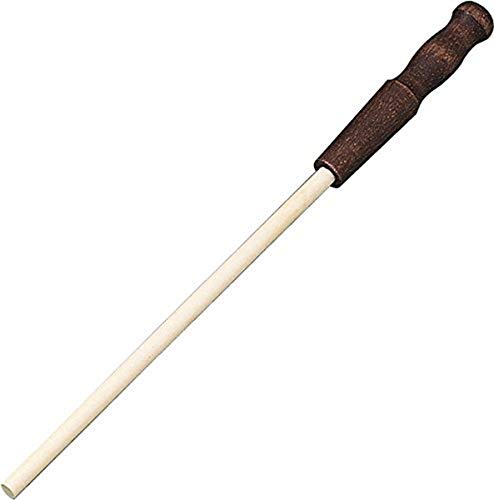
The Arkansas Sharpeners Ceramic Sharpening AC46 is a compact manual sharpening tool for cooks who want a basic setup. Its ceramic abrasive is suited to fine work and light edge correction. The small format takes little drawer space, which helps in a busy kitchen. It also avoids the noise, dust, and motor care that come with electric sharpeners.
This sharpener needs a careful reading of the product purpose. Ceramic abrasive is not the same as diamond abrasive, and a ceramic rod or stone may not cut a hard ceramic knife quickly. It can be more suitable for polishing or maintaining compatible steel blades. If your ceramic knife has a chip or a rounded edge, a diamond system or professional service is a safer choice.
Pros:
- Compact size fits small kitchen drawers
- Manual design works without electricity
- Ceramic abrasive supports fine finishing work
- Simple format has few parts to maintain
- Quiet operation suits shared kitchens
- Useful for light maintenance on compatible knives
Cons:
- May work slowly on hard ceramic knife material
- Limited control for users who need an angle guide
- Not designed for major chips or badly damaged edges
My Recommendation
The AC46 is best for a careful home cook who wants a small finishing tool and understands its limits. I would not make it my first pick for a fully dull ceramic blade because ceramic-on-ceramic abrasion may not provide enough cutting power. Still, it can offer good value for light maintenance and steel knife care. For the best knife sharpener for ceramic knives, pair this type of fine tool with a true diamond abrasive when the blade needs repair.
AIERLIAN Rolling Diamond Sharpener

The AIERLIAN Rolling Knife Sharpener combines diamond and ceramic surfaces in a guided rolling design. Its magnetic angle system offers 15- and 20-degree positions, which can make sharpening less stressful for beginners. The rolling action helps keep the tool moving in a straight path instead of relying on a freehand stroke. It is promoted for knives of different hardness levels, making it a flexible option for a mixed kitchen.
For ceramic knives, the diamond side is the important feature. Diamond abrasives can cut hard ceramic more effectively than standard steel or basic ceramic rods, but gentle pressure still matters. The angle guide can help reduce uneven grinding, yet I would check the ceramic knife maker’s recommended angle before using it. The ceramic side is better suited to refining the edge after the diamond side does the main work.
Pros:
- Diamond surface is more suitable for hard ceramic blades
- 15- and 20-degree guides simplify angle control
- Rolling design feels approachable for new users
- Ceramic finishing side helps smooth the edge
- Useful for steel knives of different hardness levels
- Compact kit stores easily in a kitchen cabinet
Cons:
- Magnetic angle settings may not match every ceramic knife
- Rolling motion still requires slow, even strokes
- Users may need practice to keep the roller stable
My Recommendation
The AIERLIAN is one of the more promising choices here for people who want a manual best knife sharpener for ceramic knives. I especially like the combination of diamond cutting power, ceramic finishing, and guided angles. It suits beginners who do not feel confident with a freehand rod, as well as cooks with both steel and ceramic knives. Its overall value is good when you want control without buying a full electric machine.
4-in-1 Three-Stage Kitchen Sharpener
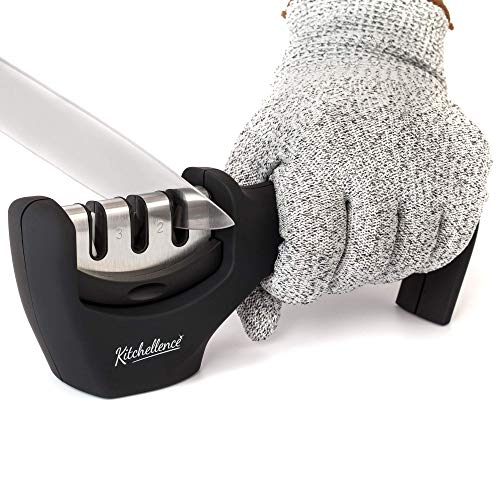
This 4-in-1 kitchen tool is designed to repair, restore, and polish knife edges through a three-stage process. It also includes a cut-resistant glove, which adds a useful safety layer for new users. A staged system can feel less confusing because each slot has a clear task. The compact body should fit well beside other everyday kitchen tools.
The main concern is material compatibility. Many low-cost three-stage sharpeners are made with slots intended for standard steel knives, and a ceramic blade needs a suitable diamond abrasive. The sharpening stages may be useful for steel, but I would not assume that every slot can safely sharpen zirconia ceramic. Before using it on an expensive ceramic knife, confirm the abrasive material and instructions.
Pros:
- Three stages give a clear sharpening sequence
- Included glove adds practical hand protection
- Compact design suits small kitchens
- Simple slots are easy for beginners to understand
- Can restore many common steel kitchen knives
- Usually needs only a stable counter and light pressure
Cons:
- May not contain the diamond abrasive needed for ceramic blades
- Fixed slots offer less angle flexibility
- Coarse stages can remove too much material if used often
My Recommendation
I recommend this tool for budget-minded cooks who mainly use stainless steel kitchen knives and want a simple all-in-one station. The glove is a thoughtful extra for people who are new to sharpening. It is not my leading choice for a ceramic knife unless the product instructions clearly confirm ceramic compatibility. For a ceramic owner, a diamond-guided sharpener offers a safer and more direct path to the best knife sharpener for ceramic knives.
Narcissus Electric Diamond Sharpener

The Narcissus electric knife sharpener uses diamond abrasives and is listed for both stainless steel and ceramic knives. It also includes a scissors sharpening function and a metal dust collection box. The electric format can save time when a blade needs more than a light touch-up. For busy cooks, the promise of quick sharpening and polishing is appealing.
Electric sharpeners need a calm, measured approach, especially with brittle ceramic. I would use short passes, low pressure, and only the number of passes stated in the manual. The dust box may help keep the work area cleaner, but it does not remove the need to wipe and inspect the blade. Angle control, motor speed, and replacement abrasive availability are worth checking before purchase.
Pros:
- Diamond abrasives are suitable for hard ceramic material
- Electric operation reduces manual effort
- Designed for ceramic and steel knives
- Separate scissors function adds versatility
- Dust collection box helps contain metal filings
- Fast format suits busy home kitchens
Cons:
- Electric speed can remove material too quickly
- Motor noise may bother users in quiet homes
- Power-based sharpening needs careful pressure control
- Replacement parts and abrasive life should be confirmed
My Recommendation
The Narcissus is best for cooks who want an electric best knife sharpener for ceramic knives and value speed over hands-on control. It can make sense for a household with several dull knives, scissors, and little time for manual sharpening. I would choose it over a basic steel-slot sharpener because it uses diamond abrasives and lists ceramic compatibility. Its value depends on careful use and the long-term availability of replacement components.
Work Sharp Ceramic Honing Rod

The Work Sharp Kitchen Ceramic Honing Rod is built for chef, santoku, paring, and serrated knives. Its angle-guided design can help users keep the blade in a repeatable position. That feature matters because inconsistent angle changes can create an uneven edge. The rod is also useful for routine maintenance when a steel blade starts to feel less keen but is not truly dull.
Despite the word “ceramic” in its name, this tool is not automatically the best way to sharpen a ceramic knife. It refers to the rod’s abrasive material, not necessarily the blade material it can repair. A ceramic knife usually needs a diamond abrasive to reshape its edge. I would use this Work Sharp rod for compatible steel knives, and I would select a diamond tool for a zirconia blade.
Pros:
- Angle guide helps improve sharpening consistency
- Works with several common kitchen knife shapes
- Useful for routine steel knife honing
- Manual design gives the user good control
- Does not require batteries or a power outlet
- Helpful for cooks learning basic edge care
Cons:
- Ceramic rod material may not sharpen a ceramic blade
- Not ideal for chips or major edge damage
- Serrated knives still require careful technique
My Recommendation
I suggest the Work Sharp rod for a home cook who wants angle guidance for steel chef and santoku knives. It is a practical maintenance tool, and the guided design can build confidence. I would not buy it as the only answer to a dull ceramic knife. For that task, choose a diamond sharpener, while keeping this rod for regular care of your steel blades.
RazorSharp Adjustable Angle Sharpener

The RazorSharp Knife and Scissor Sharpener offers an adjustable angle range from 14 to 24 degrees. This range gives users more choice than a fixed-angle pull-through tool. It may suit different knife styles, from thinner kitchen blades to sturdier everyday knives. The added scissor function also makes it more useful around the home.
Angle adjustment is helpful only when the abrasive matches the blade. For a ceramic knife, the tool needs a diamond surface or another abrasive rated for hard zirconia ceramic. I would inspect the manual and product details before using it on a valuable ceramic blade. If the sharpener uses a general steel abrasive, it may be better reserved for ordinary metal knives.
Pros:
- Adjustable 14- to 24-degree angle range
- Offers more flexibility than fixed-slot sharpeners
- Scissor function adds household usefulness
- Can suit different kitchen knife profiles
- Manual format gives a direct feel during use
- Angle choice helps users match maker guidance
Cons:
- Angle adjustment may feel complex for beginners
- Ceramic compatibility depends on the abrasive material
- Incorrect setting can change the original blade geometry
My Recommendation
The RazorSharp is best for a careful user who wants to adjust the edge angle rather than accept one fixed setting. It can be a useful household tool for steel knives and scissors. For ceramic knives, I would only recommend it after confirming that its abrasive is diamond and that its guide supports the knife maker’s angle. It has good flexibility, but it requires more product knowledge than a dedicated ceramic sharpener.
Shenzhen Knives 12-Inch Ceramic Rod
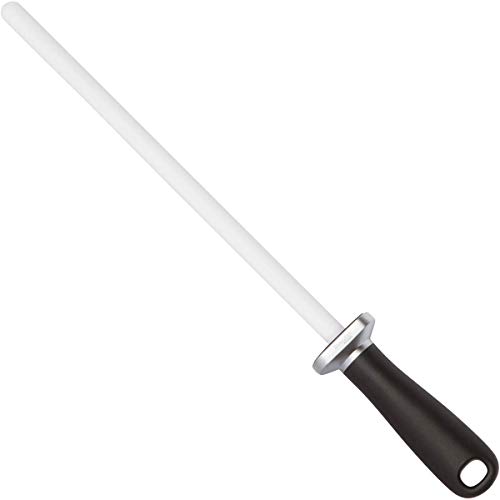
The Shenzhen Knives ceramic honing rod measures 12 inches and lists a 1000-grit surface. That extra length can help when working across a broad chef knife. The stated HRC 68 rating suggests a hard rod, although a hardness number alone does not tell you whether it can sharpen a ceramic blade. Its simple rod shape appeals to cooks who prefer traditional hand sharpening.
This product makes the difference between honing and sharpening especially important. A ceramic rod can realign or lightly refine some steel edges, but ceramic knives do not bend and realign like steel knives. Their worn edge needs material removed, which calls for an abrasive such as diamond. Therefore, I would treat this rod as a steel-knife maintenance tool rather than a primary ceramic sharpener.
Pros:
- 12-inch length covers large kitchen knives well
- 1000-grit surface supports light edge refinement
- Simple rod design is easy to store
- Manual use provides good feedback and control
- No motor, batteries, or replacement power parts
- Useful for cooks who already know freehand technique
Cons:
- Not a strong match for repairing dull ceramic blades
- Freehand angle control takes practice
- Long rod may feel awkward for small knives
My Recommendation
I recommend this rod for experienced cooks who maintain steel knives by hand. The 12-inch length is helpful for long blades, and the fine surface can support regular touch-ups. It is not my choice for someone specifically seeking the best knife sharpener for ceramic knives. If your collection includes ceramic knives, use a diamond sharpener for those blades and keep this rod for steel maintenance.
4-Rod Ceramic Sharpener Box

The 4-Rod Ceramic Sharpener Box is a multi-rod tool for kitchen knives and cutlery. Multiple rods can provide different contact points or sharpening choices, depending on the design. The box format may help keep the rods organized and can offer a stable base during use. It is an appealing option for cooks who like a traditional sharpening station rather than a motorized unit.
Still, a multi-rod system does not automatically equal ceramic knife compatibility. Most ceramic rods are better at refining steel edges than cutting a hard ceramic blade. I would check whether any rod uses diamond abrasive before placing a zirconia knife against it. If not, this set may serve steel cutlery well but should not be called the best knife sharpener for ceramic knives.
Pros:
- Four-rod design offers more setup choices
- Organized box keeps the sharpening tools together
- Manual operation stays quiet and simple
- Useful for routine kitchen cutlery maintenance
- Stable format may feel safer than a loose rod
- No electrical parts or batteries to replace
Cons:
- Ceramic rods may not cut a dull ceramic knife
- Multiple options can confuse first-time users
- Requires checking each rod’s abrasive purpose
My Recommendation
This rod box suits a cook who owns several steel knives and wants an organized manual sharpening kit. It may also appeal to someone who enjoys learning traditional sharpening methods. I would not choose it for a ceramic-only kitchen unless the listing confirms a diamond rod or ceramic-blade rating. Its value is better for broad cutlery care than for repairing a chipped ceramic edge.
KYOCERA Manual Diamond Sharpener

The KYOCERA Manual Knife Sharpener uses a diamond wheel and is designed for ceramic and steel knives. That makes it one of the most direct matches in this group for ceramic knife owners. The manual wheel format lets you sharpen without a motor, while the brand’s focus on ceramic cutlery adds useful product context. It is a compact choice for routine home use.
I like the material match, but I would still use a light hand and follow the instructions closely. Ceramic blades are hard, yet they can chip if the user pushes, twists, or drops them. A manual wheel can be easier to control than a fast electric unit, but it may not fix a large chip or badly damaged edge. For small dull spots and normal wear, this is a sensible specialist option.
Pros:
- Diamond wheel is made for hard ceramic material
- Listed for both ceramic and steel knives
- Manual design provides slower, more controlled action
- Compact body fits easily in a kitchen drawer
- Strong brand relevance for ceramic cutlery
- Does not need an outlet, batteries, or motor care
Cons:
- Manual sharpening may take more time than electric use
- Not intended for severe chips or broken tips
- Users must avoid excess pressure on brittle ceramic
My Recommendation
The KYOCERA is my top pick for most home cooks who want the best knife sharpener for ceramic knives. Its diamond wheel matches the hard blade material, and its manual design gives better control than a fast motor. It is best for routine edge restoration on compatible ceramic and steel knives, not major damage. Among these options, it offers the clearest balance of ceramic compatibility, ease, compact storage, and practical value.
Best For Comparison
| Best for | Why |
|---|---|
| Most ceramic knife owners | KYOCERA uses a diamond wheel and is listed for ceramic and steel knives. |
| Beginners who want angle help | AIERLIAN combines diamond abrasion with guided 15- and 20-degree settings. |
| Fast sharpening for several tools | Narcissus offers electric diamond sharpening plus a scissors function. |
How to Choose the Best Knife Sharpener for Ceramic Knives
Start with the abrasive. Ceramic knives are made from very hard zirconia material, so a normal steel sharpener may slide across the edge without doing useful work. Diamond is the safest general choice because it can cut hard ceramic more effectively. A product that only says “ceramic sharpener” may describe a ceramic abrasive rod, not a sharpener designed to repair ceramic blades.
Next, check the angle. Many kitchen knives use an edge near 15 to 20 degrees per side, but the correct angle depends on the knife maker and model. A guided sharpener can help a new user avoid large angle changes. If the instructions do not list an angle, use caution rather than guessing on an expensive blade.
Think about how dull the knife is. A slightly tired edge needs less work than a chipped or rounded edge. Manual diamond wheels suit small repairs and routine home care. An electric diamond machine may save time, but it can remove material quickly and demands light pressure. Large chips, broken tips, and deep damage may need professional service.
Finally, consider control and cleanup. A rod is quiet but needs a steady hand. A rolling sharpener guides the angle but still needs a flat work surface. An electric model is quick but produces noise and abrasive dust. The best knife sharpener for ceramic knives is the one that matches your skill, blade condition, and willingness to use slow, careful strokes.
How I Evaluate Ceramic Knife Sharpeners
I look at four main points when comparing these products: abrasive type, angle control, blade compatibility, and user safety. Diamond earns extra attention because hard ceramic needs a material that can actually remove a small amount of ceramic. I also separate honing from sharpening, since a honing rod may help steel but cannot restore a worn ceramic edge in the same way.
I also review the daily experience. A sharpener should sit firmly, feel predictable, and let the user see what each stage does. I favor tools that explain their purpose clearly because vague instructions can lead to excess pressure or too many passes. In this category, honest limits matter as much as strong features.
Safe Use Tips for Ceramic Knife Sharpeners
Read the knife and sharpener instructions first. Clean and dry the blade before sharpening. Place a manual sharpener on a solid counter, keep your fingers behind the guard, and move slowly. Never force a ceramic blade through a slot or twist it while the abrasive touches the edge.
Use the fewest passes needed. Wipe away dust with a soft cloth and inspect the edge under good light. Do not use a newly sharpened knife on glass, stone, or a hard plate because those surfaces can damage the edge. Store ceramic knives in a block, sheath, or protected drawer so the blade does not strike other tools.
Remember that ceramic knives do not need frequent sharpening. Their edges can stay keen for a long time when used on a suitable cutting board. A diamond sharpener is useful when the blade begins to drag, but sharpening too often can shorten the knife’s useful life.
FAQs Of best knife sharpener for ceramic knives
Can I sharpen a ceramic knife with a regular knife sharpener?
Usually, no. Many regular sharpeners use steel or abrasives made for softer metal blades. Choose a sharpener that clearly lists diamond abrasive and ceramic knife compatibility.
Is a ceramic honing rod the best sharpener for a ceramic knife?
Not usually. A ceramic rod often maintains steel knives, but a ceramic blade normally needs diamond abrasion to remove worn material. Always check the product instructions before use.
Can an electric sharpener damage a ceramic knife?
It can if the user applies heavy pressure, uses too many passes, or chooses the wrong slot. Use an electric model made for ceramic knives and follow its pass limits carefully.
What angle should I use for a ceramic knife?
Use the angle recommended by the knife maker. If no angle appears in the instructions, contact the manufacturer before sharpening an expensive blade.
How often should I sharpen a ceramic knife?
Sharpen it only when the edge feels dull during normal cutting. Ceramic knives usually need less frequent sharpening than many steel knives, especially when used on wood or soft plastic boards.
Final Verdict: Which Should You Buy?
For most home cooks, the KYOCERA Manual Diamond Sharpener is the best knife sharpener for ceramic knives. It uses a diamond wheel, supports ceramic and steel blades, and offers controlled manual use.
Choose AIERLIAN for guided angles or Narcissus for speed. Whichever you buy, match the abrasive to the blade and sharpen with light pressure for a clean, lasting edge.