
The best knife sharpener for expensive knives offers precise angle control, gentle abrasives, and repeatable results without damage.
A dull premium knife can feel frustrating and unsafe. You may own a fine Japanese gyuto, a costly German chef’s knife, or a favorite pocket knife, yet worry that the wrong sharpener could scratch the blade or remove too much steel. I understand that concern. In this guide, I compare popular manual, electric, rolling, and guided systems to help you find the best knife sharpener for expensive knives. I focus on angle control, abrasive quality, ease of use, safety, and long-term value.
4-in-1 Kitchen Knife Sharpener
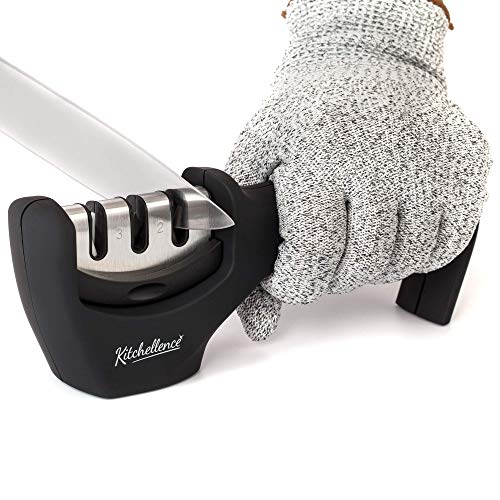
This 4-in-1 kitchen sharpener gives home cooks several basic tools in one compact set. Its three-stage design aims to repair, sharpen, and polish a dull edge. The included cut-resistant glove adds a useful safety layer, especially for new users. I see it as a simple entry point for people who want a low-cost way to maintain common kitchen knives.
The key point is control. Pull the knife through each stage with light pressure and steady motion rather than forcing the blade. The coarse stage can help restore a neglected edge, while the finer stage can smooth it for cleaner cuts. Still, I would use extra care on a thin, hard, or highly polished premium blade because pull-through sharpeners may remove more metal than a guided system.
Pros:
- Three sharpening stages for repair, sharpening, and polishing
- Includes a cut-resistant glove for added hand protection
- Compact size suits small kitchens and drawers
- Simple design helps beginners get started quickly
- Useful for routine care of standard kitchen knives
- Combines several basic accessories in one package
Cons:
- Less precise than a fixed-angle sharpening system
- May not suit very thin Japanese edges
- Can remove more steel than careful hand honing
AIERLIAN Rolling Knife Sharpener

The AIERLIAN rolling knife sharpener takes a different approach from a standard pull-through tool. You place the knife on a stable surface and roll the abrasive wheel along the blade. Its magnetic angle design offers 15- and 20-degree settings, which cover many common Western and Asian kitchen knives. That guided movement can feel more natural to users who want visible control over the sharpening path.
The diamond and ceramic surfaces serve different jobs. The diamond side can restore a worn edge, while the ceramic side can refine and polish it. A magnetic guide helps keep the angle more consistent, but it does not replace good technique. I would keep the knife flat, use light pressure, and make even passes from heel to tip.
For many cooks, this is a strong candidate for the best knife sharpener for expensive knives when they want manual control without learning a full whetstone system. It is less aggressive than a careless electric sharpener, yet faster to learn than freehand stone work. I would still confirm the blade angle before use, since a knife with a custom bevel may need a different setting.
Pros:
- Offers two common angle choices for kitchen knives
- Rolling motion is easy to understand and repeat
- Diamond and ceramic surfaces support repair and refinement
- Works with many types of steel
- Manual design avoids motor heat and high-speed abrasion
- Can give users more visual control than a slot sharpener
Cons:
- Requires a flat, stable work surface
- May not match unusual factory or custom bevels
- Needs practice to keep each pass smooth
AccuSharp Ergonomic Knife Sharpener

The AccuSharp is built for speed and ease. Its ergonomic handle gives the user a firm grip, and the compact body stores easily in a kitchen drawer. The sharpener is designed for straight and serrated knives, which makes it more flexible than many basic manual tools. It can restore a working edge in a short time when a knife has become noticeably dull.
I like the simple learning curve, but I would not treat this as a precision restoration system for a rare or very thin blade. The tool is better suited to everyday knives that need quick maintenance. On a valuable knife, I would use gentle passes and stop as soon as the edge improves rather than repeating the motion many times.
This model can be the best knife sharpener for expensive knives for an owner who values compact storage and quick touch-ups more than fine angle adjustment. It also makes sense as a backup tool for a vacation home, camper, or busy family kitchen. The low-effort design is convenient, but premium blades deserve slower and more careful handling.
Pros:
- Comfortable handle supports a secure grip
- Compact body stores almost anywhere
- Simple operation suits first-time users
- Can sharpen straight and serrated knives
- Useful for quick edge touch-ups
- Does not require electricity or setup time
Cons:
- Offers limited angle customization
- Not the best choice for delicate custom edges
- Fast pull-through use may remove excess metal
Chef’sChoice 15XV EdgeSelect Sharpener
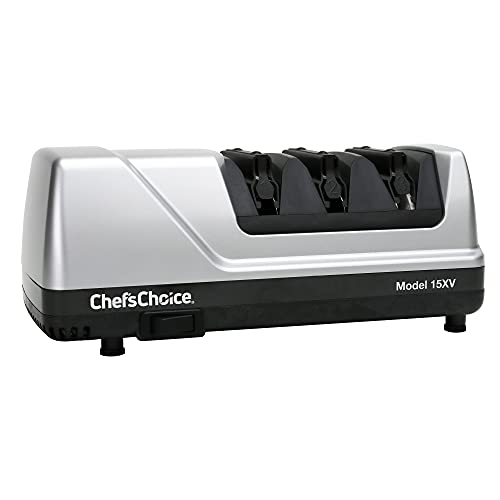
The Chef’sChoice 15XV EdgeSelect is one of the more serious electric options in this group. It uses a three-stage process with diamond abrasives and guided angle control. The 15-degree format is made for creating a sharper, narrower edge on many Asian-style and converted Western knives. It also supports straight and serrated blades, which adds useful range.
Stage one forms or repairs the edge, stage two refines it, and stage three polishes and helps create a smooth cutting feel. The guides reduce guesswork, which can help users who do not want to manage a whetstone. I recommend short passes, light pressure, and careful attention to the manufacturer’s instructions.
Among the listed models, this is one of my strongest candidates for the best knife sharpener for expensive knives when speed and repeatability matter. However, electric power does not mean careless use is safe. A premium blade still needs the correct stage, a clean slot, and a limited number of passes.
Pros:
- Three-stage system covers repair, sharpening, and polishing
- Diamond abrasives can work on many steel types
- Guides help maintain a repeatable sharpening angle
- Handles both straight and serrated knives
- Fast results suit busy home cooks
- Creates a refined edge when used with care
Cons:
- Higher price than simple manual sharpeners
- Electric action can remove metal quickly
- 15-degree design may not suit every blade
Narcissus Two-Stage Electric Sharpener
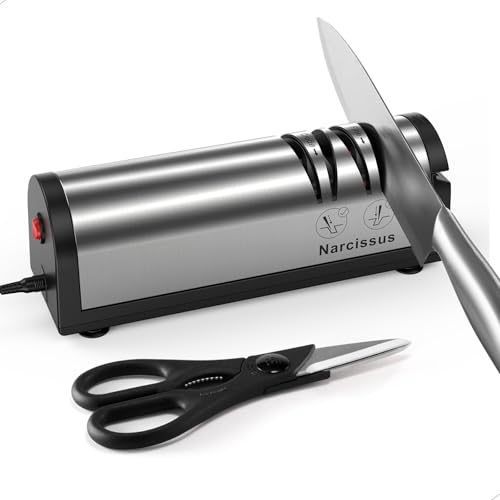
The Narcissus electric sharpener focuses on quick sharpening and polishing in a two-stage body. Its stainless-steel look gives it a neat place on a countertop, while the dust collection box helps contain some of the fine debris produced during sharpening. It also includes a scissors sharpening function, which adds value for homes with several cutting tools.
A two-stage system is easy to understand. The first stage works on a dull edge, and the second stage smooths the result. This simple layout can reduce mistakes for new users, but I would still avoid repeated passes on an expensive knife. Let the abrasive do the work and inspect the edge after each short cycle.
I would consider this a practical choice for someone who wants the best knife sharpener for expensive knives but also needs to maintain everyday scissors and kitchen blades. It is convenient and fast, though a guided manual system may offer better control for a rare handmade knife. Always check the supported blade size and angle before starting.
Pros:
- Two-stage process is simple for new users
- Electric operation saves time and effort
- Includes a polishing stage for a smoother edge
- Scissors slot adds useful household function
- Dust collection box helps keep the work area cleaner
- Stainless-steel body fits many kitchen counters
Cons:
- Less angle flexibility than a guided system
- Motorized sharpening needs careful timing
- May be too aggressive for very thin blades
Presto 08800 EverSharp Electric Sharpener
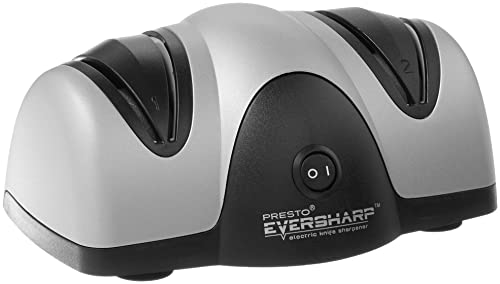
The Presto 08800 EverSharp is a familiar two-stage electric sharpener aimed at everyday kitchen use. Its compact shape takes up little space, and its guided slots make the sharpening process easy to follow. The first stage restores a dull edge, while the second stage helps finish it. For regular household knives, that straightforward design can be very useful.
The main advantage is convenience. I can see this model working well for a home cook who wants a sharp edge without studying stone angles or buying several accessories. Still, I would use it with restraint on costly knives because a powered abrasive can take away steel faster than a careful stone or ceramic rod.
This model may be the best knife sharpener for expensive knives only when the user understands its limits and the blade suits its guides. It is a better match for robust chef’s knives than fragile, narrow, or unusually shaped blades. It offers good everyday value, but I would choose a more adjustable system for high-end knife collecting.
Pros:
- Compact design fits small kitchens
- Two-stage operation is easy to learn
- Electric motor reduces hand effort
- Guided slots help keep the blade positioned
- Works well for routine household maintenance
- Usually costs less than advanced professional systems
Cons:
- Limited angle adjustment
- Not ideal for custom or delicate knife edges
- Requires a power outlet near the work area
SHARPAL 191H Knife and Scissors Sharpener

The SHARPAL 191H is a small multi-purpose sharpener for knives and scissors. Its compact form makes it easy to keep in a drawer, toolbox, or travel kit. It is made for users who want basic sharpening help without a large machine. The design can suit routine touch-ups on common blades.
Its size is both its strength and its limit. A small tool is easy to store, but it gives less room for detailed angle work than a larger guided system. I would use it for simple maintenance and reserve a precision sharpener for a valuable chef’s knife with a known bevel.
This is a sensible budget option for someone seeking the best knife sharpener for expensive knives as a secondary tool rather than a main restoration system. It can help keep household blades useful between professional sharpenings. Use light pressure and check the edge often to avoid unnecessary abrasion.
Pros:
- Very compact and easy to store
- Supports knife and scissors maintenance
- Useful for quick touch-ups
- Simple design needs little setup
- Convenient for travel or a secondary kitchen
- Usually offers an affordable entry price
Cons:
- Limited precision for premium knife edges
- Small body may feel less stable to some users
- Not designed for advanced bevel work
2026 New Three-Stage Electric Sharpener

This newer three-stage electric sharpener is designed around quick sharpening and polishing. The product description highlights 100 percent diamond abrasives, a 20-degree precision angle, and a non-slip base. Those features target common needs in a busy kitchen: speed, stability, and a clear sharpening path. The black and orange body also makes it easy to spot on a crowded counter.
The three stages should be used in order only when the knife needs that level of work. A repair stage is not necessary for every small dull spot, and repeated use can shorten blade life. I would begin with the least aggressive suitable stage, make a few controlled passes, and test the edge with paper or a soft food item.
For users who prefer electric tools, this can be the best knife sharpener for expensive knives when the 20-degree angle matches the blade. It may be especially helpful for standard Western kitchen knives. I would not assume that every premium knife uses 20 degrees, so angle fit remains the most important check before purchase.
Pros:
- Three stages support repair, sharpening, and polishing
- Diamond abrasives are suited to many knife steels
- 20-degree guides match many common kitchen knives
- Non-slip base helps improve countertop stability
- Electric design provides fast results
- Useful for cooks who prefer an automatic process
Cons:
- Fixed 20-degree format may not suit every premium blade
- Powered stages can remove steel quickly
- Long-term performance depends on abrasive wear and care
5 Precision Adjust Knife Sharpener
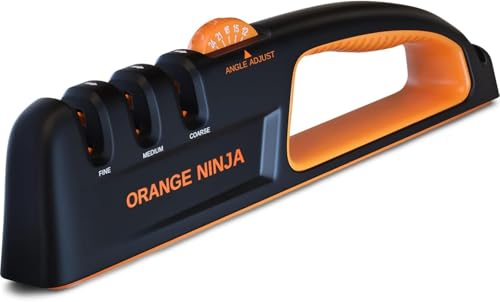
The 5 Precision Adjust sharpener uses a guided format instead of a motor. A clamp holds the knife while the abrasive assembly moves along the edge at a set angle. Its three-stage design aims to sharpen and refine the blade with a more measured process. This style can appeal to owners who want more control than a slot sharpener provides.
Guided sharpening takes more time, but that extra time can protect a valuable blade. I can set the angle, use light pressure, and work through the edge in a repeatable way. The clamp and frame still require careful setup, and I would make sure the knife sits securely before each pass.
This system is a strong candidate for the best knife sharpener for expensive knives for a careful home user who enjoys hands-on maintenance. It can also help someone learn how bevel angle changes cutting feel. The trade-off is speed: it does not offer the instant results of an electric model, but it gives the user a better view of the work.
Pros:
- Guided design offers more control than pull-through tools
- Three stages help refine the edge in steps
- Manual action reduces the risk of motor heat
- Useful for users learning angle-based sharpening
- Can support careful work on valuable blades
- Compact compared with many full sharpening systems
Cons:
- Requires more setup and practice
- Sharpening takes longer than electric methods
- Small clamps may not fit every blade shape
Work Sharp Precision Adjust Elite

The Work Sharp Precision Adjust Elite is the most complete guided system in this comparison. It is made for kitchen knives, pocket knives, and other blades that benefit from a controlled angle. The fixed-angle frame helps reduce hand movement, while the abrasive progression gives the user more ways to shape and refine an edge. This is a tool for people who care about repeatable results.
The Elite format rewards patience. I would begin by checking the existing bevel, secure the knife, and use the lowest abrasive level that solves the problem. A smooth burr removal step matters as much as the initial sharpening pass. When used well, a guided system can help preserve the blade shape and avoid the uneven bevels that freehand beginners sometimes create.
For me, this is the best knife sharpener for expensive knives among the listed options when precision matters most. It suits collectors, serious home cooks, and owners of costly pocket knives. It has a learning curve and takes longer than a pull-through tool, but that is a fair trade for control, adjustability, and a careful approach to premium steel.
Pros:
- Fixed-angle design supports repeatable results
- Suitable for kitchen and pocket knives
- Elite kit offers a broader sharpening progression
- Manual process gives strong control over material removal
- Helps users learn proper bevel and burr management
- Good fit for expensive or personally important blades
Cons:
- Costs more than basic manual sharpeners
- Requires setup, patience, and practice
- May not accommodate every extra-long or unusual blade
My Recommendation
After comparing these sharpeners, I would choose the Work Sharp Precision Adjust Elite for owners who want the best knife sharpener for expensive knives and are willing to learn a careful process. Its guided angle system gives better control than most pull-through models, and its manual action helps limit unnecessary steel removal. The Chef’sChoice 15XV is my electric pick for speed, especially when the knife suits a 15-degree edge.
The AIERLIAN rolling sharpener is a nice middle ground. It offers a guided feel without the cost or complexity of a larger kit. The basic AccuSharp, SHARPAL, and Presto models make more sense for everyday knives or quick maintenance. Before buying, match the sharpener angle to the knife, read the care guide, and avoid using a coarse stage when a fine touch-up is enough.
| Best for | Why |
|---|---|
| Best overall precision | Work Sharp Precision Adjust Elite offers guided control and a broad sharpening system. |
| Best electric choice | Chef’sChoice 15XV provides fast, repeatable sharpening with diamond abrasives. |
| Best simple manual option | AIERLIAN uses a rolling design with 15- and 20-degree magnetic guidance. |
A sharp knife should cut with little force. If you need to push hard, saw through food, or notice a rough edge, it is time to maintain the blade. However, sharpness is only one part of good knife care. Washing by hand, drying the blade soon after use, using a proper cutting board, and storing the knife safely can help preserve both the edge and the steel.
Angle is also important. Many Western knives use an edge near 20 degrees per side, while some Japanese-style knives use a narrower angle. These are general guides, not universal rules. The manufacturer’s instructions should take priority, especially for specialty knives, single-bevel blades, serrated edges, and hard powder steels.
Abrasive type matters too. Diamond cuts hard steel quickly, ceramic refines an existing edge, and a coarse surface repairs damage. More abrasion is not always better. When I sharpen an expensive knife, I start with the finest suitable stage and use the fewest passes needed to restore clean cutting.
Safety deserves equal attention. Keep fingers away from the edge, secure the sharpener, and follow the direction required by the tool. Do not test sharpness with a thumb. A small paper test or careful slice through a soft food item gives a safer answer.
FAQs Of best knife sharpener for expensive knives
What is the best knife sharpener for expensive knives?
The Work Sharp Precision Adjust Elite is my top pick for precision and control. Its guided system helps users keep a consistent angle and limit unnecessary metal removal. The best match still depends on the knife’s bevel, steel, and edge style.
Are electric sharpeners safe for premium knives?
They can be safe when the angle matches the blade and the user follows the instructions. Electric models remove material quickly, so use light pressure and limited passes. For rare or thin knives, a guided manual sharpener often gives more control.
Is a 15-degree or 20-degree sharpener better?
Neither angle is always better. A 15-degree edge may suit many Asian-style knives, while 20 degrees works well for many Western kitchen knives. Check the knife maker’s recommended angle before sharpening.
Can I use a pull-through sharpener on a Japanese knife?
Some pull-through tools may work, but caution is wise. Thin Japanese blades can lose metal quickly or develop an unsuitable bevel. A guided system or quality whetstone usually offers better control for premium Japanese knives.
How often should I sharpen an expensive kitchen knife?
Sharpening frequency depends on use, steel, board type, and cutting habits. Many home cooks need true sharpening only a few times per year. A honing or ceramic maintenance step can help between full sharpening sessions.
Final Verdict: Which Should You Buy?
The Work Sharp Precision Adjust Elite is the best knife sharpener for expensive knives when control matters most. Choose the Chef’sChoice 15XV if you want fast electric results and your blade suits its angle.
For a safer long-term edge, match the angle, use light pressure, and sharpen only as much as needed. The right tool can protect your investment and make every cut feel smooth again.