
The best knife sharpener for fillet knives restores a fine edge without bending or damaging the flexible blade.
A dull fillet knife can turn a smooth fish-cleaning job into a slow, messy chore. The right sharpener helps the blade glide through skin, meat, and small bones with less force. I looked at angle control, abrasive type, portability, safety, and ease of use. These picks cover quick touch-ups, field work, full edge repair, and careful sharpening for thin fishing blades.
Smith’s CCKS 2-Step Knife Sharpener

Smith’s CCKS is a small, simple sharpener made for quick edge care. It uses preset coarse and fine slots, so I do not need to guess the sharpening angle. The compact body fits well in a tackle box, hunting pack, or kitchen drawer. Its bright yellow color also makes it easy to spot when I am working outdoors.
The coarse slot helps bring back a tired edge, while the fine slot smooths the working edge for cleaner cuts. I find it most useful for routine touch-ups rather than major blade repair. The preset angle works well for many outdoor and fishing knives, but I still use a light hand on thin fillet blades. For anglers who want a fast tool at a low cost, this is a practical option.
Pros:
- Very compact and easy to carry
- Coarse and fine slots handle basic edge care
- Preset angle makes use simple for beginners
- Bright body is easy to find outdoors
- Useful for fishing, pocket, and fillet knives
- Does not need batteries or a power cord
Cons:
- Preset slots offer little angle control
- Not ideal for heavy edge damage
- Can remove more metal than a fine stone if pressed hard
My Recommendation
I recommend the Smith’s CCKS for anglers who want a basic backup sharpener at the dock or on a boat. It is also a good choice for anyone who values speed over fine control. As the best knife sharpener for fillet knives on a tight budget, it offers simple results with little learning time. Use gentle passes and stop as soon as the edge feels crisp.
5 Precision Adjust 3-Stage Sharpener
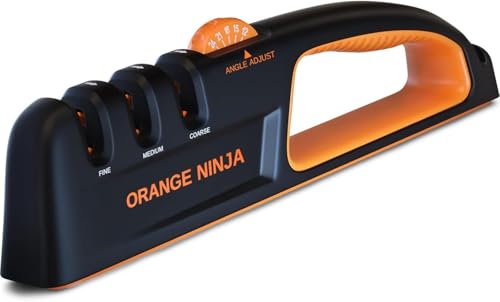
The 5 Precision Adjust sharpener is built for users who want more control than a pull-through tool can offer. Its guided system helps keep the blade at a steady angle during each pass. A three-stage process supports sharpening, refining, and polishing. That staged approach matters when a flexible fillet knife needs a smooth, clean edge.
I like this style of sharpener for home use because it slows the process down in a helpful way. It gives me a better chance to match both sides of the edge instead of rushing through the job. The guided design can also help new users build good habits. It takes more setup than a pocket sharpener, but the added control can improve the final cut.
Pros:
- Guided design helps maintain a steady angle
- Three stages support repair and finishing
- Better control than a simple pull-through sharpener
- Good choice for regular home knife care
- Can help beginners learn consistent strokes
- Useful for more than just fillet knives
Cons:
- Less portable than a compact handheld tool
- Requires more time and setup
- Users must follow the stages carefully
My Recommendation
This sharpener suits home cooks, serious anglers, and knife owners who want repeatable results. I would choose it when edge control matters more than speed. It may be the best knife sharpener for fillet knives for a user who wants to learn a careful sharpening method. Its value is strongest when you sharpen several knives often, not just one blade once a year.
RazorSharp Adjustable Angle Sharpener

RazorSharp stands out because its angle guide adjusts from 14 to 24 degrees. That range gives me more freedom to match different knife designs and edge needs. A thin fillet knife often benefits from a narrow angle, while a tougher utility knife may need a wider one. The adjustable guide makes this tool more flexible than fixed-angle models.
This sharpener can help users avoid one common mistake: changing the angle during each stroke. I still need to keep the blade steady and use light pressure, especially with a thin edge. The adjustable setting is useful, but it does not remove the need for proper technique. For someone who owns fishing knives with different edge profiles, the range can save space and money.
Pros:
- Adjustable 14-to-24-degree angle range
- Works with several knife styles
- Helps users keep a more steady edge angle
- Useful for thin and general-purpose blades
- Compact enough for normal kitchen storage
- Offers more control than fixed-slot tools
Cons:
- Angle adjustment may take practice
- Not the smallest option for a tackle box
- Incorrect pressure can still damage a fine edge
My Recommendation
I recommend RazorSharp for users who own more than one type of knife and want adjustable control. It is especially useful for anglers who switch between thin fillet blades and stronger camp knives. For many people, it can be the best knife sharpener for fillet knives because the angle range supports careful edge work. It offers good overall value when flexibility is a priority.
4-in-1 Knife Sharpener With Glove
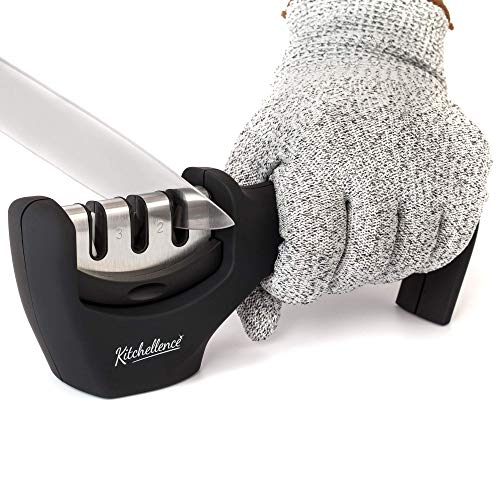
This 4-in-1 kit combines sharpening tools with a cut-resistant glove. The three-stage sharpener is designed to repair, restore, and polish a blade. That makes it useful for a fillet knife that needs more than a quick touch-up. The included glove adds a useful safety layer while I learn the correct hand position.
I see this kit as a practical starter set for a kitchen or small fishing station. It gives beginners the basic pieces needed to sharpen and work more safely. The stages are easy to understand, but I would still use short strokes and low pressure on a flexible blade. The glove is helpful, though it should never replace careful handling.
Pros:
- Includes a cut-resistant safety glove
- Three sharpening stages cover common needs
- Supports repair, restoration, and polishing
- Useful starter kit for new users
- Works for kitchen and outdoor knives
- Offers several tools in one package
Cons:
- May take up more drawer space than a single sharpener
- Glove fit may not suit every hand
- Pull-through use still needs gentle pressure
My Recommendation
This kit is best for beginners who want a sharpener and a basic safety accessory in one purchase. I also like it for shared kitchens where several people may use the tool. It could be the best knife sharpener for fillet knives for a new angler who wants a complete starting kit. Its value comes from convenience, though advanced users may prefer a more precise guided system.
AccuSharp Handheld Carbide Sharpener
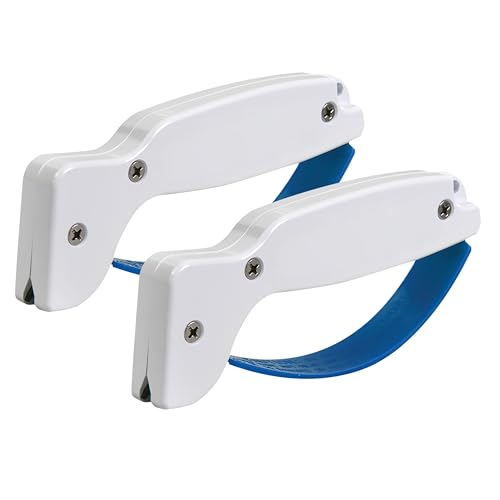
AccuSharp is a familiar handheld design that uses carbide sharpening technology. Its wide handle gives me a firm grip, which helps when I work near a sink, counter, or boat table. The tool is made for straight and some serrated knives, so it can serve more than one purpose. This two-pack also makes it useful for keeping one sharpener at home and one in a gear bag.
The carbide element can restore a dull edge with only a few passes. That speed is convenient, but I avoid pressing hard because aggressive sharpening can remove excess steel. It is better for repair and quick maintenance than for creating a highly refined edge. For a sturdy fillet knife that needs fast attention after a fishing trip, AccuSharp is easy to understand.
Pros:
- Fast handheld sharpening method
- Firm grip supports better control
- Two-pack allows home and travel use
- Can restore dull straight-edge knives
- Simple design suits beginners
- Does not require electricity or setup
Cons:
- Carbide sharpening may remove more steel
- Not the best choice for delicate finishing work
- Angle control is limited
My Recommendation
I recommend AccuSharp for anglers who need a fast fix and do not want a complex system. It works best when a knife feels dull but does not need careful bevel restoration. It may be the best knife sharpener for fillet knives for boat use, camp use, or emergency touch-ups. Keep the pressure light and consider a fine honing tool when you want a smoother final edge.
Work Sharp Guided Field Sharpener Elite

The Work Sharp Guided Field Sharpener Elite is designed for people who sharpen knives away from home. Its guided format helps keep the blade at a repeatable angle, while the compact case supports clean storage. I like this type of tool for fishing trips, hunting camps, and outdoor work. It gives more sharpening control than a tiny pull-through tool without needing power.
A field sharpener can be valuable when a knife must work all day. The guided surfaces help repair a worn edge, refine it, and maintain it between larger sharpening sessions. I still take care around the flexible tip of a fillet knife because the point can catch if I move too fast. The case is a useful detail for keeping abrasive surfaces away from wet tackle and dirt.
Pros:
- Designed for travel and outdoor use
- Guided angle support improves consistency
- Compact case helps protect the tool
- Works without batteries or electricity
- Useful for fishing, hunting, and camping
- Better control than many basic pocket sharpeners
Cons:
- May feel complex for a first-time user
- Small working surfaces require patience
- Costs more than basic handheld sharpeners
My Recommendation
This is a strong choice for anglers who spend time in the field and still want careful edge maintenance. I would choose it for a tackle box when a basic slot sharpener feels too rough or limited. It can be the best knife sharpener for fillet knives for serious outdoor users who value guided control. Its overall value is high if you sharpen more than one outdoor blade during each trip.
AIERLIAN Rolling Knife Sharpener

The AIERLIAN rolling sharpener uses a magnetic angle system with 15- and 20-degree settings. Its rolling design lets the abrasive move along the blade while the knife stays in contact with the guide. Diamond and ceramic surfaces support both sharpening and finishing. This approach can feel natural for users who want a visual way to control the blade angle.
I find rolling systems most useful on a stable table with a clean, dry surface. The magnetic guide can help hold the knife, but I still check that the blade sits correctly before each pass. A thin fillet knife needs extra care because its flexible steel may not stay perfectly flat. Used slowly, this sharpener can create a more even edge than a rushed handheld tool.
Pros:
- Rolling design is easy to understand
- Offers 15- and 20-degree angle choices
- Diamond and ceramic surfaces support two tasks
- Magnetic guide helps with positioning
- Works with many steel types
- Good for users who prefer a controlled table method
Cons:
- Needs a flat, stable work surface
- Thin flexible blades may need careful support
- Slower than a quick pull-through sharpener
My Recommendation
I recommend the AIERLIAN rolling sharpener for home users who enjoy a slower, more visible sharpening process. It is a good fit for people who want angle choices but do not want a large sharpening machine. For careful users, it may be the best knife sharpener for fillet knives when edge consistency is the main goal. It offers strong value when you have a clean table and time to work with care.
Presto EverSharp Electric Sharpener

The Presto EverSharp is an electric sharpener made for users who want fast results at home. Its powered wheels do the work at a steady pace, which can save time on several kitchen knives. The unit is simple to place on a counter and use when a knife collection needs routine care. It is more convenient than manual sharpening for people with limited hand strength.
Electric sharpeners can be helpful, but I use extra care with thin fillet knives. I guide the blade smoothly and avoid stopping in the middle of a slot. Too much pressure or too many passes may remove more metal than needed. This model is best for users who want speed and a repeatable process rather than detailed manual control.
Pros:
- Fast electric sharpening action
- Useful for sharpening several knives in one session
- Good option for users with limited hand strength
- Simple counter-top operation
- Consistent powered movement reduces manual effort
- Convenient for regular kitchen maintenance
Cons:
- Needs access to a power outlet
- Less portable than manual sharpeners
- Requires careful use on very thin fillet blades
My Recommendation
The Presto EverSharp suits home cooks who want quick sharpening with little physical effort. I would choose it for a kitchen with many standard knives and occasional fillet-knife use. It can be the best knife sharpener for fillet knives for users who value speed, but I would not use it carelessly on an ultra-thin blade. Follow the instructions and use the fewest passes needed.
danco Fishing Fillet Knife Sharpener Puck

The danco sharpening puck is made with fishing knives in mind. It has coarse and fine surfaces in a compact shape that fits well with outdoor gear. I can hold the puck in a hand or use it on a stable surface, depending on the job. Its simple form makes it useful when I need a tool that takes up almost no room.
A puck does require more practice than a guided sharpener. I need to keep the angle steady as I move the blade across the abrasive surface. The coarse side can help with a tired edge, while the fine side improves the feel of the cut. This method gives direct control, but it also means the user must protect fingers and avoid rushing.
Pros:
- Made with fishing knife care in mind
- Compact shape fits tackle boxes
- Coarse and fine surfaces support two stages
- Works without power or extra parts
- Allows direct control over the blade
- Useful for quick outdoor maintenance
Cons:
- Requires practice to hold a steady angle
- Hand use may feel less safe for beginners
- Not as simple as a guided slot sharpener
My Recommendation
I recommend the danco puck for experienced anglers who already understand basic sharpening angles. It is small, tough, and easy to carry on a fishing trip. It may be the best knife sharpener for fillet knives for users who want direct control in a compact format. Beginners should practice on an older knife before using it on a favorite fillet blade.
Dexter-Russell EZ Edge Sharpener

The Dexter-Russell EZ Edge is a handheld sharpener aimed at quick, practical knife care. Its compact body is easy to hold and store near a kitchen prep area. Dexter-Russell is known for food-service and professional knife products, so this tool fits well with working kitchens. It is a useful choice when a knife needs attention during a busy day.
I like this type of sharpener for routine maintenance because it does not require a long setup. A few controlled passes can help bring back bite to a dull edge. As with other handheld tools, I use light pressure on a flexible fillet knife and avoid repeated passes after the edge feels sharp. It is not a full replacement for precise stone work, but it is convenient for daily use.
Pros:
- Quick and simple handheld design
- Easy to store in a kitchen or work area
- Useful for routine knife maintenance
- Good fit for busy food-prep settings
- Does not require electricity
- Easy for many beginners to understand
Cons:
- Limited angle adjustment
- Not designed for detailed edge restoration
- Users must avoid heavy pressure on thin blades
My Recommendation
The Dexter-Russell EZ Edge is best for cooks, fish cleaners, and food-service users who need a fast maintenance tool. I would keep it near a prep station for small touch-ups during regular work. It can be the best knife sharpener for fillet knives when convenience and brand familiarity matter most. Its value is strongest as a maintenance tool, not as a substitute for professional sharpening.
How to Choose the Best Knife Sharpener for Fillet Knives
Choosing a sharpener for a fillet knife takes more care than choosing one for a thick chef’s knife. Fillet blades are often narrow, thin, and flexible. They can bend away from a fixed abrasive surface if you use too much force. A sharpener that works well on a heavy outdoor knife may feel too aggressive on a delicate fishing blade.
I start by checking angle control. Many fillet knives use a narrow edge angle, but the correct angle depends on the blade and maker. A guided sharpener can help new users keep both sides even. A fixed pull-through model is faster, but it gives less control. If you are unsure, check the knife maker’s care instructions before sharpening.
Choose the Right Abrasive
Diamond surfaces cut fast and can repair a dull edge. Ceramic surfaces are better for light honing and finishing. Carbide cutters work quickly, but they may remove more steel than a fine stone. For a fillet knife, I prefer the least aggressive abrasive that can solve the problem.
If the knife has a small nick, begin with a coarse surface only until the damage is gone. Then move to a finer surface. Do not keep using the coarse stage just because it feels fast. A few careful passes can protect the blade and help it last longer.
Look for Safe Handling
A sharpener should stay stable while you use it. A firm grip, non-slip base, or guided system can lower the chance of a slip. I keep my free hand behind the cutting path and wear a cut-resistant glove when the design calls for one. I also dry the knife before sharpening because water, scales, and fish residue can make handling harder.
Manual or Electric?
Manual sharpeners are portable and give the user more control over speed. They work well on a boat, at a camp, or beside a fish-cleaning table. Electric models save time and hand effort, but they need a power source and careful blade movement. For thin fillet knives, manual tools are often easier to control.
How Often Should You Sharpen a Fillet Knife?
Sharpening frequency depends on use, steel, cutting surface, and cleaning habits. A knife used every weekend may need a light touch-up after several trips. A knife used on a hard table, bone, or shell may need attention sooner. I test the edge on a clean piece of paper or a soft food item rather than dragging a finger across it.
Regular light maintenance is better than waiting until the blade becomes very dull. A badly dull knife needs more abrasive work and can lose more metal. After cleaning and drying the knife, store it in a sheath or safe block. Good storage protects the edge between trips.
Best Uses at a Glance
| Best for | Why |
|---|---|
| Best budget and boat pick | Smith’s CCKS is small, simple, and easy to carry. |
| Best for angle control | RazorSharp and the guided Work Sharp help keep sharpening consistent. |
| Best for fast home use | Presto EverSharp saves time when several knives need care. |
FAQs Of best knife sharpener for fillet knives
What is the best knife sharpener for fillet knives?
The best choice depends on your skill and use. I prefer a guided manual sharpener for careful control, while an angler may prefer a compact Smith’s or danco tool. A good model should use light pressure and support a narrow, even edge.
Can I use a pull-through sharpener on a fillet knife?
Yes, but use care. Pull-through sharpeners can work for quick maintenance, yet some remove steel quickly. Keep the knife straight, use gentle passes, and stop when the edge returns.
What angle should I use for a fillet knife?
Many fillet knives use a narrow angle, but the correct setting varies by model. Check the maker’s guidance when possible. If no guidance exists, start with a controlled, moderate setting rather than an aggressive angle.
Are electric sharpeners safe for fillet knives?
They can be safe when used as directed. Move the blade smoothly, avoid heavy pressure, and do not make extra passes. Manual guided sharpeners often give more control over very thin flexible blades.
Should I sharpen a fillet knife or hone it?
Honing realigns a slightly bent edge, while sharpening removes a small amount of steel to create a new edge. Use honing for light maintenance and sharpening when the knife no longer cuts cleanly after honing.
Final Verdict: Which Should You Buy?
For most anglers, I recommend the Work Sharp Guided Field Sharpener Elite for its balance of control, portability, and edge care. For quick low-cost touch-ups, Smith’s CCKS is easier to carry. The best knife sharpener for fillet knives is the one that matches your skill, blade, and work setting.
Use light pressure, keep the angle steady, and store the knife safely after cleaning. A small amount of regular care can keep a fillet knife smooth, safe, and ready for the next catch.