
The best manual knife sharpener restores a dull edge fast, safely, and without the cost of an electric machine.
A dull kitchen knife can turn a simple tomato into a crushed mess and make meal prep feel like hard work. I know that frustration, especially when the knife slips instead of cutting cleanly. The best manual knife sharpener gives you a simple way to repair, refine, and maintain your blades at home. I compared angle control, abrasive type, grip, safety, versatility, and ease of use to help you choose a sharpener that fits your kitchen, skill level, and budget.
4-in-1 Kitchen Knife Sharpener
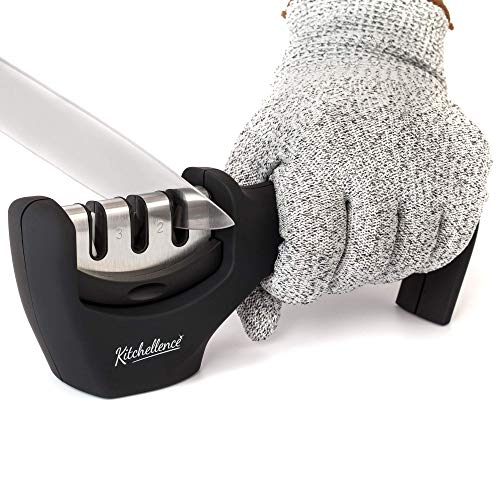
This 4-in-1 manual knife sharpener is made for home cooks who want more than a basic pull-through tool. Its three sharpening stages let you repair a rough edge, restore a dull blade, and polish the cutting surface. The included cut-resistant glove adds a useful layer of protection during sharpening. Its black body also looks neat beside most kitchen tools.
I like the broad purpose of this model because it can handle routine blade care without asking you to learn complex stone work. Use light pressure and steady passes for the best result. The stages make it easier to move from repair to finish in a controlled way. Still, this type of sharpener works best on common kitchen knives rather than expensive handmade blades that need exact custom angles.
Pros:
- Three sharpening stages for repair, sharpening, and polishing
- Includes a cut-resistant glove for added hand protection
- Simple pull-through design for new users
- Useful for routine home kitchen maintenance
- Compact size fits easily in a drawer
- Helpful value for shoppers who want several functions
Cons:
- May not suit premium knives with special edge angles
- Requires steady pressure for an even result
- The glove may not fit every hand equally well
Chef’sChoice 2-Stage Manual Sharpener
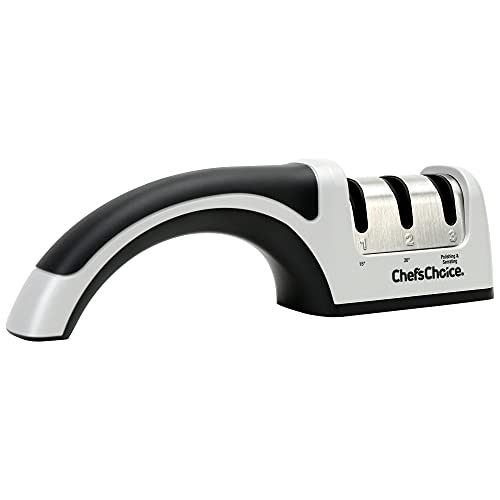
Chef’sChoice designed this two-stage sharpener for both 15-degree and 20-degree knife edges. That angle choice matters because modern thin blades often use a narrower angle, while many traditional American and European knives use a wider one. Diamond abrasives help remove metal and shape the edge with less effort than a simple steel rod. The compact gray housing takes little room on a counter.
This is one of the strongest choices for cooks who want clear angle guidance without using a whetstone. It also supports straight-edge and serrated knives, although serrated blades require careful use in the correct slot. I appreciate the stable layout because it helps reduce guesswork. The main trade-off is that the unit does not offer the many extra accessories found in larger multi-stage kits.
Pros:
- Supports both 15-degree and 20-degree knife edges
- Diamond abrasives sharpen efficiently
- Works with straight-edge and serrated knives
- Compact footprint suits small kitchens
- Guided slots help improve sharpening consistency
- Strong option for mixed knife collections
Cons:
- Costs more than many basic pull-through sharpeners
- Users must choose the correct angle slot
- It does not include a storage case or glove
RazorSharp Adjustable Angle Sharpener

The RazorSharp stands out because its angle guide adjusts from 14 to 24 degrees. That range gives you more control than a fixed-slot model. You can use a lower setting for a fine, precise edge or a wider setting for a tougher working edge. The design also supports knife and scissor sharpening, which adds value for a busy home.
Adjustable angle tools can be useful when a household has several blade types. I would choose this model for someone who enjoys learning a little about edge geometry but still wants a guided manual process. The adjustment system needs careful setup, so it may feel less instant than a fixed-angle sharpener. Once the angle is set, it gives a more tailored approach to blade care.
Pros:
- Wide 14-to-24-degree angle adjustment range
- Offers more control than fixed-angle models
- Can sharpen knives and scissors
- Useful for different blade styles
- Good choice for users who want to learn sharpening
- Manual operation gives direct control over each pass
Cons:
- Angle adjustment may confuse complete beginners
- Needs careful setup before each sharpening job
- Not as quick as a simple two-slot sharpener
5-Stage Premium Kitchen Sharpener
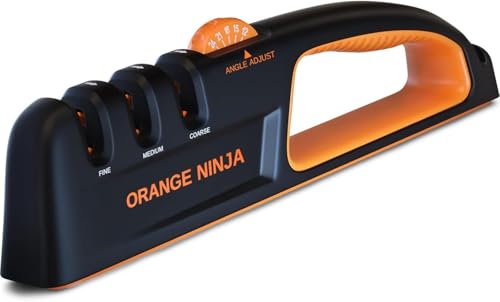
This five-stage sharpener targets shoppers who want a complete kitchen blade kit in one compact tool. Its multiple stages are intended to cover repair, sharpening, honing, and finishing tasks. A design with several slots can help restore neglected knives before giving them a smoother final edge. It is also a practical choice for households that use many common kitchen tools.
The extra stages offer flexibility, but more is not always better if the instructions are unclear. I suggest reading the guide and learning what each slot does before placing a valuable knife into it. Short, gentle passes usually work better than forceful pulls. For everyday blades, this can act like a small maintenance station rather than a tool used only in an emergency.
Pros:
- Five stages provide broad sharpening functions
- Useful for repairing neglected kitchen knives
- Supports a gradual sharpening process
- Good fit for homes with many blade types
- Can reduce the need for separate sharpening tools
- Compact design saves drawer and counter space
Cons:
- Several stages may seem confusing at first
- Not every stage is needed for routine touch-ups
- Heavy pressure can remove more metal than needed
AccuSharp Ergonomic Manual Sharpener

AccuSharp is known for a simple handheld format with an ergonomic handle. This model is designed to restore and hone both straight and serrated knives. Its white body is easy to see in a busy drawer, and its compact shape makes it simple to carry or store. The uncomplicated design suits people who want a sharp blade without a long learning curve.
I see this as a useful choice for quick maintenance. It does not ask you to manage several stages or adjust a complicated system. Hold the handle firmly, keep the blade aligned, and use controlled strokes. The small size is convenient, though users with large hands may prefer a wider grip or a countertop base.
Pros:
- Comfortable ergonomic handle
- Simple design helps new users begin quickly
- Works with straight and serrated knives
- Compact enough for a kitchen drawer
- Useful for fast touch-ups before meal prep
- Lightweight design is easy to store
Cons:
- May not provide the angle control of premium systems
- Handheld use requires a firm, careful grip
- Less suitable for major edge damage
Orange Ninja 4-Stage Sharpener

The Orange Ninja uses a four-stage layout to address several sharpening needs. Its bright color makes it easy to spot, even when kitchen tools crowd the counter. The design is aimed at serrated and standard kitchen knives, so it may appeal to families with mixed cutlery. Multiple stages can help move a worn blade from rough repair to a cleaner finish.
This sharpener is a practical fit for shoppers who like visible controls and a broad range of functions. I recommend using each stage only as needed, since a knife that needs a small touch-up does not need a full repair cycle. The tool should sit on a stable surface whenever possible. Its larger feature set adds versatility, but it also means you should follow the intended order.
Pros:
- Four sharpening stages for different blade needs
- Bright color is easy to find and store
- Designed for serrated and standard knives
- Useful for restoring tired household blades
- Offers more functions than a basic sharpener
- Suitable for cooks who want a clear process
Cons:
- Large feature set may be more than some users need
- Requires attention to the correct stage order
- May take up more drawer space than a slim model
Henckels Handheld Knife Sharpener

Henckels takes a clean and familiar approach with this handheld manual knife sharpener. Its non-slip handle helps users keep control while sharpening. The tool is made for simple kitchen care, so it suits cooks who do not want a large machine or a complex kit. Its brand history in kitchen cutlery also makes it a natural match for everyday knife owners.
I would choose this model for quick maintenance rather than severe restoration. Its straightforward format removes much of the guesswork, which can help a busy cook keep knives ready. I still advise using slow strokes and avoiding excess pressure. The compact build is easy to store, but the fixed design gives less flexibility than an adjustable-angle sharpener.
Pros:
- Ergonomic non-slip handle supports firm control
- Simple design suits first-time users
- Compact shape stores easily
- Good for routine kitchen knife maintenance
- Trusted cutlery brand name
- Quick to use before cooking
Cons:
- Limited angle adjustment
- May not repair badly damaged edges quickly
- Not as versatile as multi-stage systems
Longzon 5-in-1 Knife Sharpener

The Longzon 5-in-1 sharpener combines four sharpening stages with a cut-resistant glove. It is designed for home users who want one tool for knives and scissors. The several stages can help repair, sharpen, and polish common blades, while the glove gives extra peace of mind. Its black and silver finish has a practical look that fits most kitchens.
This is one of the more complete packages in the group. I especially like the inclusion of safety gear because new users often focus on the blade and forget their supporting hand. The large number of functions may be helpful in a family kitchen with varied tools. As with every pull-through sharpener, use gentle pressure and confirm that the blade fits the slot before starting.
Pros:
- Five-in-one design offers broad kitchen use
- Four sharpening stages support repair and finishing
- Includes a cut-resistant glove
- Works with many common knives and scissors
- Good value for a multi-purpose kit
- Useful for households with several blade types
Cons:
- May feel bulky beside a basic handheld sharpener
- Users must learn what each stage does
- The glove does not replace careful handling
Chef’sChoice Pronto Hone Sharpener

The Chef’sChoice Pronto Hone is a two-stage sharpener built around a 15-degree edge. That angle is common on many modern Asian-style knives and other thin-blade designs. Diamond abrasives help shape and refine the edge without electricity, cords, or motor noise. Its black body has a small footprint, making it easy to keep near a prep area.
I see this as a focused tool rather than an all-purpose kit. It can sharpen straight and serrated knives, but users should place serrated blades in the proper slot and avoid forcing them. The guided design makes the sharpening path easy to repeat. If your collection mainly uses 20-degree European knives, another model with dual-angle settings may fit better.
Pros:
- Designed for a precise 15-degree edge
- Diamond abrasives support efficient sharpening
- Two-stage process remains easy to understand
- Works with straight and serrated knives
- Compact footprint saves counter space
- Good option for Asian-style kitchen knives
Cons:
- Focused mainly on a 15-degree edge
- Not ideal for users who need several angle choices
- Does not include a protective glove
Work Sharp Precision Adjust Kit
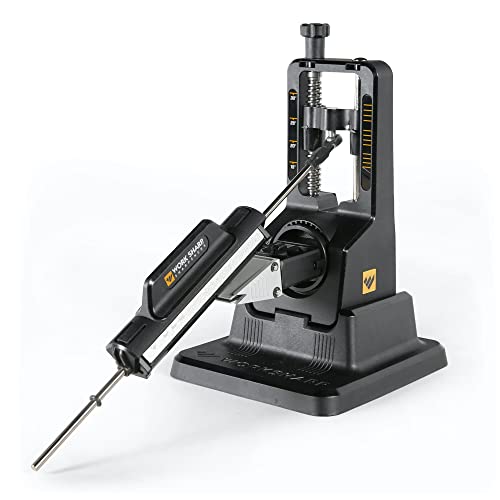
The Work Sharp Precision Adjust takes a guided-system approach to sharpening. Instead of pulling a knife through a fixed slot, you secure the blade and guide an abrasive at a set angle. This layout gives you more control over the edge and can suit kitchen knives, pocket knives, and other small blades. Its guided design also makes it easier to repeat the same angle on both sides.
This is the best fit here for a hobbyist who wants to build real sharpening skill without jumping straight to freehand stones. It takes longer to set up than a handheld tool, but that extra time buys precision. I would use it when edge control matters more than speed. The system may feel excessive for someone who only needs a fast touch-up once a month.
Pros:
- Guided system offers strong angle control
- Suitable for kitchen and pocket knives
- Helps users repeat a consistent edge
- Good learning tool for sharpening beginners
- More precise than many fixed pull-through models
- Useful for people with varied blade collections
Cons:
- Setup takes longer than a handheld sharpener
- Higher learning curve for casual users
- May require more storage space
My Recommendation
For most home cooks, I would start with the Chef’sChoice two-stage model because it offers clear angle control, diamond abrasives, and support for straight and serrated knives. It balances ease of use with a level of precision that basic pull-through tools often lack. If you want the best manual knife sharpener for a mixed kitchen, its 15- and 20-degree options make it a strong everyday choice.
Choose the AccuSharp or Henckels if you want a small tool for quick touch-ups. Pick the RazorSharp or Work Sharp if you care about angle control and enjoy a more involved process. The Longzon and 4-in-1 models suit shoppers who want extra stages and safety accessories. Product availability and prices can change, so check the current Amazon listing before ordering.
| Best for | Why |
|---|---|
| Most home kitchens | Chef’sChoice offers guided 15- and 20-degree sharpening in a compact design. |
| Fast touch-ups | AccuSharp and Henckels are small, simple, and easy to use before meal prep. |
| Precision-minded users | Work Sharp and RazorSharp provide more control for users who want custom angles. |
How to Choose the Best Manual Knife Sharpener
Choosing the best manual knife sharpener starts with the knives you own. Look at the blade type, edge angle, and level of damage. A tool made for a 15-degree edge may not be the right match for a thick 20-degree chef’s knife. If your drawer contains several styles, choose a model with more than one angle or a guided adjustment system.
Check the Sharpening Stages
Most manual sharpeners use one, two, three, four, or more stages. A coarse stage removes enough steel to rebuild a damaged edge. A fine stage smooths that edge and improves the cut. Some models add a honing or polishing stage for a cleaner finish.
More stages can help, but they can also add confusion. I prefer a simple two-stage design for normal maintenance. A multi-stage tool makes more sense when you often restore very dull knives or sharpen scissors as well.
Understand Knife Angles
Knife angle affects sharpness, strength, and cutting feel. A narrow angle can create a very keen edge, but that edge may be less tough during heavy work. A wider angle often gives more support for thick foods, hard squash, or general utility use.
Many Asian-style kitchen knives use an angle near 15 degrees per side. Many European and American kitchen knives use an angle near 20 degrees per side. These are general guides, not rules for every brand. When possible, follow the knife maker’s instructions.
Look for a Stable Base
A sharpener should stay in place while you use it. A non-slip base, rubber feet, or a wide body can help keep the tool steady. Handheld models can work well, but you must hold the handle firmly and keep your fingers away from the blade path.
A stable tool feels like a firm bridge under your hand. It reduces movement and helps each pass follow the same path. This matters for both results and safety.
Consider Serrated Knives
Serrated blades need special care because their teeth do not behave like a smooth edge. Some manual sharpeners include a slot for serrated knives. Others are designed only for straight edges.
Never assume every slot can sharpen every knife. Check the product instructions first. A serrated knife may need a fine ceramic rod or a dedicated slot that reaches the individual teeth without flattening them.
Think About Safety
A sharpener cannot make knife work risk-free. Keep the unit on a stable surface when the design allows it. Keep your free hand behind the blade and move the knife in the direction recommended by the manufacturer.
Do not rush. A slow pass with light pressure usually gives better control than a hard pull. A cut-resistant glove can add protection, but it does not replace good handling habits.
Manual Versus Electric Knife Sharpeners
A manual sharpener gives you direct control and does not need a power outlet. It is often smaller, quieter, and less expensive than an electric unit. Many cooks also like the fact that a manual model can stay in a drawer and come out only when needed.
An electric sharpener may work faster, especially on very dull knives. However, its motor can remove steel quickly, and the unit may cost more or take up more counter space. For many home kitchens, a good manual model offers enough power without the bulk.
I usually suggest a manual tool for people who sharpen a few kitchen knives at a time. It makes the process feel less like operating a machine and more like caring for a useful tool. With the right angle and light pressure, the result can be clean and reliable.
How I Evaluate a Manual Knife Sharpener
I focus first on the edge angle and the type of abrasive. Diamond abrasives can remove metal efficiently, while ceramic stages often help refine an edge. I also look at how easy it is to keep the knife aligned because poor alignment can lead to an uneven bevel.
Next, I consider grip and stability. A sharpener may have excellent abrasives, but it is not a good choice if it slides or feels awkward in the hand. I also check whether the design works with straight and serrated blades, since many homes use both.
Finally, I consider the learning curve and long-term value. The best manual knife sharpener is not always the one with the most stages. It is the one that matches your knives, your patience, and the way you cook. A simple tool that you use correctly is better than an advanced tool that stays in a drawer.
How to Use a Manual Knife Sharpener
Start by cleaning and drying the knife. Place the sharpener on a stable, flat surface if the design allows it. Read the stage labels and begin with the coarse slot only when the edge needs repair.
Insert the heel of the blade into the slot. Pull the knife toward you in one smooth motion, moving from heel to tip. Do not saw back and forth unless the instructions specifically allow that motion.
Use only light pressure. Several gentle passes are usually safer and more effective than a few hard passes. After the coarse stage, move to the fine or polishing stage as directed.
Wipe the blade clean and test it on a soft food such as a tomato or piece of paper. Do not test sharpness by running a finger along the edge. If the knife still feels dull, repeat the process carefully rather than pressing harder.
Common Manual Sharpening Mistakes
The most common mistake is using too much force. Strong pressure can remove excess metal and may damage the edge. Let the abrasive do the work.
Another mistake is skipping the angle guide. A knife pulled through the wrong slot may sharpen unevenly or lose its original profile. If you are unsure, use a model with clear angle labels.
Some users also sharpen too often. Frequent heavy sharpening shortens blade life. Regular honing or light touch-ups can keep an edge ready, while coarse sharpening should happen only when the blade needs real repair.
Finally, do not sharpen a wet or dirty knife. Food residue can affect the process and make cleanup harder. Wash, dry, and inspect the blade before each session.
How Often Should You Sharpen a Kitchen Knife?
The answer depends on how often you cook, what you cut, and the surface beneath the knife. A home cook may need a full sharpening every few months, while a busy cook may need it more often. A knife that feels dull, slips on food, or crushes soft produce needs attention.
Use a honing tool between sharpening sessions if your knife maker recommends it. Honing can help realign a slightly bent edge, while sharpening removes metal to create a new edge. These tasks are related, but they are not the same.
Good storage also helps. Keep knives away from loose forks and other tools that can strike the edge. A block, sheath, or magnetic strip can protect the blade and extend the time between sharpening sessions.
FAQs Of best manual knife sharpener
Are manual knife sharpeners safe to use?
Yes, when you use them as directed. Keep the sharpener stable, hold the handle firmly, and keep your free hand away from the blade path. Move slowly and never rush the process.
Can a manual sharpener sharpen serrated knives?
Some can, but not all. Look for a model with a serrated knife slot or a dedicated sharpening feature. Use the correct slot and follow the instructions for the blade style.
What angle should I use for a kitchen knife?
Many Asian-style knives use about 15 degrees per side, while many European and American knives use about 20 degrees. Check the knife maker’s guidance when available. A dual-angle sharpener offers more flexibility.
Is a whetstone better than a manual sharpener?
A whetstone can offer excellent control, but it takes more practice. A manual sharpener is faster to learn and easier for routine home use. The best choice depends on your skill, time, and knife collection.
How many strokes should I use?
There is no single number for every blade or tool. Begin with a few light passes and check the edge. Stop when the knife cuts cleanly, since extra passes can remove more metal than needed.
Final Verdict: Which Should You Buy?
For most cooks, the Chef’sChoice two-stage model is the best manual knife sharpener because it offers useful 15- and 20-degree control, diamond abrasives, and a compact design. Choose Work Sharp for guided precision or AccuSharp for quick touch-ups.
A sharp knife makes cooking safer, faster, and more pleasant. Pick the best manual knife sharpener for your blade angles, skill level, and daily needs, then use it gently for lasting results.