
The best meat thermometer for BBQ gives fast, accurate readings without making you lift the grill lid.
You know the feeling: the ribs smell ready, the brisket looks perfect, and everyone is waiting. Yet the center may still be tough or unsafe. Guessing can turn a great cook into a dry meal. I tested the features that matter most for BBQ, including speed, accuracy, probe length, screen design, wireless range, and ease of cleaning. These five thermometers fit different cooking styles, from quick burgers to long overnight smokes, so you can choose with confidence.
Alpha Grillers Instant-Read Thermometer

The Alpha Grillers Instant Read Thermometer is a simple tool for cooks who want quick checks at the grill. Its digital screen is easy to read, and the slim probe lets you check the center of meat with a small opening. I like this style for steaks, burgers, pork chops, chicken pieces, and sausages. It helps you check doneness without cutting the food open and losing valuable juices.
This thermometer works best as a fast spot-check tool. I can open the lid, test more than one piece, and close the grill in a short time. That matters when you cook over hot charcoal, since every open-lid check can waste heat. It is not a remote monitor for brisket, but it is a strong choice for everyday BBQ cooks who value speed and simple controls.
Pros:
- Fast digital temperature checks
- Clear display for outdoor cooking
- Compact size fits a grill tool drawer
- Useful for meat, poultry, fish, and oil
- Simple design suits beginners
- Helps reduce guesswork without cutting meat
Cons:
- It does not provide wireless monitoring
- It requires you to open the grill during each check
- It is less suited to long cooks that need constant tracking
My Recommendation
I recommend the Alpha Grillers for home grillers who cook steaks, burgers, chicken, and smaller cuts. It is a good fit if you want the best meat thermometer for BBQ without adding an app, receiver, or complicated setup. The fast read helps you make quick choices at the grate, while the compact body stays out of the way when you work with tongs and gloves. It also makes a useful backup for a smoker owner who already has a wireless thermometer.
This model offers good value for cooks who want a direct answer at the moment it matters. Use it to check the thickest part of the meat, avoid touching bone, and clean the probe after every use. Availability and price can change, so check the current Amazon listing before buying.
ThermoMaven 0.5-Second Professional Thermometer
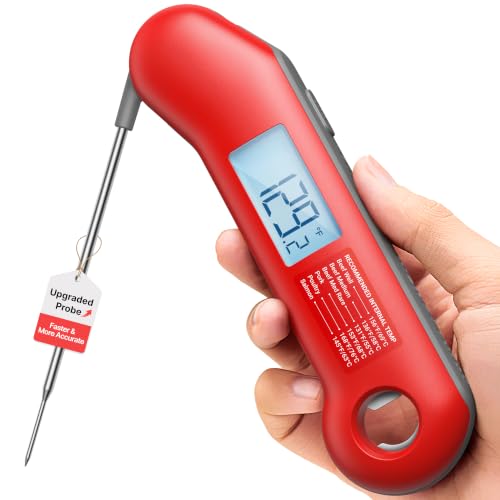
The ThermoMaven Professional Meat Thermometer focuses on speed and precision. Its listed response time is 0.5 seconds, which is useful when several items cook at once. The advertised accuracy is plus or minus 0.5 degrees Fahrenheit, giving you a close reading when you need to separate medium-rare from medium. That level of control can help you protect the texture of expensive steak and delicate fish.
I see this as a strong instant-read option for cooks who check food often. The quick response means I do not need to hold the probe in place for long over an open fire. That short check can help limit heat loss, especially on a kettle grill or kamado. It also suits meal prep, baking, frying, candy work, and other kitchen tasks, so it can earn its space beyond BBQ season.
Pros:
- Very quick listed 0.5-second response
- Advertised accuracy of ±0.5°F
- Good for fast checks across several steaks
- Useful for both grilling and indoor cooking
- Reduces time with the lid open
- Helps fine-tune steak and poultry doneness
Cons:
- It is an instant-read tool, not a remote probe system
- Fast readings still depend on correct probe placement
- The feature set may feel more than needed for casual cooks
My Recommendation
The ThermoMaven is best for detail-focused BBQ cooks who want a very fast reading and tight temperature control. I would choose it for someone who cooks premium steaks, several proteins at once, or food that can overcook in a narrow window. It may also appeal to recipe testers and serious home cooks who use one thermometer for the grill, oven, stovetop, and smoker. In my view, its speed is the main reason to consider it as the best meat thermometer for BBQ in the instant-read class.
Remember that accuracy claims describe the thermometer under stated test conditions. You still need to place the probe in the coldest part of the food and avoid bone or the cooking grate. For the best value, compare the current Amazon price with the features you will use most.
TempPro TP19H Digital Meat Thermometer

The TempPro TP19H is built for cooks who want a reliable one-second temperature check. It has the familiar instant-read format, so you can test food without leaving a probe in the meat. I find that style especially useful for burgers, chicken thighs, pork tenderloin, and steaks that need separate checks. It gives you control without forcing you to learn a phone app or manage a separate receiver.
A good instant-read thermometer should feel natural in the hand, show the number clearly, and let you move from one piece to the next. The TP19H fits that basic BBQ need. It works well for quick cooks where a constant alarm is not necessary. It can also support safer food handling because you can check the thickest section instead of judging poultry or pork by color alone.
Pros:
- One-second digital reading
- Easy format for first-time thermometer users
- Good for steaks, burgers, poultry, and pork
- Useful for quick checks on a hot grill
- Portable design is easy to store
- No wireless setup or app pairing is required
Cons:
- It cannot monitor a roast while you are away
- Checking food means opening the grill
- It may not replace a dedicated leave-in probe for brisket
My Recommendation
I recommend the TP19H for budget-minded grillers who need a practical thermometer for normal BBQ meals. It is a sensible pick for families, new pitmasters, and anyone who wants a backup in the outdoor cooking kit. The one-second reading is fast enough for most daily cooks, and the simple design keeps the learning curve low. If you want the best meat thermometer for BBQ at a straightforward price, this model deserves a close look.
It will not replace a wireless system during a twelve-hour brisket cook. Still, it can handle the quick work that many grillers do most often. Check the current listing for price, included features, and availability before ordering.
ThermoMaven Sub-1G Smart Wireless Thermometer

The ThermoMaven Sub-1G Smart Wireless Meat Thermometer is aimed at cooks who want freedom from the grill. Its wireless design lets you track food while you prepare sides, sit with guests, or step inside for a moment. The standalone base is important because it can reduce your dependence on a phone or app. That makes the system easier to use when your hands are busy or your phone battery is low.
Wireless cooking feels like having a small guard beside the smoker. You can set a target, watch the temperature rise, and respond before the meat goes too far. This setup makes sense for brisket, pork shoulder, turkey, roasts, and other foods that need a long cook. I would still check the probe, connection, and battery before a major event, since wireless tools work best when you prepare them before lighting the fire.
Pros:
- Wireless monitoring supports long BBQ sessions
- Standalone base can simplify the cooking setup
- Lets you spend less time beside the grill
- Useful for brisket, pork shoulder, and whole poultry
- Helps track temperature without lifting the lid
- Good choice for cooks who prefer smart features
Cons:
- Costs more than a basic instant-read thermometer
- Wireless tools need charging or fresh batteries
- Walls, metal grills, and distance may affect the signal
My Recommendation
The Sub-1G is best for serious backyard cooks who smoke large cuts and want more control over time. I would choose it for brisket, pork shoulder, turkey, and weekend cooks where I do not want to stand at the pit all day. The standalone base also suits people who want wireless help without relying only on a smartphone. For those needs, it may be the best meat thermometer for BBQ among the smart, long-cook options.
Wireless range is never a promise to ignore setup. Place the base where it can maintain a clear connection, keep the probe lead away from direct flame, and confirm the reading before you walk away. Its value is highest when you cook large cuts often and can use the freedom it provides.
TempPro TempSync 1000FT Wireless Thermometer

The TempPro TempSync is made for people who want a long wireless range while grilling or smoking. Its listed range reaches up to 1,000 feet in open conditions, which gives you room to move around the house or yard. A wireless thermometer like this can monitor food while you prepare a salad, answer the door, or relax away from the smoker. It turns a long cook from a constant watch into a more manageable routine.
The word “open” matters with any range claim. Buildings, fences, trees, metal surfaces, and other signals can reduce real-world distance. Even so, a long-range system can be useful in a normal backyard. I would treat the TempSync as a leave-in monitoring tool and keep an instant-read thermometer nearby for quick cross-checks and final doneness checks.
Pros:
- Listed wireless range of up to 1,000 feet in open conditions
- Useful for smoking and long grilling sessions
- Lets you monitor food away from the pit
- Helps reduce unnecessary lid opening
- Good fit for brisket, ribs, and pork shoulder
- Supports a more relaxed outdoor cooking routine
Cons:
- Actual range can drop around walls and metal objects
- Wireless systems need power and connection checks
- A long-range feature may be unnecessary for small patios
My Recommendation
The TempSync is best for BBQ fans with a smoker, large yard, or busy home routine. It is a strong fit when you want to walk away from the grill but still keep an eye on the cook. The long advertised range makes it attractive for outdoor events, though I would always test the signal at home before trusting it for a major meal. If freedom and distance matter most, this can be the best meat thermometer for BBQ in the long-range wireless group.
Its value depends on how often you cook large cuts. A casual burger cook may not need it, while a weekend pitmaster can benefit every time the smoker runs. Keep the receiver close enough for a stable signal, protect the probe wire from flame, and use a clean probe for every food check.
How I Choose the Best Meat Thermometer for BBQ
A thermometer is small, but it controls a big part of the meal. The right model helps you protect texture, food safety, and cooking time. I look at more than a fast number on a screen. I also consider how the thermometer behaves beside real heat, how easy it is to clean, and whether it fits the cook’s habits.
Instant-Read or Wireless?
An instant-read thermometer gives you a temperature when you insert the probe. It works well for steaks, burgers, chicken pieces, chops, and other foods that cook in a short time. It is also useful for checking several parts of a large roast before serving. The main tradeoff is that you must open the lid to take each reading.
A wireless thermometer stays in the food during the cook. It sends temperature data to a base or receiver. This design is better for brisket, ribs, pork shoulder, turkey, and other long cooks. It helps you watch the rise without poking the meat again and again. In most homes, the best meat thermometer for BBQ depends first on this choice.
Accuracy Matters More Than Fancy Features
A reading is only useful when the probe sits in the right place. Insert it into the thickest part of the meat. Avoid bone, the pan, the grate, and pockets of fat when possible. These areas can give a false reading.
The U.S. Department of Agriculture advises checking meat with a food thermometer rather than relying on color, feel, or cooking time alone. The USDA lists 145°F with a three-minute rest for whole cuts of beef, pork, lamb, and veal. It lists 160°F for ground meats and 165°F for poultry. Follow the latest USDA guidance for the food you cook, since final temperatures can vary by food type and preparation.
A BBQ thermometer does not replace safe handling. Keep raw and cooked foods separate. Wash hands and tools after contact with raw meat. Clean the probe before and after each use.
Speed Helps Protect Grill Heat
Every second with the lid open lets heat escape. A fast thermometer limits that loss. This matters most on charcoal grills and smokers, where recovery can take time. It also matters when you cook several steaks and need to make quick decisions.
A one-second thermometer is enough for most cooks. A half-second model can feel even smoother when you move from one item to another. Yet speed should not be the only factor. A slower reading with a clear display and sturdy probe can serve you better than a fast tool that feels hard to use.
Probe Length and Shape
A thin probe makes a small hole in the meat. That helps reduce juice loss and lets you reach the center of smaller foods. A longer probe can help with thick roasts, pork shoulders, and deep foods. For a smoker, you should also inspect the probe wire and its heat rating.
Do not place an electronic body over direct flames. Use the probe as directed. A BBQ can create hot spots that damage parts not made for high heat. The best meat thermometer for BBQ should match the size of your food and the heat around your cooker.
Display and Night Use
Outdoor cooks often work at dusk or after dark. A bright display, large digits, and a backlight can save time. Some screens rotate when you turn the thermometer. That feature helps left-handed and right-handed users. A display should also remain easy to read when grease, smoke, or glare surrounds it.
Wireless models add another screen or receiver. Look for a layout that shows current temperature and target temperature without confusion. If you need to check the number through a window, a clear receiver can matter more than extra menu options.
Cleaning and Food Safety
The probe touches raw food, so cleaning is not optional. Wipe and sanitize it after each use. Do not place the whole thermometer under water unless the instructions say it is waterproof. Grease and meat juice can enter buttons or seams on low-protection models.
I prefer designs with a smooth probe and few hard-to-reach grooves. A probe cover can protect the tip in a drawer, but it should be clean and dry before storage. Never use a dirty cover on a clean probe.
Best Meat Thermometer for BBQ: Which Type Fits You?
If you cook burgers and steaks on weeknights, choose an instant-read model. It will be quick, compact, and easy to grab. The Alpha Grillers and TempPro TP19H fit this type of cook.
If you care about very fast readings and close temperature control, consider the ThermoMaven professional model. It suits cooks who prepare premium cuts or many foods at once. Its speed can reduce lid-open time.
If you smoke large cuts, choose wireless monitoring. The ThermoMaven Sub-1G offers a smart wireless approach with a standalone base. The TempPro TempSync targets cooks who want a long listed range. Both can help you spend less time beside the pit.
I also suggest keeping two thermometers if you smoke often. Use a wireless probe for the long cook. Keep an instant-read tool for checking several spots and confirming the final temperature. This two-tool setup works like a map and a compass: one tracks the journey, and one confirms where you arrived.
How to Use a BBQ Meat Thermometer Correctly
First, check the thermometer before you cook. Make sure the battery has power and the display responds. For a wireless model, pair the receiver and place the base where you plan to use it. A small test now can prevent a large problem later.
Insert the probe into the thickest part of the meat. For a steak, enter from the side so the tip reaches the center. For poultry, avoid bone and check the thickest breast or inner thigh area, depending on the cut. For a roast, test more than one spot because the shape may create hot and cool zones.
Close the lid after the check. Do not keep opening the grill to chase a number. For a leave-in probe, keep the tip in the meat and the wire away from direct flame. If the display jumps, check whether the probe touched bone, the pan, or the grate.
Let large cuts rest after cooking. Carryover heat can continue to raise the internal temperature while the meat rests. Resting also helps the juices spread through the cut. Follow the recipe and current food safety guidance for the type of meat you prepare.
Tips for Better BBQ Results
Use the Thermometer Early
Do not wait until the food looks finished. Begin checking before the expected end time. This gives you room to adjust the grill or remove a cut before it passes your target. A thermometer works best as an early warning tool, not a last-second rescue tool.
Check More Than One Area
Grills have hot spots. One side of a rack may cook faster than the other. Check more than one item when possible. On a large roast, test different locations before serving.
Do Not Chase a Perfect Number
Temperature can move up and down as the probe shifts. Give the tip time to settle. Keep the probe in the center. Small changes are normal, but a large jump often means the tip moved into a different part of the food.
Keep the Lid Closed
Heat is part of your cooking budget. Spend it wisely. An instant-read model helps you make quick checks, while a wireless model helps you avoid many checks. This is one reason the best meat thermometer for BBQ can improve both food quality and fuel use.
Calibrate When Needed
Some thermometers let you calibrate them. The ice-water method should read close to 32°F when prepared correctly, though the result can vary with water quality, ice, and local conditions. Boiling water should read close to 212°F at sea level, but elevation changes the boiling point. Always follow the maker’s instructions for testing and calibration.
Best For Comparison
| Best for | Why |
|---|---|
| Fast everyday grilling | Instant-read models give quick checks for steaks, burgers, and chicken. |
| Long smoking sessions | Wireless systems track large cuts without repeated lid opening. |
| Precise temperature control | Fast, accurate models help protect the texture of premium cuts. |
FAQs Of best meat thermometer for bbq
What is the best meat thermometer for BBQ?
The best choice depends on your cooking style. Choose an instant-read model for steaks, burgers, and quick checks. Choose a wireless model for brisket, ribs, pork shoulder, and other long cooks. For many home grillers, a fast instant-read thermometer offers the best mix of value and ease.
Can I leave an instant-read thermometer in the grill?
Usually, no. An instant-read thermometer is made for short checks, not long exposure to grill heat. Use a leave-in probe system for continuous monitoring. Always follow the product instructions before placing any probe near high heat.
How accurate should a BBQ thermometer be?
A good cooking thermometer should give consistent readings and have a stated accuracy range. Accuracy alone does not ensure a correct result. Probe placement, calibration, and contact with bone or metal can change the reading.
Do I need a wireless thermometer for brisket?
You do not need one, but it can make brisket cooking easier. A wireless thermometer lets you monitor the cook without lifting the lid. It is especially helpful when you need to manage a fire for many hours.
How do I clean a meat thermometer?
Clean and sanitize the probe after every use. Use a damp cloth or the cleaning method listed in the manual. Do not submerge the electronic body unless the manufacturer says it is waterproof. Dry the probe before storage.
Final Verdict: Which Should You Buy?
For most backyard cooks, the ThermoMaven Professional is the best meat thermometer for BBQ when speed and precision matter. Choose the Sub-1G or TempSync for long smoking sessions, and the Alpha Grillers or TP19H for simple instant checks.
The right BBQ thermometer removes guesswork and protects every meal. Pick the model that matches your grill, cuts, and cooking time, then use it with safe food-handling habits.