
The best stand mixer for baking combines steady power, useful tools, simple controls, and a bowl size that fits your recipes.
You start a cake after work, only to find your arm tired from mixing butter and sugar. Then bread dough turns sticky, and a hand mixer splashes batter across the counter. I know that frustration. A good stand mixer takes over the hard work, keeps speed steady, and leaves your hands free to measure, shape, and clean. In this guide, I compare five popular options for cakes, cookies, bread, pizza dough, and daily baking. I focus on bowl size, controls, attachments, ease of use, and real kitchen value so you can choose with confidence.
NEWBULIG 6.3QT Stand Mixer

The NEWBULIG 6.3QT Stand Mixer gives home bakers a roomy bowl for large batches. Its size suits family cookies, birthday cakes, cupcakes, and many bread recipes. The bowl also helps when you want to mix without stopping to scrape a small container. For anyone who often doubles a recipe, this extra space can feel like a quiet gift.
This mixer comes with the core tools most bakers need, including a dough hook, flat beater, and wire whisk. Those three tools cover bread dough, cake batter, cookie dough, cream, and whipped egg whites. The larger bowl makes it a useful choice for holiday baking or meal prep. Before making a very large dough batch, I would still follow the maker’s capacity guidance and avoid forcing the motor.
Pros:
- Large 6.3-quart bowl suits family-size batches
- Useful tool set for dough, batter, and whipping
- Helpful choice for frequent home baking
- Roomy bowl reduces spills during mixing
- Good fit for cooks who like to double recipes
- Hands-free mixing gives you time for other steps
Cons:
- Larger body needs more counter and storage space
- A full-size mixer may feel excessive for one-person kitchens
- Large dough batches still require care and proper speed
My Recommendation
I recommend the NEWBULIG 6.3QT to bakers who make generous batches and want one machine for many jobs. It is especially useful for families, cookie sellers, and people who bake bread on a regular basis. The bowl offers breathing room, while the basic attachments cover the recipes most home kitchens make. If you want the best stand mixer for baking with a large-batch focus, this model deserves a close look.
Martha Stewart 5.3QT Tilt-Head Mixer
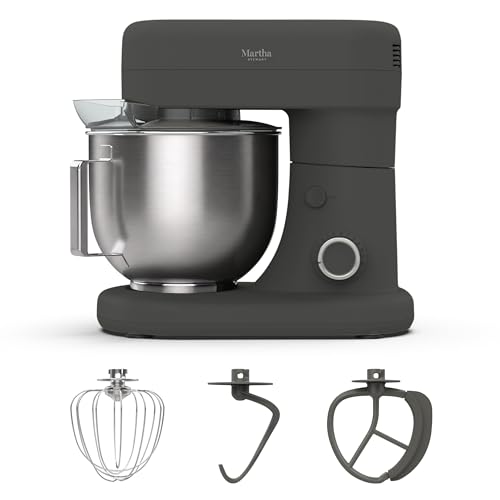
The Martha Stewart 5.3QT Tilt-Head Stand Mixer offers a balanced size for everyday baking. Its bowl is large enough for most cake, cookie, frosting, and bread recipes without taking over the kitchen. The tilt-head design lets you lift the mixer head and reach the bowl with less fuss. That small design detail matters when you need to add flour slowly or scrape the sides.
With 12 speeds, this mixer gives you more control than a simple low, medium, and high switch. Low speed helps combine dry ingredients with less flour dust, while higher speeds help whip cream or egg whites. The stainless steel bowl should also be easy to wipe and useful for chilled or warm ingredients within normal kitchen limits. I would begin every recipe at a low speed, then increase it only when the mixture looks ready.
Pros:
- 5.3-quart bowl fits common home baking tasks
- Tilt-head design makes bowl access simple
- 12 speeds allow fine control over mixing
- Stainless steel bowl resists stains and odors
- Good size for cakes, cookies, and frosting
- Easy speed changes help new bakers learn technique
Cons:
- May not suit very large commercial-style batches
- Tilt-head mixers can need careful bowl positioning
- More speed settings may feel busy at first
My Recommendation
The Martha Stewart 5.3QT is a strong match for the everyday baker who wants control without a huge machine. I like its middle-ground size for homes that make cakes, cookies, muffins, and occasional bread. The tilt head helps with ingredient changes, and the 12-speed layout supports both gentle mixing and fast whipping. For many households, this could be the best stand mixer for baking because it balances space, control, and daily ease.
Martha Stewart 5.3QT Mixer With 12 Speeds

This second Martha Stewart model also pairs a 5.3-quart stainless steel bowl with a tilt-head layout and 12 speeds. Its practical appeal comes from the familiar format. You get a bowl size that handles normal family recipes, plus a head that lifts for quick access. It is a sensible style for someone moving from a hand mixer to a stand mixer.
The included whisk, flat beater, and dough hook support a wide range of baking work. Use the flat beater for cookie dough and cake batter, the whisk for cream and light mixtures, and the dough hook for yeast dough. I suggest checking the bowl and beater position before the first use, since correct placement helps the tool reach the mixture. As with any stand mixer, pause to scrape the bowl when a recipe calls for it rather than expecting the machine to do every job alone.
Pros:
- Practical 5.3-quart capacity for routine baking
- 12 speeds offer useful mixing flexibility
- Tilt head makes adding ingredients easier
- Stainless steel bowl is easy to maintain
- Three main attachments cover most recipes
- Good stepping-stone from a hand mixer
Cons:
- Not the best match for repeated extra-large batches
- Small kitchens may still need to store the bowl separately
- Users should monitor dough load and mixing time
My Recommendation
I would choose this Martha Stewart mixer for a new baker who wants a clear, familiar setup. It works well for cakes, cookies, cupcakes, frosting, and modest bread projects. The controls give room to grow as your skills improve, but the machine does not demand a complex learning curve. If you want the best stand mixer for baking in a balanced household format, this model is a worthy option to compare with the other 5.3-quart choice.
Kourice 6.5QT Heavy-Duty Stand Mixer

The Kourice 6.5QT Tilt-Head Stand Mixer targets bakers who want a larger bowl and a heavy-duty feel. Its capacity gives you space for bread, pizza dough, cookies, and cakes. The stainless steel cladding and stainless steel bowl add a sturdy look to the machine. A large mixer can act like an extra pair of strong hands when dough becomes thick and hard to stir.
This model includes a dough hook, wire whisk, and flat beater, so it covers the main stages of home baking. Its 10-speed control offers a simple range from slow combining to faster whipping. The tilt head makes it easier to add flour, remove the bowl, and switch attachments. I would use low speeds for yeast dough and heavy mixtures, follow the manual for batch limits, and give the motor breaks during demanding work.
Pros:
- 6.5-quart bowl gives generous working room
- Useful for bread and pizza dough projects
- Includes dough hook, whisk, and flat beater
- 10 speeds keep controls easy to understand
- Tilt head improves access to the bowl
- Large format suits families and regular batch baking
Cons:
- Large footprint may crowd a small counter
- Heavy dough can still strain any home mixer
- Less convenient to move than a compact model
My Recommendation
The Kourice is best for bread makers, pizza fans, and families who mix large amounts at once. I see its 6.5-quart bowl as the main reason to choose it. It gives dough room to develop and reduces the chance of flour spilling over the rim. For shoppers seeking the best stand mixer for baking with extra capacity, this model offers a useful blend of size, tools, and simple speed control.
Kitchen in the box 3.2QT Compact Mixer
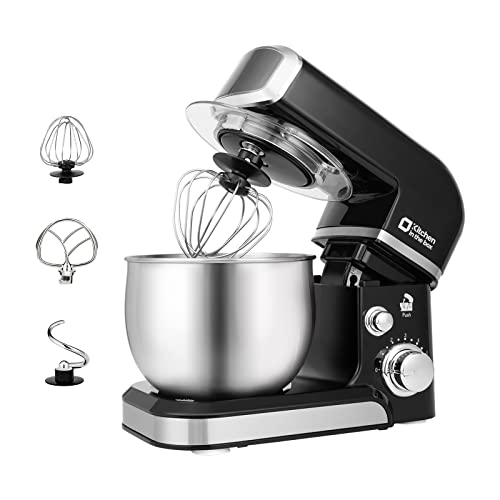
The Kitchen in the box 3.2QT Stand Mixer takes a different path from the larger models. It focuses on a small body, light weight, and easy storage. That makes it appealing for apartment kitchens, dorm rooms, RVs, and bakers who make small portions. A compact mixer can be a better fit than a powerful-looking machine that stays packed in a cabinet.
The six-speed control and three main attachments cover daily tasks such as cupcakes, small cookie batches, whipped cream, and light dough. The smaller bowl helps with modest recipes, but it also asks you to respect the batch size. I would not choose it for frequent large loaves or double batches. For small baking jobs, though, it can save time and reduce the hand strain that often makes people avoid baking.
Pros:
- Compact 3.2-quart size fits small kitchens
- Lightweight design is easier to move and store
- Six speeds keep operation simple
- Includes whisk, dough hook, and flat beater
- Good for small cakes, cookies, and frosting
- Lower space needs suit apartments and dorms
Cons:
- Small bowl limits large recipes
- Not the first choice for heavy bread batches
- Small mixtures may need more frequent scraping
My Recommendation
I recommend this compact Kitchen in the box mixer for solo bakers, students, renters, and occasional users. It is also a good choice when lifting a full-size mixer would be difficult. The small footprint helps keep baking equipment within reach instead of hidden away. If your recipes are modest, this may be the best stand mixer for baking in a tight kitchen, even though larger models offer more capacity.
Best Stand Mixer for Baking: Quick Comparison
Every baker has a different “best.” A bread baker needs room and steady control, while a small-apartment cook may care more about weight and storage. The table below gives a quick way to match each main need with the right style.
| Best for | Why |
|---|---|
| Large family batches | NEWBULIG 6.3QT offers generous bowl space for cakes, cookies, and dough. |
| Everyday baking control | Martha Stewart 5.3QT models provide a balanced size with 12 speeds. |
| Small kitchens and light batches | Kitchen in the box 3.2QT is compact, light, and easy to store. |
How I Chose the Best Stand Mixer for Baking
A stand mixer should do more than look attractive on a counter. I look first at the work it can handle, then at how easily a home baker can use it. Bowl size, speed control, attachments, cleaning, stability, and storage all matter. A mixer can have a large motor, but poor controls or a hard-to-reach bowl can still make baking feel like a chore.
I also consider the type of dough you make. Cake batter and whipped cream are light jobs. Cookie dough is thicker, and yeast dough can place far more demand on the mixer. A large bowl does not automatically mean unlimited capacity. I always advise readers to check the product manual for flour limits, dough limits, operating time, and cleaning rules.
Bowl Capacity
Bowl size affects both comfort and output. A 3.2-quart bowl can suit a small household, but it may not hold a double batch of cookies. A bowl around 5.3 quarts gives most home bakers a useful middle ground. Bowls above six quarts make more sense when you often bake for a crowd or make large bread and pizza batches.
Capacity also affects mess. A bowl with room above the ingredients helps reduce flour clouds and splashes. Still, I do not fill any bowl to the rim. Ingredients expand, and thick dough needs space to move. A little extra room often makes the mixer easier to use.
Speed Settings
More speeds can help, but numbers alone do not prove that a mixer is better. Low speed matters when you add flour or start a dough. Medium speed works well for creaming butter and sugar. High speed helps whip cream and egg whites. A control that changes smoothly can matter more than a long list of settings.
New bakers should start slow. This keeps dry ingredients in the bowl and gives the mixer time to combine them. It also protects the texture of many recipes. Fast mixing can overwork flour, warm butter, or create a rough dough when the recipe needs a gentle hand.
Attachments
The three key attachments are a flat beater, wire whisk, and dough hook. The flat beater handles cake batter, cookie dough, mashed foods, and frosting. The whisk adds air to cream and egg whites. The dough hook kneads yeast dough with less hand effort.
Extra attachments may sound exciting, but I would first confirm that the basic tools are included and easy to clean. A mixer cannot replace good measuring, correct ingredient temperature, or proper baking time. Think of the attachments as tools, not magic. They make the job easier, but they still need the right recipe method.
Stability and Counter Space
A mixer should stay steady as it works. Larger models often take more room, but their size may help with stability. Compact models are easier to store and move, yet you may need to keep one hand near the machine during thick mixing. Place any mixer on a dry, level counter before turning it on.
Measure your space before buying. Check the width, depth, and height beneath cabinets. A tilt-head mixer needs room above the head, while a bowl-lift design may need less swing space but more effort to access. A mixer that fits your habits will get more use than one that only looks impressive in a product photo.
Cleaning and Care
Most baking mess comes from flour, butter, sugar, and dried dough around the bowl or attachment area. Wipe the body after each use. Remove attachments before cleaning. Follow the manual for dishwasher use, because finishes and parts can vary.
Do not submerge the motor housing. Keep the control area dry, and unplug the mixer before cleaning around the attachment hub. If dough climbs the hook, stop the machine rather than pulling at it while the motor runs. These simple habits help protect both the mixer and the baker.
Which Stand Mixer Size Should You Buy?
A small mixer suits light recipes and limited storage. Choose this size if you usually make one cake, a small batch of cookies, or a little frosting. The Kitchen in the box 3.2QT model fits this use well. Its main advantage is convenience, not maximum output.
A medium mixer works for most families. The two Martha Stewart 5.3QT models sit in this useful range. They offer enough space for common recipes without the large footprint of a very big machine. This is often the safest choice for a first stand mixer.
A large mixer suits serious home bakers. The NEWBULIG 6.3QT and Kourice 6.5QT models offer more room for large batches. They make sense when you bake bread, pizza, holiday cookies, or multiple cakes. The trade-off is more weight, more counter space, and a greater need to follow capacity instructions.
Tips for Getting Better Results From a Stand Mixer
Read the recipe before you start. Set out ingredients, check the attachment, and place the bowl correctly. Soft butter creams better than cold butter, while warm liquid can affect yeast dough. Small details create a smoother mix and a better bake.
Use the lowest speed when adding flour. This reduces the white cloud that can cover your counter. Increase the speed only after the ingredients come together. Stop the mixer before scraping the bowl or changing an attachment.
Watch the dough, not only the clock. A dough hook may need a few pauses, especially with a thick mixture. If the machine sounds strained, stop and check the amount. Letting the motor rest can be wiser than pushing through a heavy batch.
Do not use the whisk for thick dough. Do not use the dough hook to whip cream. Each tool has a shape for a reason. Matching the attachment to the job improves texture and reduces wear.
Keep the mixer on a level surface. A rubber mat can help protect the counter and reduce movement, if the manufacturer allows it. Store attachments dry. A clean, dry tool is ready for the next batch and less likely to develop odors or stains.
Stand Mixer Buying Guide for Cakes, Cookies, and Bread
If cakes are your main goal, choose a mixer with a whisk and flat beater, plus a bowl that lets you cream butter without crowding. A tilt head can make it easier to add eggs and scrape the sides. Speed control also matters because cake batter needs gentle mixing after flour enters the bowl.
For cookies, look for a sturdy flat beater and a bowl of at least moderate size. Cookie dough can become dense, especially with chilled butter or a high flour load. A 5.3-quart or larger bowl may feel more comfortable for family batches. The 3.2-quart option works best for smaller portions.
For bread, place dough hook quality and bowl room high on your list. Bread dough is heavier than cake batter and often needs longer mixing. The Kourice 6.5QT and NEWBULIG 6.3QT models are the more natural choices here because their bowls provide added room. Even so, use the maker’s limits and never treat a home mixer like a bakery machine.
For whipped cream and egg whites, speed control and a clean whisk matter most. Any trace of grease can reduce egg-white volume. Chill the bowl when a recipe calls for it, and keep the speed change smooth. A good mixer should make the process feel calm, not rushed.
Common Mistakes to Avoid
One common mistake is choosing the biggest mixer without checking the counter. A large model may be hard to lift and hard to clean. Another mistake is choosing a tiny bowl for large family recipes. Match the mixer to the food you actually make.
Some shoppers focus only on motor language. I prefer a wider view. A mixer needs useful low-speed control, a stable base, accessible controls, and attachments that suit your recipes. Marketing terms can sound strong, but daily comfort tells you more.
Another mistake is ignoring the manual. Capacity limits protect the motor and improve results. Directions can also explain which parts are dishwasher safe, how to attach the bowl, and how long the mixer should run. A few minutes of reading can prevent weeks of frustration.
Finally, do not expect the mixer to scrape every spot. Pause the machine when needed and use a spatula. Good baking still needs a human eye. The mixer is the engine, but you remain the driver.
FAQs Of best stand mixer for baking
What size stand mixer is best for home baking?
A mixer from about 5 to 6.5 quarts suits many homes. It gives enough space for cakes, cookies, and moderate dough batches. Choose a 3.2-quart model if you mainly bake small portions or have very limited storage.
Can a stand mixer knead bread dough?
Yes, a stand mixer with a dough hook can knead many home bread recipes. Use low speeds and follow the maker’s dough and flour limits. Stop if the motor sounds strained or the mixer moves across the counter.
Is a tilt-head stand mixer good for baking?
Yes. A tilt head makes it easy to add ingredients, scrape the bowl, and change attachments. It works especially well for cakes, cookies, frosting, and everyday home recipes.
How many speeds does a baking mixer need?
Six speeds can handle many basic recipes. Ten or 12 speeds offer finer control, but the quality of the speed change matters more than the number. Low speed is key for adding flour, while high speed helps with whipping.
What attachments should a stand mixer include?
Look for a flat beater, wire whisk, and dough hook. These tools cover most home baking tasks. You can consider extra accessories later, but the basic three should come first.
Final Verdict: Which Should You Buy?
For large batches, I would choose the NEWBULIG 6.3QT. The Martha Stewart 5.3QT is the best balanced pick for everyday baking, while Kitchen in the box suits small kitchens. Bread fans should consider the Kourice 6.5QT.
The best stand mixer for baking is the one that matches your batch size, recipes, and counter space. Choose carefully, follow capacity limits, and your mixer can make baking faster, cleaner, and far more enjoyable.