
A Frigidaire ice maker freezes water, releases the ice, and refills itself through a timed electrical cycle.
Learning how does a Frigidaire ice maker work can make troubleshooting much easier. Instead of treating the appliance like a sealed mystery, you can view it as a small system of water, temperature, gears, sensors, and electrical controls. This guide explains each step, shows what can go wrong, and shares safe checks that help you decide whether you need a simple fix or a technician.
How Does a Frigidaire Ice Maker Work?
A Frigidaire ice maker works through a repeating cycle. It fills a mold with water, freezes that water, warms the mold slightly, ejects the ice, and then fills again. The cycle may take about 60 to 120 minutes, depending on the freezer temperature, model, and room conditions.
The main parts work together like a small factory:
• Water inlet valve: Opens to let water enter the ice maker.
• Fill tube: Carries water from the valve into the ice mold.
• Ice mold: Holds the water while it freezes.
• Thermostat or temperature sensor: Detects when the ice is cold enough to harvest.
• Motor and ejector arms: Push the finished cubes out of the mold.
• Heater: Loosens the ice from the mold.
• Control module: Manages the timing and order of the cycle.
A useful way to picture it is to imagine a tiny production line. Water is the raw material, the freezer is the cold room, and the ejector arm moves the finished product into the ice bin.
The answer to how does a Frigidaire ice maker work also depends on the exact model. Some Frigidaire refrigerators use a traditional modular ice maker. Others use a larger automatic ice system, a dual ice maker, or electronic controls. The basic process remains similar, but the sensors and control boards may differ.
The Frigidaire Ice-Making Cycle Step by Step
Understanding the ice-making cycle helps you spot the stage where a problem begins. Here is the normal sequence.
1. The ice maker checks its condition
After the refrigerator has power, the ice maker control system checks temperature and position. The freezer usually needs to stay near 0°F for reliable ice production. A warmer freezer may still freeze food, but it can slow or stop ice production.
The ice maker may also check whether the ejector arm or mold is in the correct position. If the ice bin is full, some models pause production to prevent overflow.
2. The water valve opens
When the ice maker calls for water, the refrigerator sends power to the water inlet valve. The valve opens for a short period, often only a few seconds.
Water flows through the fill tube and into the ice mold. The amount must be carefully controlled. Too little water creates small or hollow cubes. Too much water can cause an ice bridge, frozen fill tube, or cubes that stick together.
3. The water freezes
The filled mold sits inside the cold freezer compartment. Heat leaves the water and moves into the surrounding air through the mold and evaporator system.
Freezing time varies. A warm kitchen, frequent door openings, blocked air vents, or a heavily loaded freezer can increase the time. The ice maker does not usually harvest ice just because a fixed number of minutes has passed. A thermostat or sensor helps confirm that the cubes are ready.
4. The heater loosens the cubes
When the ice reaches the proper temperature, a small heater may warm the underside of the mold. It does not melt the cubes. It only creates a thin layer of meltwater between the cubes and the mold.
This step is similar to warming a stuck ice tray under tap water, but the heater uses much less heat and works for a short time.
5. The motor rotates the ejector arms
The motor turns a set of ejector fingers. These fingers push the cubes out of the mold and into the ice bin.
You may hear a short buzzing, clicking, or scraping sound during this part. A brief sound can be normal. A repeated clicking noise, grinding sound, or motor that runs without moving the arms may signal a damaged gear, jam, or failed motor module.
6. The ice maker refills
After the cubes fall, the ejector mechanism returns to its starting position. The water valve opens again, and the mold receives a fresh supply of water.
This cycle explains how does a Frigidaire ice maker work from start to finish. If the ice maker freezes water but never ejects it, the fault may involve the thermostat, heater, motor, or control module. If it ejects dry cubes but never refills, the water valve, fill tube, wiring, or water supply may be the issue.
What Parts Make a Frigidaire Ice Maker Work?
The ice maker is compact, but each part has a specific job. Knowing these parts makes appliance terms easier to understand.
Ice mold
The ice mold is the tray-shaped section that holds water. Many molds use a coating that helps ice release during harvest. A damaged or corroded mold can cause cubes to stick or develop an unusual taste.
Thermostat or thermistor
Older designs often use a thermostat. Newer models may use a thermistor or electronic temperature sensor. These parts tell the control system when the ice is cold enough to remove.
If the sensor gives the wrong reading, the ice maker may harvest too soon, wait too long, or stop making ice.
Water inlet valve
The water inlet valve receives an electrical signal and opens for a limited time. It depends on steady water pressure and a clean filter.
A weak valve may produce small cubes. A valve that does not close fully can cause dripping, frozen fill tubes, or an ice sheet inside the mold.
Fill tube
The fill tube directs water into the mold. It can freeze when the valve leaks, water pressure is low, the freezer is too cold, or the tube is not aligned correctly.
Do not use a knife or sharp object to clear a frozen fill tube. The tube can crack, and a puncture may cause a water leak inside the refrigerator.
Ejector motor and gears
The motor turns plastic gears and the ejector fingers. These parts must move in the correct order.
A stripped gear can leave the motor humming while the ejector arms stay still. A jammed cube can also stop the mechanism before it completes the harvest cycle.
Ice level arm or bin sensor
Some Frigidaire ice makers use a shutoff arm. When the arm rises, the system assumes the bin is full. Other models use an electronic sensor.
A stuck arm, an overfilled bin, or an incorrectly placed ice bucket can make the refrigerator stop making ice even when every other part works.
Control board
The control board coordinates the water valve, heater, motor, and sensor signals. It is less common for a basic issue, such as a closed water supply, to require board replacement.
A good technician tests the simpler parts first. Replacing a control board without testing the water supply or fill tube can waste money.

What Controls the Ice-Making Process?
Temperature is one of the most important controls. The freezer must be cold enough to freeze water, but the ice maker also needs accurate feedback from its thermostat or sensor.
Most refrigerators perform best when the freezer is set close to 0°F. The actual temperature can differ from the display, so an inexpensive freezer thermometer can help. Place it near the ice maker, but not directly against a wall or air vent.
The door switch may also matter. On some designs, the refrigerator uses door position information to control lights, fans, or ice functions. A faulty switch can create unusual symptoms, especially in models with electronic ice controls.
Water pressure matters too. A clogged filter, partly closed shutoff valve, kinked supply line, or weak household supply can reduce the fill volume. This is why understanding how does a Frigidaire ice maker work requires more than looking at the ice mold alone.
In practical troubleshooting, I have found that people often replace the ice maker first when the real problem is a clogged filter or frozen fill tube. A simple water-flow check can prevent an unnecessary repair.
How Long Does a Frigidaire Ice Maker Take to Make Ice?
A new installation may need several hours before it begins producing ice. The freezer must become cold, the water line must fill, and the ice maker must complete its first cycle.
After the first batch, many Frigidaire ice makers produce ice at regular intervals. The exact output depends on the model, freezer temperature, room temperature, door use, and ice demand.
Production may slow when:
• The freezer is warmer than 0°F.
• The refrigerator door opens often.
• The ice bin is nearly full.
• The water filter is clogged.
• The water pressure is low.
• The condenser coils or air vents are dirty or blocked.
• The ice maker was recently turned on.
The first cubes may have an unusual taste after installation or filter replacement. Discarding the first few batches is a practical way to clear residual tastes from the water line and new filter.
Why Is My Frigidaire Ice Maker Not Making Ice?
When a Frigidaire ice maker stops working, start with simple checks. Many problems do not require removing parts.
Check the ice maker switch
Make sure the ice maker is turned on. Depending on the model, this may involve a wire shutoff arm, an electronic button, or a setting on the refrigerator control panel.
If the shutoff arm is raised, lower it gently. Never force it. A bent arm can prevent the ice maker from sensing the correct position.
Check the freezer temperature
Use a thermometer instead of relying only on the control display. A freezer that is too warm may preserve frozen food but fail to complete the ice-making cycle.
Look for blocked air vents, heavy frost, or a door that does not seal. A damaged gasket can let warm air enter and create frost around the ice maker.
Check the water supply
Confirm that the refrigerator water valve is fully open. Inspect the supply line for sharp bends or crushed areas.
If the water dispenser is also weak, the filter or household water supply may be the cause. Replace the filter with the correct model and follow the installation instructions.
Inspect the fill tube
Look for ice blocking the tube where water enters the mold. Turn off power before attempting any inspection.
Never chip away ice with a screwdriver, knife, or other sharp tool. A hair dryer can damage plastic parts and create an electrical hazard near water. If the tube repeatedly freezes, the valve may be leaking or another condition may need repair.
Check for jammed cubes
An oversized cube can stop the ejector fingers. Remove loose ice from the mold and bin only when it is safe to do so.
Do not force the ejector arm. If it will not move during a proper test cycle, the motor, gears, or control system may need professional diagnosis.
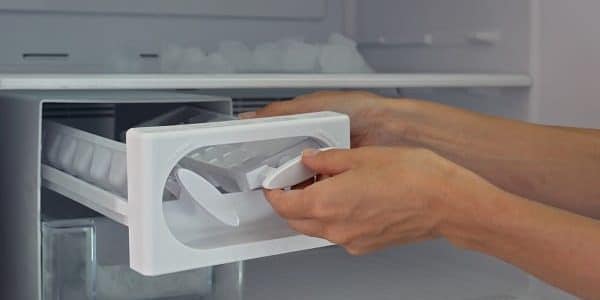
Common Frigidaire Ice Maker Problems and Causes
The symptom often points toward the failed part, but it does not prove the diagnosis. Use these patterns as starting points.
| Symptom | Possible causes |
|---|---|
| No ice at all | Ice maker off, warm freezer, no water supply, failed valve, sensor problem, or control fault |
| Small or hollow cubes | Low water pressure, clogged filter, restricted line, short fill time, or weak valve |
| Frozen fill tube | Leaking inlet valve, low pressure, poor alignment, or excessive cold air |
| Ice stuck in the mold | Failed heater, damaged mold, faulty thermostat, or jammed ejector |
| Ice maker overflows | Valve not closing, control fault, incorrect fill, or sensor problem |
| Ice tastes bad | Old filter, stale water, dirty bin, or recently installed water line |
| Ice maker makes noise | Normal harvest sound, jammed cubes, worn gears, or motor trouble |
This table explains how does a Frigidaire ice maker work by connecting each stage to real symptoms. For example, water that enters the mold but never leaves points to a harvest problem. A completely dry mold points more toward a fill or water-supply problem.
Safe Maintenance Tips for Better Ice Production
Good maintenance helps the ice maker work consistently. It also protects water quality and reduces stress on moving parts.
• Replace the water filter according to the refrigerator manual or when flow becomes weak.
• Clean the ice bin with mild soap and warm water, then rinse and dry it well.
• Do not store food in the ice bin.
• Keep freezer vents clear so cold air can circulate.
• Check the door gasket for gaps, tears, or loose sections.
• Remove clumped ice before it interferes with the ejector arm.
• Keep the water line straight and free from sharp bends.
• Discard old ice if it has been stored for a long time and tastes stale.
• Never pour hot water into the ice maker mold.
A clean ice bin matters more than many owners expect. Ice can absorb odors from uncovered food, spills, and dirty surfaces. Cleaning the bin is simple, but it can improve both taste and hygiene.
Always disconnect power before removing covers or testing internal parts. Water and electricity create a serious shock risk. If you smell burning, see melted wiring, or find a leak near electrical components, stop using the appliance and contact a qualified technician.

Can You Test a Frigidaire Ice Maker?
You can perform a few basic checks without advanced tools. Start by confirming power, water supply, freezer temperature, and the ice maker shutoff setting.
Some models have a test button. The location varies, and the test procedure depends on the model number. Use the owner’s manual before starting a test cycle.
A multimeter can help a trained person check continuity through components such as the inlet valve or thermostat. However, live-voltage testing is not a beginner task. Improper testing can cause shock, short circuits, or damage to the control board.
The model number is usually found inside the refrigerator compartment, on a side wall, ceiling, door frame, or product label. Accurate model information is important because Frigidaire uses different ice maker designs and replacement parts.
A helpful repair lesson is to diagnose the complete system, not just one part. The ice maker may be healthy while the refrigerator has a water problem. Testing in the correct order saves time and avoids replacing good parts.
When Should You Call a Technician?
Call a qualified appliance technician when the ice maker leaks, trips a breaker, shows burned wiring, or fails after basic checks. Professional help is also wise when the refrigerator uses a complex electronic control system.
You may need service if:
• The inlet valve leaks continuously.
• The fill tube freezes again and again.
• The motor runs but the ejector does not move.
• The ice maker overfills the mold.
• The freezer has heavy frost or cannot hold temperature.
• The refrigerator has a water leak inside the cabinet.
• You are uncomfortable working around electricity.
A technician can test water pressure, valve operation, wiring, sensors, heaters, and control signals. This is safer and often less expensive than replacing several parts by guesswork.
Frequently Asked Questions About How Does a Frigidaire Ice Maker Work
How does a Frigidaire ice maker know when the ice is ready?
A thermostat or temperature sensor checks the ice mold. When the mold reaches the proper low temperature, the control system starts the harvest cycle.
Does a Frigidaire ice maker need a water filter?
Many models use a water filter, but the exact design depends on the refrigerator. A clogged filter can reduce water flow and cause small cubes or slow production.
Why does my Frigidaire ice maker fill with water but not make ice?
The freezer may be too warm, or the ice maker may have a sensor, heater, motor, or control problem. Check that the freezer is near 0°F and that the ice maker is turned on.
Why is the Frigidaire ice maker making hollow cubes?
Hollow cubes usually result from low water flow or a short fill. Check the filter, supply line, shutoff valve, and inlet valve before replacing the ice maker.
How long does a Frigidaire ice maker last?
Service life varies with water quality, use, temperature, and maintenance. A well-maintained ice maker can work for many years, but heaters, motors, valves, and plastic parts can eventually wear out.
Can I manually add water to a Frigidaire ice maker?
Manual filling is not recommended unless the product manual specifically allows it. Adding water by hand can cause overflow, spills, or damage to electronic parts.
Conclusion
A Frigidaire ice maker follows a simple but carefully timed process: it fills the mold, freezes the water, loosens the cubes, ejects them, and refills. Temperature sensors, water pressure, the inlet valve, heater, motor, and shutoff system must all work together.
Once you understand how does a Frigidaire ice maker work, common problems become easier to narrow down. Check the freezer temperature, water filter, supply line, fill tube, and ice maker setting before buying replacement parts. Use safe methods, follow your model manual, and call a technician when electrical or water faults go beyond basic checks.
Try these simple checks during your next ice problem, and share your experience or questions in the comments.