
Most home ice makers use about 3 to 15 kilowatt-hours of electricity each month.
How much electricity does an ice maker use? The answer depends on its size, cooling system, settings, room temperature, and how often it makes ice. A small countertop unit may cost only a few dollars each month, while a large undercounter or commercial model can use much more. This guide explains the numbers, shows how to calculate your cost, and shares simple ways to reduce energy use.

How much electricity does an ice maker use?
Most household ice makers use between 100 and 400 watts while actively making ice. They do not run at full power all day. Instead, the compressor, fan, water pump, and control system turn on and off during each cooling cycle.
For many countertop ice makers, average energy use falls near 3 to 15 kilowatt-hours per month. At an electricity rate of $0.16 per kilowatt-hour, that equals about $0.48 to $2.40 per month.
Larger built-in ice makers often use more energy. Their yearly use may range from about 200 to 500 kilowatt-hours, depending on the model and use pattern. That could cost $32 to $80 per year at the same electricity rate.
How much electricity does an ice maker use in your home? The label, manual, or a plug-in energy meter will give the best answer. Published estimates are useful, but real use can change with room temperature, cleaning, and how often you remove the ice.
Energy use by ice maker type
Different ice maker designs have very different power needs. A small machine that makes bullet-shaped ice is not comparable to a large commercial flake ice machine.
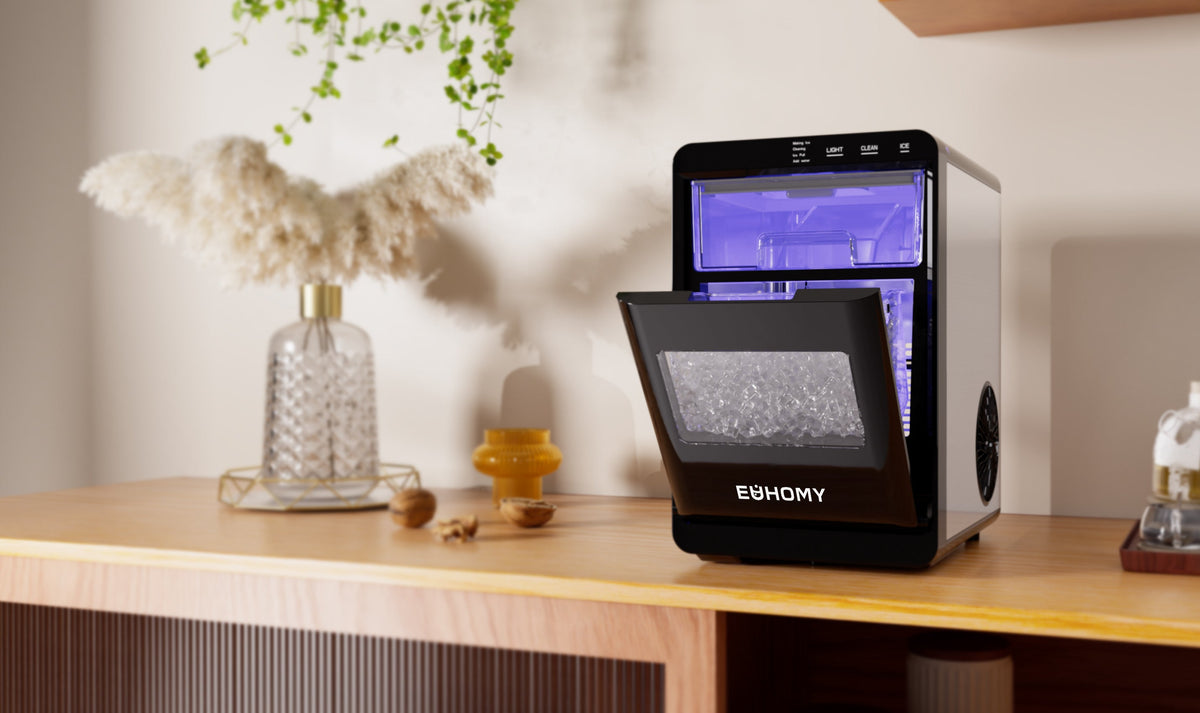
Countertop ice makers
Countertop models are usually the most common choice for apartments, offices, RVs, and small kitchens. They often draw about 100 to 150 watts while running.
Many models make ice in short cycles. They may use roughly 0.1 to 0.3 kilowatt-hours during a busy day, although heavy use can push this higher. That means how much electricity an ice maker uses may be closer to 3 to 9 kilowatt-hours per month for light use.
These units often do not keep ice frozen for a long time. Meltwater returns to the reservoir, and the machine may freeze it again. This repeated cooling can raise energy use.
Built-in undercounter ice makers
Undercounter ice makers have stronger compressors and larger storage bins. They are designed to stay connected and produce ice throughout the day.
A typical unit may use 300 to 600 kilowatt-hours per year. The exact number depends on insulation, ventilation, room temperature, ice production, and whether the storage bin has its own cooling system.
If you use one every day, how much electricity an ice maker uses can become noticeable on your electric bill. It may use more energy than a small countertop unit but less than many large kitchen appliances.
Refrigerator ice makers
A refrigerator ice maker usually uses less electricity than a separate machine because it shares the refrigerator’s cooling system. However, the refrigerator compressor must work harder when the freezer is warm, full, or opened often.
The ice maker itself uses electricity for a water valve, motor, heater, and control board. Its direct use is often modest, but measuring it separately is difficult because the refrigerator and ice maker share one power cord.
A modern refrigerator may use about 400 to 800 kilowatt-hours per year in total. The ice maker is only one part of that figure.
Commercial ice makers
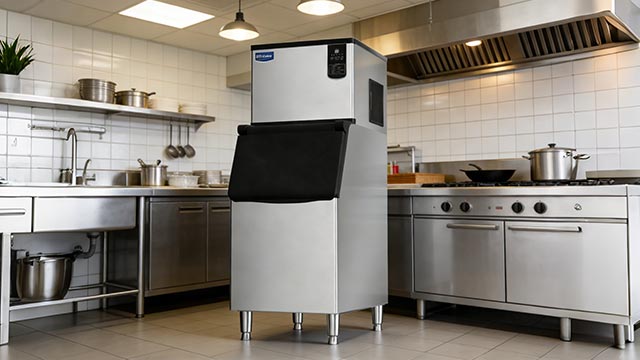
Commercial machines can produce hundreds of pounds of ice per day. They use powerful compressors, water pumps, fans, and heated harvest systems.
A restaurant or hotel ice maker may use hundreds or even thousands of kilowatt-hours per year. Energy use also rises when the machine runs in a hot kitchen or lacks enough air space around its condenser.

What affects ice maker electricity use?
How much electricity an ice maker uses depends on more than its watt rating. The following factors can change your monthly cost.
Ice production
The more ice you need, the more often the machine runs. A unit making a full bin every day will use much more energy than one used for weekend drinks.
Some machines list their output as pounds of ice per day. This number can help you compare models, but it is often measured under ideal test conditions.
Room temperature
Heat makes ice production harder. A countertop machine in a hot garage may run much longer than the same machine in an air-conditioned kitchen.
High room temperature also makes the storage bin warm faster. The machine may restart more often to replace melted ice.
Ventilation
Ice makers release heat through side, rear, or front vents. If you place the unit against a wall or beside a hot oven, heat cannot escape well.
Poor airflow can increase cycle time and energy use. It may also shorten compressor life.
Ice storage design
Some machines only make ice. They do not keep it frozen. Ice melts in the bin and returns to the water reservoir.
Other machines have an insulated or refrigerated storage bin. These models use more energy because they must keep the stored ice cold.
Water temperature
Cold water freezes faster than warm water. Filling the reservoir with cool tap water may slightly reduce cycle time.
Avoid using very hot water. It can increase energy use and may damage parts not designed for high temperatures.
Cleaning and scale buildup
Mineral deposits can coat the water tray, pump, and cooling surfaces. The machine may then need more time to complete each cycle.
Regular cleaning keeps water moving and helps the system work as designed. Always follow the cleaning steps in the owner’s manual.
Age and condition
Older ice makers may have less efficient compressors, worn seals, dirty coils, or failing fans. A small fault can cause the machine to run almost nonstop.
If the compressor rarely shuts off, check airflow, room temperature, water level, and the condenser area before assuming the unit is simply energy hungry.
How to calculate ice maker energy cost
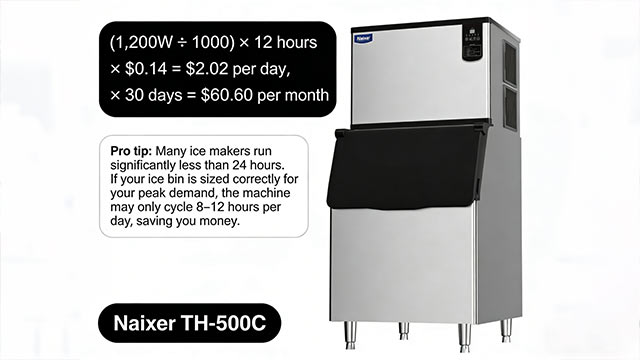
You can estimate operating cost with a simple formula:
Electricity cost = watts ÷ 1,000 × hours used × electricity rate
For example, imagine a countertop ice maker that draws 120 watts while running. If it runs for six hours per day and your electricity rate is $0.16 per kilowatt-hour:
- Convert watts to kilowatts: 120 ÷ 1,000 = 0.12 kilowatts.
- Multiply by daily hours: 0.12 × 6 = 0.72 kilowatt-hours per day.
- Multiply by 30 days: 0.72 × 30 = 21.6 kilowatt-hours per month.
- Multiply by the power rate: 21.6 × $0.16 = $3.46 per month.
This example shows how much electricity an ice maker uses under fairly active conditions. It does not mean every machine will cost $3.46 per month. Some models run fewer hours, while others cycle more often.
Check your electricity bill for the exact price per kilowatt-hour. In the United States, rates vary widely by state, utility, season, and plan.
A plug-in energy monitor is more accurate. Connect the monitor between the outlet and the ice maker, then record usage for at least seven days. Multiply the weekly result by about 4.3 to estimate monthly use.

How much does an ice maker add to your electric bill?
For a small countertop model, the added cost is often modest. Here are simple examples using an electricity rate of $0.16 per kilowatt-hour:
• 5 kWh per month costs about $0.80.
• 10 kWh per month costs about $1.60.
• 20 kWh per month costs about $3.20.
• 40 kWh per month costs about $6.40.
A built-in unit may cost more because it runs for longer periods and may keep ice cold in an insulated bin. Commercial equipment can add much more, especially when it operates all day.
How much electricity an ice maker uses is only one part of ownership cost. You should also consider water use, filters, cleaning products, repairs, and the purchase price.
A cheap machine with poor insulation may cost more over time than an efficient model with a higher purchase price. Look for energy information, annual consumption data, compressor details, and warranty coverage before buying.
Does an ice maker use electricity when it is full?
Many home ice makers stop making ice when a sensor detects a full bin. This reduces energy use, but it does not always stop the machine completely.
The control board may remain active. A fan or storage cooling system may also continue to run. Some models restart when ice melts or shifts away from the sensor.
If a countertop model does not keep ice frozen, unplugging it after the bin is full can save energy. This also prevents repeated melting and refreezing.
Do not unplug a built-in unit without checking the manual. Some models need to stay powered to maintain proper storage temperature or prevent water from sitting in the system.
How much electricity an ice maker uses while full depends on its design. A simple sensor-controlled unit may use very little, while a refrigerated bin can continue drawing power.

How to reduce ice maker energy use
You can lower energy use without giving up convenient ice. Small changes often make the biggest difference.
• Place the machine in a cool, open area with clear ventilation.
• Keep it away from ovens, dishwashers, direct sunlight, and hot appliances.
• Use cool water rather than warm water in the reservoir.
• Remove ice when the bin is full if the machine does not keep ice frozen.
• Unplug the machine when you will not use it for several days.
• Clean the water system and condenser area as directed.
• Replace damaged seals, cracked hoses, or blocked filters.
• Avoid making far more ice than your household needs.
• Use a timer only if the manufacturer allows it and the machine can safely restart.
• Choose an efficient model with an automatic shutoff and clear energy information.
In my practical view, the most common mistake is leaving a countertop unit running all day just because it is convenient. Many people forget that the ice melts and the machine starts another cycle. Making ice in batches and storing it in a freezer can reduce unnecessary cycling.

Are ice makers energy efficient?
Ice makers can be reasonably efficient when they produce only the ice you need. Their small size and short cooling cycles help keep energy use low.
Still, a countertop ice maker is not always the most efficient way to store ice. If your freezer already has enough space, using the refrigerator’s built-in ice maker may use less electricity than operating a second appliance.
Efficiency also depends on ice shape. Thin or hollow ice may freeze quickly, while thicker ice can take longer. A fast cycle does not always mean lower total energy use.
When comparing models, review these details:
• Ice production per day.
• Rated power in watts.
• Storage bin capacity.
• Whether the bin is refrigerated.
• Automatic shutoff features.
• Vent location and clearance needs.
• Cleaning and maintenance requirements.
• Warranty and replacement parts.
How much electricity an ice maker uses should be compared with how much ice it produces. A machine that uses 10 kilowatt-hours to make 100 pounds of ice may be more efficient than one that uses 7 kilowatt-hours to make only 40 pounds.
Common mistakes that increase energy use
Several simple errors can make an ice maker run longer than needed.
Blocking the vents
A blocked vent traps warm air around the condenser. The compressor then works harder to remove heat.
Leave the clearance listed in the manual. If the unit feels very hot on the sides, improve airflow and move it away from heat sources.
Ignoring mineral scale
Hard water leaves calcium and other minerals inside the machine. Scale can slow water flow and reduce cooling performance.
Clean the unit on the schedule recommended by the manufacturer. Use only approved cleaners, and rinse the system well.
Running an empty reservoir
Some machines may make loud noises or run poorly when the water level is low. This can stress the pump and interrupt normal cycles.
Check the water level before use. Do not operate the unit without enough water unless the manual says it is safe.
Keeping the unit on during long absences
If you are leaving for vacation, an ice maker does not need to run. Empty, clean, dry, and unplug it unless the manual gives different instructions.
This saves electricity and reduces the chance of stagnant water, leaks, or mold growth.
Measuring real-world electricity use
The best way to learn how much electricity an ice maker uses is to measure it in your own home. A plug-in watt meter is simple and usually inexpensive.
Follow these steps:
- Plug the energy meter into a wall outlet.
- Plug the ice maker into the meter.
- Reset the meter before beginning.
- Run the machine as you normally use it.
- Record total kilowatt-hours after seven to fourteen days.
- Multiply the result by your electricity rate.
For example, if the meter shows 4.2 kilowatt-hours after seven days, estimated monthly use is about 18.1 kilowatt-hours. At $0.16 per kilowatt-hour, the monthly cost would be about $2.90.
Measurement has limits. A short test during a cool week may not represent summer use. For a better estimate, test once in a mild season and again during a hot season.
This method also reveals problems. If the meter shows constant high use even when the bin is full, inspect the machine for blocked vents, poor insulation, or a faulty sensor.
Safety and environmental considerations
Keep the ice maker on a dry, level surface. Do not use an extension cord unless the manufacturer specifically permits it and the cord has the correct rating.
Never immerse the machine in water. Unplug it before cleaning, and follow the electrical safety instructions in the manual.
Energy use also affects your carbon footprint. The impact depends on how your local electricity is produced. A machine powered by a grid with more renewable energy will usually create fewer emissions than one powered by a coal-heavy grid.
The most practical environmental step is to avoid waste. Make only the ice you need, maintain the unit, and replace it only when repair is not sensible.
Frequently asked questions about how much electricity an ice maker uses
How much electricity does a countertop ice maker use?
A countertop ice maker often uses about 3 to 15 kilowatt-hours per month, depending on how often it runs. Heavy use, high room temperature, and poor ventilation can increase that amount.
Does an ice maker use a lot of electricity?
Most small home ice makers do not use a large amount of electricity compared with major appliances. However, a large built-in or commercial model can use several hundred kilowatt-hours per year.
Is it cheaper to make ice or buy bagged ice?
Making ice at home is often cheaper over time if you already own the appliance and use it regularly. The true cost includes electricity, water, cleaning, maintenance, and the machine’s purchase price.
Should I unplug my ice maker when I am not using it?
Unplug a countertop ice maker during long periods of nonuse after emptying and drying it. For built-in models, check the manual first because some units need special shutdown steps.
Does a full ice maker stop using electricity?
Many ice makers stop active production when the bin is full, but the control system or storage cooling may still use power. The exact behavior depends on the model.
How can I find the exact energy use of my ice maker?
Use a plug-in energy monitor for at least one week. This measures actual household use better than a watt label because it includes cycling, standby power, and real room conditions.
Conclusion
How much electricity an ice maker uses depends on its type, size, workload, temperature, ventilation, and maintenance. A small countertop unit may use only a few dollars of electricity per month, while an undercounter or commercial model can cost much more.
Use the wattage formula for a quick estimate, then confirm the result with a plug-in energy monitor. Keep vents clear, clean the machine, make only the ice you need, and unplug countertop models during long periods of nonuse.
These simple steps can lower energy waste and help you choose the right appliance for your home. Check your model’s manual, measure its real use, and share your results or questions in the comments.