
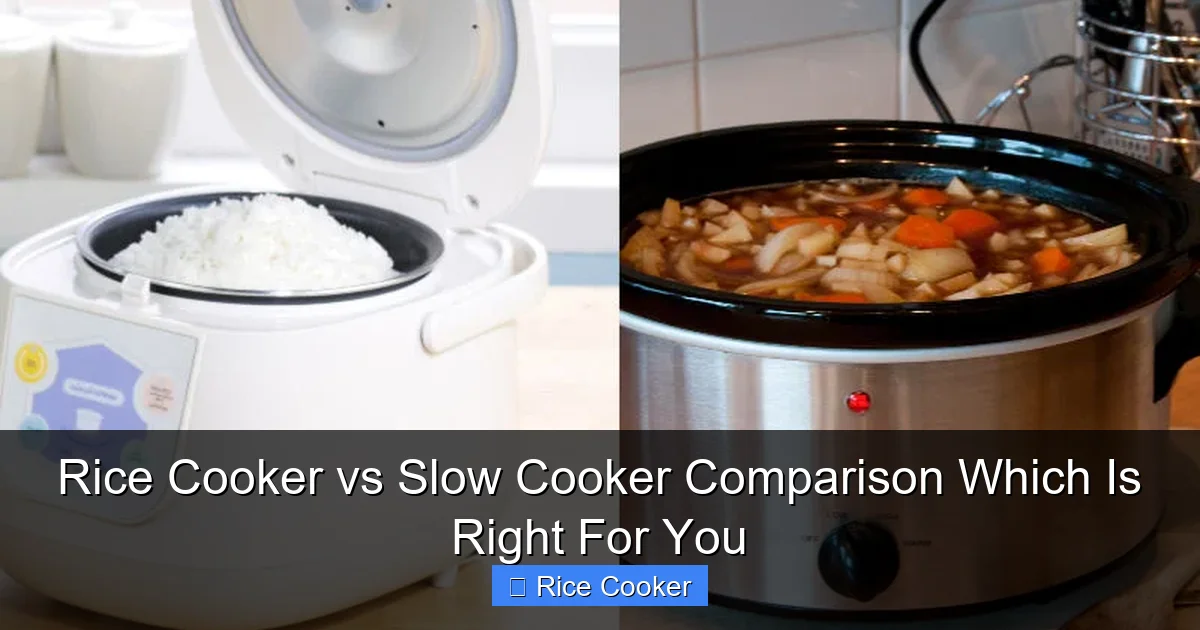
For most households in the United States, a slow cooker and a rice cooker are not the same appliance. A slow cooker cooks food slowly over several hours. A rice cooker uses heat and moisture control to cook rice, then often switches to a warm setting when the rice is done.
Some modern rice cookers include a slow-cook mode. Some slow cookers can cook rice. Even so, the two appliances are built for different main jobs, and they do not always produce the same results.

Slow Cooker vs. Rice Cooker: The Main Difference
A slow cooker is made for long, low-temperature cooking. It is useful for meals such as chili, stew, pulled pork, beans, and braised meat. A rice cooker is made to cook grains with a measured amount of water and stop or change modes when the liquid is absorbed.
The key difference is how each appliance controls heat:
- A slow cooker holds food at a steady cooking heat for a long time.
- A rice cooker senses changes in heat or moisture as water is absorbed.
- A rice cooker may switch to “Keep Warm” after the cooking cycle.
- A slow cooker usually continues cooking on Low or High until someone turns it off or a timer ends.
Think of a rice cooker as a controlled grain cooker. Think of a slow cooker as a small countertop braising pot.
Quick comparison
| Feature | Slow cooker | Rice cooker |
|---|---|---|
| Main purpose | Stews, soups, meat, beans, and one-pot meals | White rice, brown rice, and other grains |
| Cooking method | Low, steady heat over time | Heat and moisture control |
| Common settings | Low, High, Warm | Cook, Warm, and sometimes specialty modes |
| Typical cooking time | About 4–10 hours, depending on the recipe | Often about 20–60 minutes for rice |
| Best result | Tender food cooked over several hours | Separate, moist, fully cooked grains |
| Automatic shutoff | Common on newer models, but not universal | Often switches to Warm |
| Liquid needs | Usually more liquid for long cooking | Carefully measured liquid |
| Best replacement | Dutch oven or braiser | Covered saucepan or multi-cooker rice mode |
The table describes common appliance designs. Exact results vary by brand, model, batch size, and recipe.

How a Slow Cooker Works
A slow cooker heats a removable crock from the sides and holds food at a gentle cooking temperature. The lid helps trap heat and moisture. This allows tough cuts of meat, dried beans, and firm vegetables to soften over several hours.
Slow cookers work well when a recipe needs:
- Long cooking time
- Moist heat
- Tender meat
- Soft vegetables
- Hands-off cooking
- A large batch of food
Most slow cookers have Low, High, and Warm settings. Low takes longer. High cooks faster, but it does not turn the appliance into a pressure cooker. Warm is for holding already-cooked food, not for starting or fully cooking raw food.
The United States Department of Agriculture advises using a slow cooker safely by thawing meat before cooking, keeping the lid in place, and checking that food reaches a safe internal temperature. The USDA also advises against using the Warm setting to cook raw food.
A slow cooker does not usually measure whether rice has absorbed all its water. It continues applying heat based on its setting. That can make rice soft, sticky, or overcooked if the recipe does not suit the appliance.

How a Rice Cooker Works
A basic rice cooker uses a cooking bowl, a heating plate, and a temperature control system. When water remains in the bowl, the temperature stays near the boiling point of water. After the rice absorbs the water, the temperature rises, and the cooker may switch from Cook to Warm.
This simple change helps the rice cooker judge when the rice is done. It does not need a timer for every type of rice, although many advanced models use programmed cooking logic.
Rice cookers are designed for:
- White rice
- Brown rice
- Jasmine rice
- Basmati rice
- Sushi rice
- Wild rice blends
- Oatmeal and other grains, if the manual allows them
The correct water amount depends on the grain, the recipe, and the rice cooker. The cup included with a rice cooker may not equal a standard US measuring cup. For consistent results, use the cup and markings supplied with the appliance or follow the manual.
A rice cooker can make a small meal easy, but its cooking bowl and controls may not be suitable for a large stew or a long braise. Food can also scorch if the appliance is used with too little liquid or with a recipe outside its instructions.
Can a Rice Cooker Be Used as a Slow Cooker?
A rice cooker can be used as a slow cooker only when the manufacturer provides a slow-cook setting or gives instructions for that use. A basic rice cooker with only Cook and Warm modes is not a reliable substitute.
The Warm setting does not mean slow cooking. It is intended to hold food after cooking. It may not bring raw meat, poultry, or other food to a safe temperature quickly enough.
Before using a rice cooker for slow cooking, check the manual for:
- A setting labeled Slow Cook, Simmer, Stew, or similar.
- Approved foods and maximum fill levels.
- Required cooking times.
- Whether the lid must stay closed.
- Instructions for browning or preheating.
- Whether the appliance may be left unattended.
- Cleaning and removable-bowl limits.
If the manual does not mention slow cooking, use the rice cooker for rice and grains instead. A separate slow cooker is the safer and more predictable choice for recipes made for long, moist cooking.
What happens when you use the wrong setting?
The result may be:
- Undercooked meat
- Rice that turns mushy
- A burned layer at the bottom
- Food that dries out
- Liquid that boils away
- Uneven cooking
- A damaged appliance or overheated control
The problem is not only temperature. It is also the shape of the bowl, the location of the heating element, the lid seal, and the way the appliance senses doneness.

Can a Slow Cooker Cook Rice?
A slow cooker can cook rice, but the method is less automatic than using a rice cooker. Rice often needs a carefully measured amount of water and a shorter cooking period than meat or beans.
Some slow cooker recipes add rice near the end of cooking. This can work because the rice cooks in hot broth or sauce. Other recipes cook rice from the start, but they must account for the slow cooker’s heat and moisture retention.
Common problems include:
- Rice absorbing too much liquid
- Rice becoming soft before the rest of the meal is ready
- Rice sticking to the crock
- Extra liquid remaining at the end
- Rice cooking unevenly around the edges
For the best result, follow a slow cooker recipe written and tested for rice. Do not assume that the water ratio from a rice cooker manual will work in a slow cooker.
If you need plain rice with predictable texture, a rice cooker or covered saucepan is usually the better tool.

Which Appliance Should You Use?
Choose the appliance based on the food and the cooking process, not just the size of the recipe.
| Your goal | Better choice | Reason |
|---|---|---|
| Make plain white rice | Rice cooker | It controls moisture and switches modes automatically |
| Cook brown rice or grains | Rice cooker with a matching program | Grain settings can adjust time and heat |
| Make chili for a family meal | Slow cooker | It holds a moist meal at low heat for hours |
| Cook pulled pork | Slow cooker | Long cooking helps soften connective tissue |
| Make soup while away from the stove | Slow cooker | It is designed for hands-off simmering |
| Cook rice for one or two people | Rice cooker | It handles a small grain batch well |
| Make a stew with a rice side | Both appliances | Each appliance performs its main task |
| Use one appliance for many functions | Multi-cooker | Some models include rice, slow-cook, sauté, and pressure functions |
A rice cooker is usually the better buy for frequent rice eaters. A slow cooker is usually better for batch meals and tender meats. If you want both functions, check the control panel and manual of a multi-cooker rather than assuming every appliance can perform both jobs equally well.

Cooking Time and Capacity Matter
The listed capacity can mislead shoppers. A rice cooker may list capacity in rice-cooker cups, while a slow cooker may list quarts. These measurements are not directly interchangeable.
A rice-cooker cup is commonly smaller than a standard US cup. Slow cookers are usually described by total volume in quarts. For safe and even cooking, do not fill either appliance beyond the manufacturer’s recommended level.
Cooking time also differs:
- White rice may finish in roughly 20 to 40 minutes.
- Brown rice often takes longer.
- Slow-cooker meals may need 4 to 10 hours.
- Large or dense foods may need more time.
- Frozen meat can extend cooking time and create a food-safety risk.
These are broad ranges, not guarantees. Follow the recipe and the appliance manual. Use a food thermometer for meat, poultry, and other foods that require a verified internal temperature.
The USDA recommends cooking poultry to 165°F. Other foods have different safe-temperature targets. Keep cooked food out of the temperature range where bacteria grow quickly, commonly called the danger zone, and refrigerate leftovers promptly according to USDA guidance.

Safety Rules for Both Appliances
Both appliances can cause burns, food-safety problems, or electrical hazards if used incorrectly.
Follow these basic rules:
- Read the manual before using a new appliance.
- Keep the appliance on a stable, dry, heat-safe surface.
- Do not place the heating base in water.
- Use the correct inner pot or crock.
- Do not operate the appliance with a cracked bowl.
- Keep the power cord away from hot surfaces.
- Do not overfill the bowl.
- Keep the lid closed during cooking unless the recipe says otherwise.
- Use a food thermometer for meat and poultry.
- Refrigerate leftovers within the time recommended by the USDA.
- Do not use a Warm setting to cook raw food.
- Unplug the appliance before cleaning the base.
A slow cooker may be safe to leave running when used according to its instructions, but “hands-off” does not mean risk-free. A rice cooker also needs ventilation and proper placement. Never cover vents or use either appliance inside an oven unless the manufacturer specifically allows it.

Common Mistakes to Avoid
Treating Warm as a cooking setting
Warm holds cooked food. It is not a substitute for Cook, Low, or High. Starting raw ingredients on Warm can leave food at an unsafe temperature.
Using rice-cooker water ratios in a slow cooker
A rice cooker and a slow cooker lose and distribute heat differently. Use the recipe designed for the appliance you own.
Opening the lid too often
Each opening releases heat and steam. In a slow cooker, this can add meaningful time. In a rice cooker, it can disturb the cooking cycle and moisture balance.
Adding too much liquid
A slow cooker has limited evaporation. A rice cooker also depends on a specific liquid ratio. Extra liquid can lead to watery food or mushy rice.
Cooking too little food
Some slow cookers need a minimum fill level for even heating. Check the manual, especially when preparing a small batch.
Leaving rice in the cooker for too long
The Warm mode can dry rice, change its texture, or cause it to stick. Transfer leftovers to a shallow container and refrigerate them promptly.

Frequently Asked Questions
Is a slow cooker better than a rice cooker?
Neither is better for every task. A slow cooker is better for long-cooked meals, such as stew and pulled pork. A rice cooker is better for rice and grains because it manages water absorption and cooking completion.
Can I cook meat in a rice cooker?
Only if the appliance manual allows it and provides a suitable cooking program. A basic rice cooker is not automatically safe for raw meat. Use a food thermometer and follow USDA safe-temperature guidance.
Can I leave rice in a slow cooker?
You can keep rice warm only when the appliance and recipe support that use. Long holding can dry or overcook rice. Refrigerate leftovers promptly rather than leaving them at room temperature.
Is a rice cooker the same as a multi-cooker?
No. A multi-cooker is a broader category. Some models include rice cooking, slow cooking, pressure cooking, sautéing, and steaming. A rice cooker may offer only rice and warm functions, though advanced models can include more programs.
What is the closest substitute for a slow cooker?
A covered Dutch oven can perform a similar cooking job in an oven, but it requires different temperature and timing instructions. A pressure cooker can make some slow-cooker meals faster, but it is not a direct time-for-time substitute.

Next step: Check the labels and manual for your appliance. If it has only Cook and Warm functions, use it as a rice cooker—not as a slow cooker. If you often make both rice and long-cooked meals, a separate rice cooker and slow cooker will usually give more consistent results than forcing one appliance to do both.
Conclusion
A slow cooker and a rice cooker are different appliances with different control systems. A slow cooker is designed for low, moist cooking over several hours. A rice cooker is designed to cook grains by managing heat and water absorption.
Some models overlap, but the manual decides what your appliance can safely do. Use a rice cooker for reliable rice, a slow cooker for long-cooked meals, and a multi-cooker when you need several documented cooking modes in one appliance.