
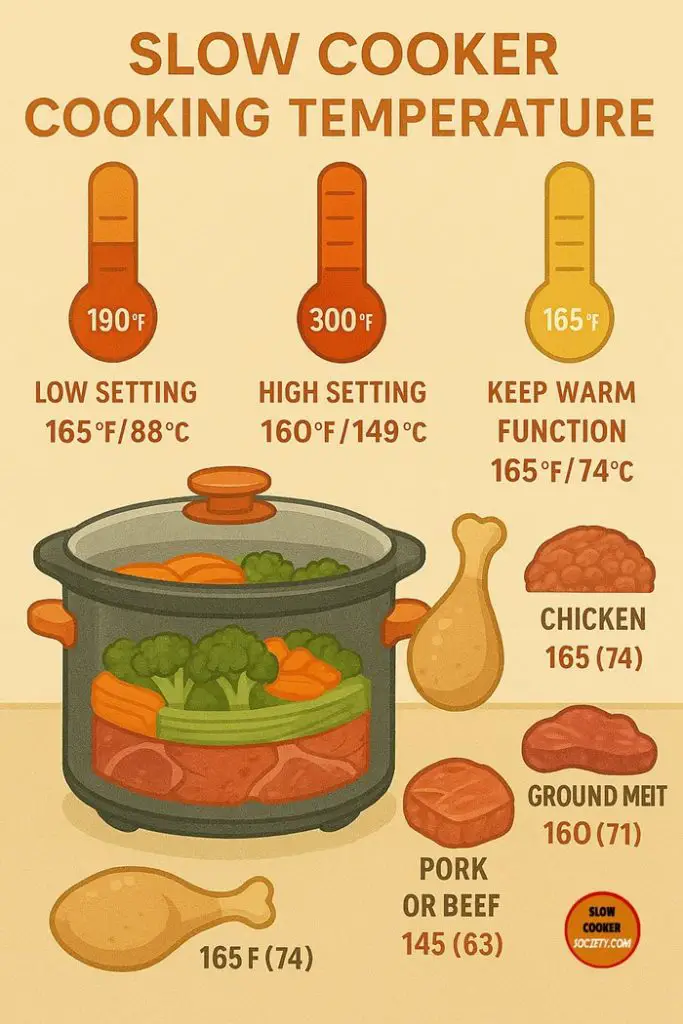
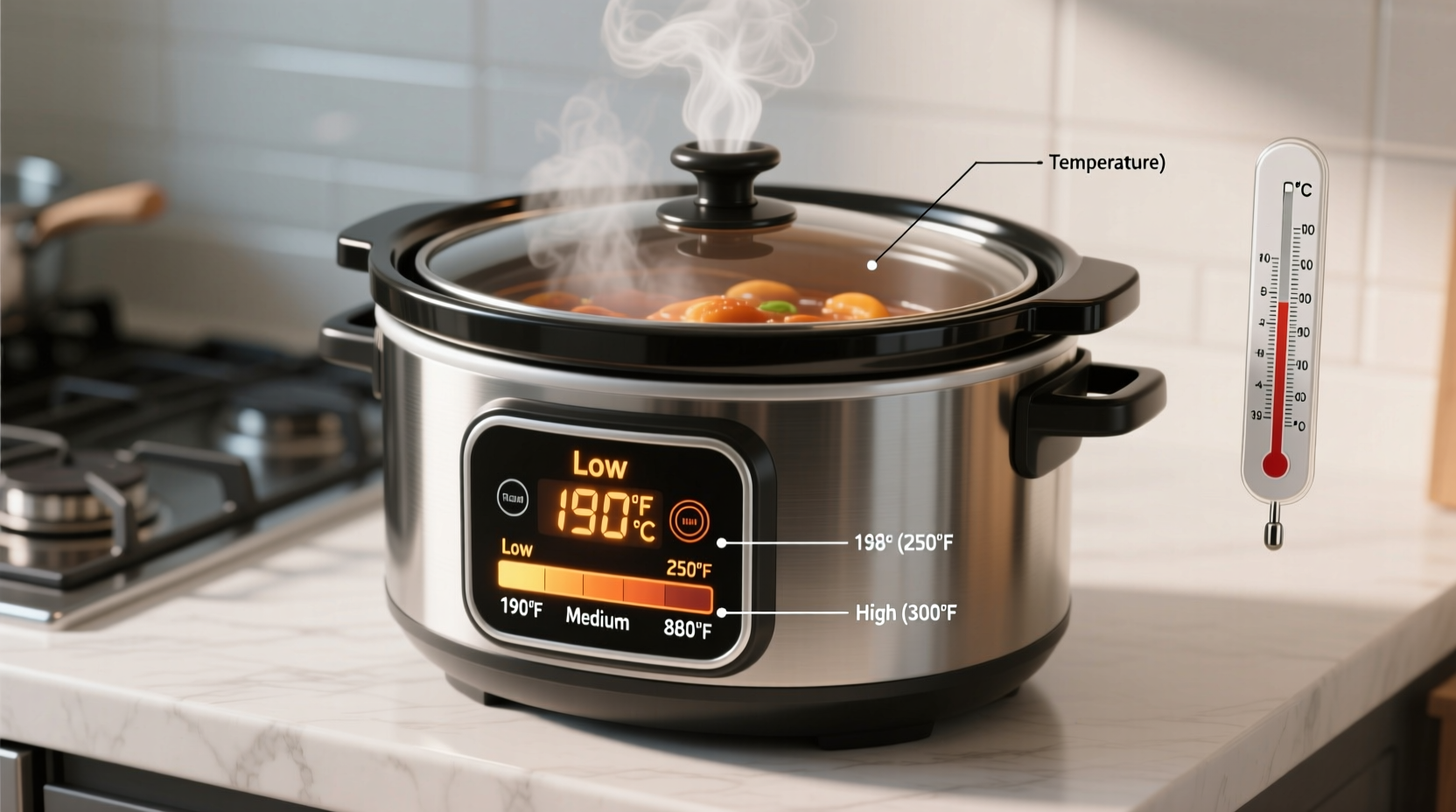
In the United States, a slow cooker usually cooks at about 190°F to 210°F on Low and 200°F to 300°F on High, depending on the brand, model, food load, and stage of cooking. These are general operating ranges, not fixed settings.
Most slow cookers heat food slowly until it reaches a gentle simmer. For food safety, the key number is 140°F: cooked food should stay at or above 140°F when held for serving. A slow cooker set to Warm is for holding already-cooked food, not for cooking raw meat from the start.

Slow cooker temperature settings explained
A slow cooker does not act like an oven with one exact temperature. Its Low, High, and Warm settings control how fast the heating element works. The food’s temperature changes as it heats, and the final temperature depends on the recipe and the cooker.
| Slow cooker setting | Typical food temperature | Main use |
|---|---|---|
| Low | About 190°F–210°F | Long cooking, often 6–10 hours |
| High | About 200°F–300°F | Faster cooking, often 3–5 hours |
| Warm | Usually 140°F or higher | Holding cooked food for serving |
| Off | Drops over time | Do not use for safe food holding |
These ranges are estimates. Some models reach a simmer on Low, while others may run hotter or cooler. The recipe, amount of food, starting temperature, and lid position also affect the result.
What temperature does “Low” reach?
The Low setting commonly brings food to about 190°F to 210°F after several hours. Many slow cookers let liquid reach a gentle simmer on Low.
Low is best for:
- Tough cuts of beef, pork, and poultry
- Stews and chili
- Dried beans that have been prepared correctly
- Recipes that need a long cooking time
- Foods that may become tough or dry on High
Low does not mean the food stays cold. The cooker still heats the food to a temperature well above the 140°F food-safety threshold.
What temperature does “High” reach?
The High setting often brings food to about 200°F to 300°F, though the food itself may not reach 300°F. Water-based foods usually remain near the boiling point of water, about 212°F at sea level, once they simmer.
High is useful when:
- You have less time to cook
- The recipe is designed for faster cooking
- You need to bring ingredients to a simmer sooner
- The food does not need a long, gentle cook
High does not always cut cooking time in half. A recipe written for 8 hours on Low may not be ready after 4 hours on High. Follow the recipe’s stated time and check the food’s internal temperature.
What temperature does “Warm” reach?
Warm should keep cooked food at 140°F or above, which is the minimum hot-holding temperature used in U.S. food-safety guidance.
Warm is not a cooking setting. Do not place raw meat, poultry, or other perishable ingredients in a slow cooker on Warm and expect them to cook safely. Use Low or High to cook the food first, then switch to Warm for serving.
How hot does food get in a slow cooker?
Food in a slow cooker often reaches a temperature near the boiling point of water when the liquid begins to simmer. However, the temperature is not the same in every part of the cooker.
A slow cooker may have:
- Hotter areas near the sides and bottom
- Cooler spots near the top
- A warmer surface around the heating element
- Different temperatures in thick and thin parts of the dish
This is why a recipe can contain both tender meat and undercooked meat if the cooker is overfilled, the lid is lifted often, or the food is cut into uneven pieces.
Why does a slow cooker not cook at one exact temperature?
The cooker uses a thermostat and heating element. When the pot reaches a target range, the thermostat cycles the heat on and off. The cooker is designed to maintain a gentle cooking environment rather than one precise temperature across the entire pot.
The final food temperature depends on:
- The setting: High heats faster than Low.
- The amount of food: A full pot takes longer to heat.
- The starting temperature: Cold ingredients take longer than room-temperature ingredients.
- The liquid level: Liquid transfers heat well and helps prevent dry spots.
- The lid: Heat escapes each time the lid is removed.
- The cooker’s size and design: A small cooker may heat differently from a large one.
- The shape and thickness of the food: Large roasts heat more slowly in the center.
Does a slow cooker boil?
A slow cooker can bring liquid to a simmer, and some models may produce a stronger boil on High. It usually does not boil as vigorously as a saucepan over direct heat.
A gentle simmer may show as:
- Small bubbles around the edge
- Steam under the lid
- Soft movement in the liquid
- Tender food after the expected cooking time
Do not use the presence or absence of bubbles as the only safety test. Use a food thermometer to check meat and poultry.

Slow cooker temperatures and food safety
The safest approach is to use the slow cooker as directed by the manufacturer and verify the finished food with a food thermometer. A slow cooker may heat food safely, but poor preparation can still create a risk.
The U.S. Department of Agriculture identifies 40°F to 140°F as the food “danger zone,” where bacteria can grow quickly. Keep raw ingredients cold until cooking begins, and do not leave perishable food at room temperature for long periods.
Safe temperature targets for common foods
The following minimum internal temperatures come from USDA guidance:
| Food | Minimum internal temperature |
|---|---|
| Poultry, including chicken and turkey | 165°F |
| Ground meats | 160°F |
| Beef, pork, lamb, and veal steaks, chops, and roasts | 145°F, followed by a 3-minute rest |
| Leftovers and casseroles | 165°F |
| Egg dishes | 160°F |
Insert the thermometer into the thickest part of the food. Avoid touching a bone, the pot, or a pocket of liquid, since those spots can give a misleading reading.
Can you cook frozen meat in a slow cooker?
The USDA advises against putting frozen meat or poultry directly into a slow cooker. Frozen food may spend too long in the danger zone while the center remains cold.
Thaw meat safely in one of these ways:
- In the refrigerator
- In cold water, changing the water often
- In a microwave, followed by immediate cooking
Do not thaw meat on the kitchen counter.
How long can food stay in a slow cooker?
Keep cooked food at 140°F or higher while serving. If the food falls below 140°F for an extended period, safety becomes uncertain.
For leftovers, refrigerate food within 2 hours of cooking or serving. If the surrounding temperature is above 90°F, refrigerate it within 1 hour. Divide large amounts into shallow containers so they cool faster.
When reheating leftovers, heat them to 165°F before placing them in a slow cooker for serving. A slow cooker is intended to hold hot food, not rapidly reheat cold leftovers.
How to check the temperature of a slow cooker
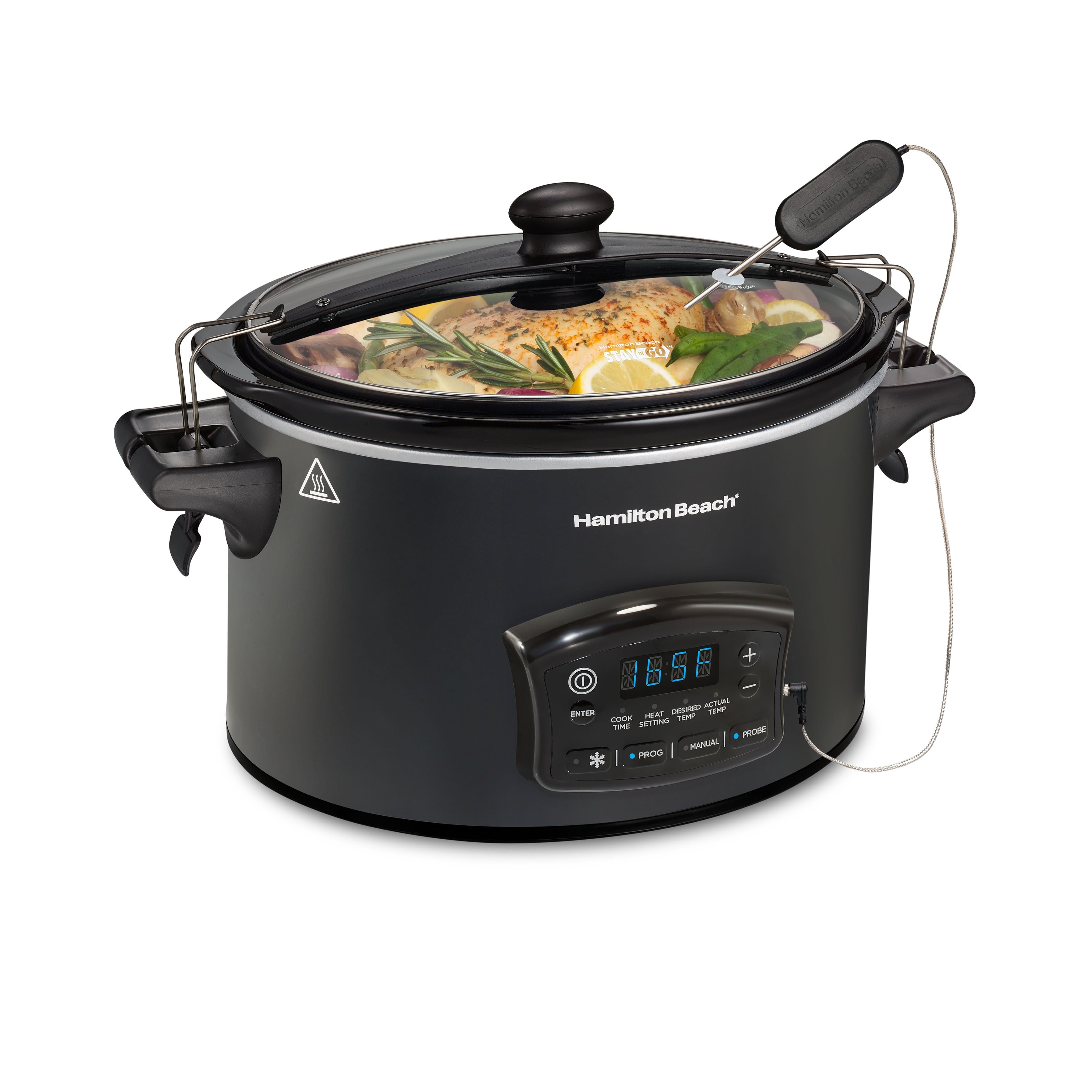
A food thermometer can show whether the food is hot enough, but it may not tell you the exact temperature of the heating element. For most home cooking, checking the food is more useful than measuring the empty pot.
To check the food temperature
- Stir the food if it is a soup, sauce, or stew.
- Place the thermometer in the thickest part of the meat.
- Avoid touching the bone or the ceramic insert.
- Take readings in more than one spot.
- Check the coolest-looking area if the food appears uneven.
- Clean the thermometer after use.
For thick foods, such as chili or pulled pork, check several places. The center may be cooler than the edges.
To test a slow cooker with water
You can perform a basic home test with water:
- Fill the slow cooker halfway with water.
- Cover it with the lid.
- Run it on Low for about 8 hours.
- Stir the water before measuring.
- Check the temperature with a calibrated thermometer.
This test can show whether the cooker reaches a hot, simmering range. It does not prove that every recipe will cook at the same rate. It also does not replace the manufacturer’s instructions or a food-safety check.
If the cooker does not become hot after several hours, the lid does not fit, or the food remains lukewarm, stop using it until the problem is resolved.
Low versus High: which setting should you use?
Choose Low when the recipe needs a long cooking time and gentle heat. Choose High when the recipe allows faster cooking and you can still check that the food reaches a safe internal temperature.
| Choose Low when… | Choose High when… |
|---|---|
| You have 6–10 hours | You have about 3–5 hours |
| Cooking a tough roast | Making a faster stew |
| You want gradual tenderizing | The recipe specifically allows High |
| You will be away for much of the day | You can monitor the food more closely |
| The food could dry out with stronger heat | The ingredients can handle a quicker cook |
Do not switch between settings without checking the recipe. Moving from Low to High changes the cooking rate, but it does not create a precise time conversion.
Can you cook a recipe on High instead of Low?
Often, yes, but not always. Many recipes use about half the time on High as a rough guide. That is only an estimate.
For example:
- 8 hours on Low may take about 4–5 hours on High.
- 6 hours on Low may take about 3–4 hours on High.
The correct finish point is based on tenderness and internal temperature, not the clock alone. Large roasts may need more time even on High, while small pieces may finish early.
How to get even heating in a slow cooker
Use the correct amount of food and keep the lid closed. These simple steps help the cooker heat more evenly.
Follow these practices:
- Fill the cooker between one-half and two-thirds full, unless the manual says otherwise.
- Cut meat and vegetables into similar sizes.
- Put dense vegetables, such as carrots and potatoes, near the bottom.
- Place meat where it has good contact with the liquid and heat.
- Thaw meat before cooking.
- Keep the lid on during cooking.
- Avoid packing food tightly around a large frozen or very cold roast.
- Use the recipe’s recommended liquid amount.
- Check the food before the expected end time if your cooker runs hot.
A slow cooker needs space for heat to circulate. An overfilled pot may cook slowly and unevenly. An underfilled pot may heat faster and dry out the food.
Why is the food still cold after several hours?
Possible causes include:
- The slow cooker is too full.
- The lid was removed often.
- Ingredients were frozen.
- The cooker is too large for the recipe.
- The appliance has a faulty thermostat or heating element.
- The outlet or power cord is not working correctly.
- The recipe contains too much cold liquid.
- The cooker was set to Warm instead of Low or High.
If food has remained below 140°F for an uncertain length of time, do not taste it to test safety. When in doubt, discard it.

Common slow cooker temperature mistakes
The most common mistake is treating Low, High, and Warm as exact temperatures. They are cooking modes, and the actual food temperature can vary between models.
Avoid these errors:
Using Warm to cook raw food
Warm is for holding cooked food. It may not raise raw meat through the danger zone quickly enough.
Lifting the lid too often
Each lid lift lets heat and steam escape. It can lengthen cooking time and make the food heat less evenly.
Filling the cooker to the top
An overfilled cooker may not heat the center properly. Leave enough space for the food and liquid to move.
Using a slow cooker to reheat cold food
Reheat leftovers on the stove, in an oven, or in a microwave until they reach 165°F. Then use the slow cooker to keep them hot.
Relying on cooking time alone
Time does not prove that poultry, ground meat, or a roast has reached a safe temperature. Use a thermometer.
Leaving the appliance unattended when it shows signs of failure
Stop using a slow cooker if it has a damaged cord, cracked ceramic insert, exposed wiring, unusual smells, sparks, or a control that does not work properly. Unplug it and contact the manufacturer or replace it.

Frequently asked questions
Is a slow cooker hotter on High than on Low?
Yes. High usually heats food faster and may produce a stronger simmer. The exact temperature varies by cooker, and the food itself often stays near the temperature of simmering water once it becomes liquid and hot.
Is 200°F hot enough for a slow cooker?
Yes, 200°F is within the normal cooking range for many slow cookers. Water-based foods can cook safely at this temperature when the cooker is used correctly and the food reaches the required internal temperature.
What is the safest slow cooker temperature?
For cooking, use Low or High according to the recipe. For holding cooked food, keep the food at 140°F or higher. Raw meat should not be held on Warm as a substitute for cooking.
Can a slow cooker reach 212°F?
Yes, liquid in some slow cookers can reach a simmer near 212°F at sea level. The exact boiling point changes with altitude, and not every part of the food will reach the same temperature at the same time.
How do I know if my slow cooker is working properly?
Place water in the cooker, cover it, and run it on Low for several hours. The water should become clearly hot, and it may reach a simmer. If the cooker stays lukewarm, has a damaged cord, or behaves inconsistently, stop using it and check the manual or contact the manufacturer.
Bottom line
A typical slow cooker runs at about 190°F to 210°F on Low and 200°F to 300°F on High, but these settings are not exact temperatures. The food often reaches a gentle simmer, while Warm should keep cooked food at 140°F or above.
Use Low or High to cook raw ingredients, check meat with a food thermometer, and use Warm only after the food is fully cooked. For the most accurate information, check the manual for your specific slow cooker model because heating performance differs between appliances.