
Cooking spaghetti squash in a slow cooker is simple: add water, place the squash in the cooker, and cook until a fork slides through the skin and flesh. A whole squash usually takes 3 to 4 hours on HIGH or 6 to 8 hours on LOW. Halved squash cooks faster, often in 2 to 3 hours on HIGH or 4 to 6 hours on LOW.
This method works well in American home kitchens because it needs little active work and does not heat the oven. It is useful during busy weeknights, hot summers, and holiday meal prep. The cooked strands can replace pasta or serve as a base for sauce, vegetables, meat, or beans.
Introduction
Spaghetti squash is a winter squash sold in many U.S. grocery stores and farmers markets. When cooked, its soft flesh separates into long strands that resemble spaghetti. It does not taste exactly like pasta, but it works well in dishes that use marinara, pesto, cheese, or meat sauce.
A slow cooker gives the squash gentle, steady heat. You can cook it whole or cut it in half first. Cooking it whole is easier, while cooking it in halves can shorten the cooking time and makes it easier to remove the seeds before cooking.

What You Need
You need only a few basic items:
- 1 medium spaghetti squash
- 1 cup water
- A 6-quart slow cooker, if the squash fits comfortably
- A sharp chef’s knife, if cutting the squash
- A fork
- Tongs or oven mitts
- A large spoon
- A kitchen thermometer for checking the finished squash if desired
The water creates steam inside the covered cooker. The squash does not need to sit fully underwater. Too much water can make the flesh wet and dilute its flavor.
Choose a squash that feels firm and heavy for its size. The skin should be hard and free from soft, leaking, or deeply damaged spots. Small and medium squash are usually easier to fit in a slow cooker than very large ones.
How to Cook a Whole Spaghetti Squash in a Slow Cooker
Cooking the squash whole is the simplest option. You do not need to cut through its hard skin before cooking.
Steps
-
Wash the squash.
Rinse the skin under cool running water and scrub away visible dirt. Dry it with a clean towel. -
Pierce the skin.
Use a sturdy fork or the tip of a small knife to make about 8 to 12 small holes around the squash. Space the holes over several sides. These openings let steam escape. -
Add water to the slow cooker.
Pour 1 cup of water into the cooker. -
Place the squash inside.
Set the whole squash in the cooker. It should fit without forcing the lid upward. Keep the lid closed during cooking. -
Cook until tender.
Cook for about 3 to 4 hours on HIGH or 6 to 8 hours on LOW. The exact time depends on the squash’s size, shape, age, and the slow cooker’s heat. -
Check for doneness.
The skin should give slightly when pressed with tongs. A fork or thin skewer should pass through the skin and flesh with little resistance. -
Cool before cutting.
Move the squash to a cutting board with tongs. Let it cool for several minutes. It will be very hot inside. -
Cut and remove the seeds.
Slice the squash lengthwise. Scoop out the seeds and the stringy center with a large spoon. -
Pull the strands apart.
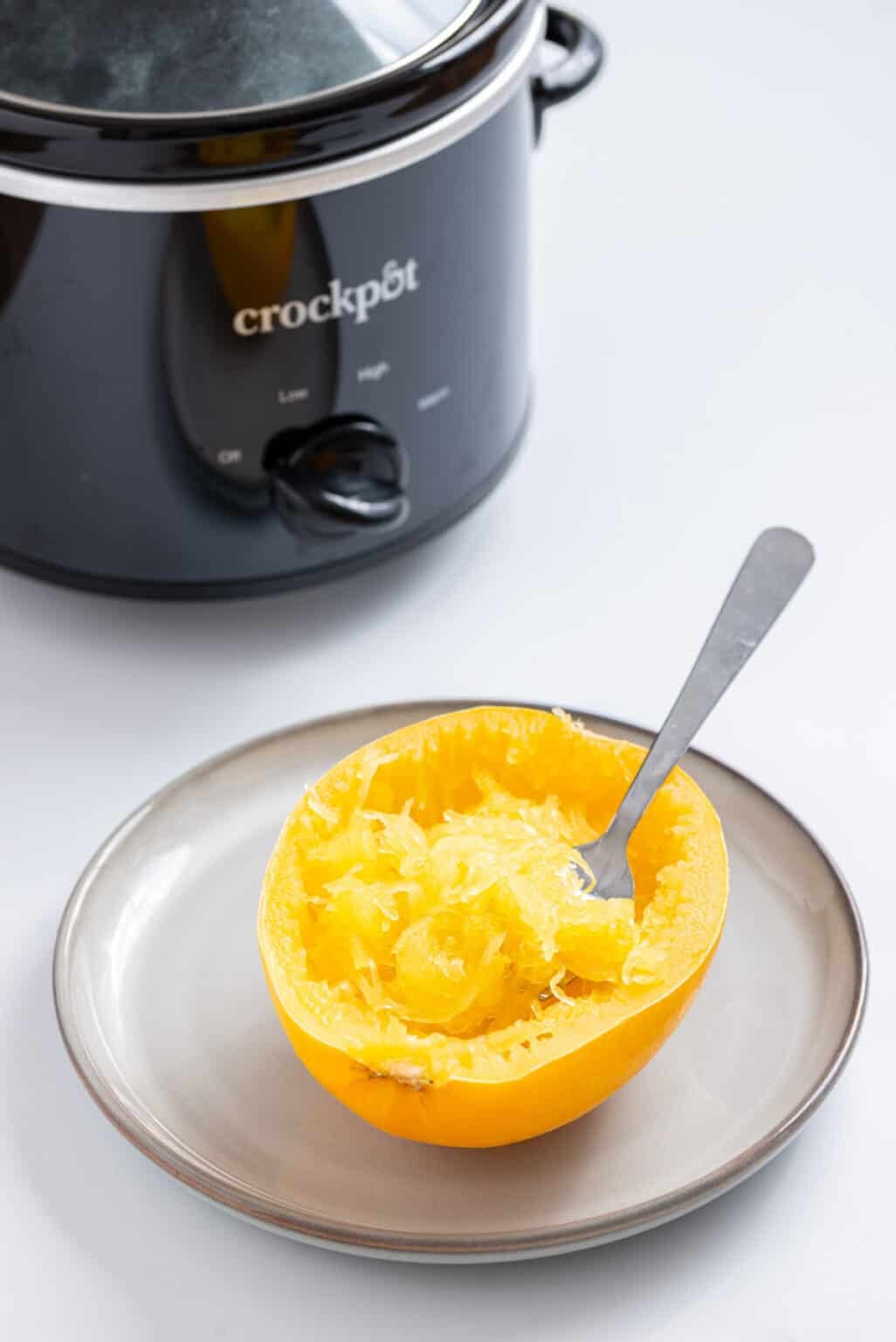
Use a fork to scrape the flesh from end to end. Serve the strands warm.
Do not cut into a whole squash as soon as it leaves the slow cooker. Steam can escape quickly and cause burns. Use a stable cutting board and keep your hands away from the first opening.

How to Cook Spaghetti Squash Halves in a Slow Cooker
Halving the squash before cooking gives you more control over the final texture. It also lets you remove the seeds first and season the flesh before it cooks.
Steps
- Wash and dry the squash.
- Cut it lengthwise.
Place the squash on a stable cutting board. Cut from stem to end with a sharp knife. If the squash is too hard to cut safely, use the whole-squash method instead. - Scoop out the seeds.
Remove the seeds and loose fibers with a spoon. You can save the seeds for roasting. - Add water.
Pour 1 cup of water into the slow cooker. - Place the halves cut side down.
Set the halves in the cooker. They should fit in one layer if possible. - Cook until tender.
Cook for about 2 to 3 hours on HIGH or 4 to 6 hours on LOW. - Test the thickest part.
Insert a fork into the skin and flesh. The fork should slide in easily. - Drain and scrape.
Remove the halves carefully. Let them cool briefly, then scrape the flesh into strands with a fork.
Cooking the halves cut side down usually gives a firmer texture than cooking them in extra liquid. It also reduces the chance of watery strands.

Whole or Halved: Which Method Is Better?
The best method depends on your priority.
| Method | Typical cooking time | Main benefit | Main drawback |
|---|---|---|---|
| Whole on LOW | 6–8 hours | Easiest prep | Longer cooking time |
| Whole on HIGH | 3–4 hours | No cutting of hard raw squash | Must cool before cutting |
| Halved on LOW | 4–6 hours | Seeds are removed first | Requires careful cutting |
| Halved on HIGH | 2–3 hours | Faster cooking | Can become soft if overcooked |
Choose whole squash when you want the safest and easiest preparation. Choose halves when you want faster cooking or prefer to season the flesh before cooking.
The size of the squash matters more than the exact clock time. A small squash may finish early, while a large squash may need extra time. Start checking at the early end of the range rather than relying on time alone.
How to Tell When Spaghetti Squash Is Done
The squash is done when the flesh is tender but still holds its shape. Use these signs together:
- A fork penetrates the skin and flesh easily.
- The flesh separates into strands when scraped.
- The center is no longer hard or crunchy.
- The squash feels tender when lifted with tongs.
- The strands remain intact instead of turning into mash.
For a more precise check, measure the thickest part with an instant-read thermometer. A temperature around 180°F to 190°F generally indicates that the flesh is fully tender, but texture remains the best test for this vegetable.
If the squash is undercooked, return it to the slow cooker and continue cooking for 30 to 60 minutes. If it is mushy, reduce the next cooking time and use less liquid. You can also drain the cooked strands in a colander for several minutes.

How to Prevent Watery Spaghetti Squash
Watery strands usually come from excess moisture or overcooking. These steps help:
- Use about 1 cup of water, not several cups.
- Place halved squash cut side down.
- Avoid adding broth unless you want a softer, seasoned result.
- Do not scrape the flesh immediately into a pool of cooking liquid.
- Let the cooked halves drain briefly before serving.
- Cook only until tender.
- If needed, spread the strands in a skillet over medium heat for a few minutes to remove extra moisture.
Spaghetti squash naturally contains a large amount of water. The slow cooker traps steam, so the final texture may be softer than oven-roasted squash. If you want drier, more caramelized strands, roasting is usually a better method.
Seasoning Ideas and Serving Options
Season the squash after cooking for the clearest flavor. Toss the warm strands with:
- Olive oil, salt, and black pepper
- Butter, garlic, and Parmesan
- Marinara sauce and ground beef or turkey
- Pesto and roasted vegetables
- Lemon juice, feta, and chickpeas
- Chili powder, lime juice, black beans, and corn
- Soy sauce, sesame oil, and cooked vegetables
For a simple American weeknight meal, top the strands with tomato sauce and meatballs. For a lighter dish, use pesto, spinach, and white beans. The squash can also fill tacos, support a grain bowl, or replace noodles in a casserole.
The strands are easiest to separate while warm. For longer strands, scrape from the outer edge toward the center instead of stirring the flesh repeatedly.

Food Safety and Storage
Cooked spaghetti squash should be handled like other cooked vegetables. Transfer leftovers to a shallow container and refrigerate them within 2 hours. If the room temperature is above 90°F, refrigerate them within 1 hour.
Store cooked strands in a covered container in the refrigerator and use them within 3 to 4 days. Reheat them until steaming hot. A microwave, skillet, or covered saucepan can work well.
You can freeze cooked spaghetti squash, although the strands may become softer after thawing. Cool them first, remove extra moisture, and freeze them in airtight portions. Thaw in the refrigerator and use the squash in soups, casseroles, sauces, or skillet meals.
Do not leave cooked squash in a switched-off slow cooker for hours. A slow cooker may keep food warm for a time, but it is not a substitute for prompt refrigeration.
For general slow-cooker food safety guidance, see the USDA’s slow cooker safety recommendations.
Common Problems and Fixes
The squash does not fit
Do not force the lid closed. Use a smaller squash, cut it in half, or use a larger slow cooker. A lid that does not seal properly can extend cooking time and increase moisture loss.
The squash is still hard
It may be too large, undercooked, or positioned in a cooler part of the cooker. Continue cooking and check it every 30 minutes. If the squash was halved, test the thickest area near the center.
The strands are mushy
The squash was likely overcooked or exposed to too much liquid. Drain it well and use it in soup, sauce, or a casserole. Next time, check it sooner and use only 1 cup of water.
The skin split during cooking
A small split is not usually a problem. Steam and heat soften the skin. Remove the squash carefully, allow it to cool, and check that the flesh smells fresh and looks normal.
The squash has a bitter taste
A strong, unusual bitterness is a reason to stop eating it. Some squash can contain naturally occurring bitter compounds. Do not try to hide the taste with sauce; discard the squash if the bitterness is pronounced.
The squash is difficult to cut raw
Do not push a knife through a hard squash with force. Use the whole-cooking method, or soften the squash briefly by another safe method before cutting. Keep the squash stable and use a sharp knife.

Key Takeaways
- Use 1 cup of water in the slow cooker.
- Cook a whole squash for about 3 to 4 hours on HIGH or 6 to 8 hours on LOW.
- Cook halves for about 2 to 3 hours on HIGH or 4 to 6 hours on LOW.
- Test the thickest part with a fork rather than trusting the clock alone.
- Let a whole squash cool before cutting it.
- Use less liquid and avoid overcooking if you want firmer strands.
- Refrigerate leftovers within 2 hours and use them within 3 to 4 days.
Frequently Asked Questions
Can you put a whole spaghetti squash in a slow cooker?
Yes. Wash it, pierce the skin in several places, add about 1 cup of water, and cook it until tender. Piercing the skin allows steam to escape. Let the squash cool before cutting it open.
Do you have to add water when cooking spaghetti squash in a slow cooker?
Adding about 1 cup of water is a practical way to create steam and protect the cooker from drying out. The squash does not need to be submerged. Too much water can make the strands wet.
Is it better to cook spaghetti squash on HIGH or LOW?
Both settings work. HIGH is useful when you need the squash in a few hours. LOW suits meal planning and produces gentle cooking. Check the texture because slow cookers vary in heat and squash sizes differ.
Can you cook spaghetti squash without cutting it?
Yes. Whole cooking avoids cutting through the hard raw skin. Pierce the squash first, cook it until tender, and cut it only after it has cooled enough to handle safely.
Can you prepare spaghetti squash ahead of time?
Yes. Cook the squash, scrape out the strands, and refrigerate them in a covered container for up to 3 to 4 days. Reheat them in a skillet or microwave, then add sauce or seasoning.
Conclusion
The easiest way to cook spaghetti squash in a slow cooker is to pierce it, add 1 cup of water, and cook it whole until a fork passes through the flesh. Use halved squash when you want faster cooking or easier seasoning. Check tenderness rather than following the clock alone, then drain and season the strands to suit your meal.
For your next step, choose the whole method if cutting the raw squash feels difficult. Choose the halved method if you want a quicker dinner with more control over texture.