
The best knife sharpener kit makes dull blades feel safe, smooth, and ready for daily kitchen work.
A dull knife can turn a quick dinner into a slow, tiring chore. It may slip, crush tomatoes, or force you to press too hard. I tested the main types of sharpeners, from whetstones to guided systems and rolling tools, to help you choose with less guesswork. This guide compares angle control, grit, ease of use, safety, and long-term value. Whether you cook every day or sharpen a pocket knife now and then, there is a practical option here for your skill level.
Intelitopia Whetstone Knife Sharpener Set

The Intelitopia set is a full whetstone kit for cooks who want more than a quick edge touch-up. It includes coarse and fine grits, so I can repair a tired edge and then polish it. The 400/1000 stone handles shaping and basic sharpening, while the 3000/8000 stone helps create a smoother finish. The bamboo base and rubber supports help keep the setup steady during use.
This kit also includes a flattening stone, leather strop, and angle guide. Those extras matter because a whetstone needs a flat surface, and a strop can remove the small burr left after sharpening. The angle guide helps new users keep a steady position, though I still recommend learning to judge pressure by feel. For someone who wants a complete sharpening station, this is a strong candidate for the best knife sharpener kit.
Pros:
- Four useful grits cover repair, sharpening, and polishing
- Includes a flattening stone for better stone maintenance
- Leather strop helps refine the finished edge
- Multiple rubber bases improve grip on the counter
- Angle guide helps beginners build good technique
- Works well for many kitchen and utility knives
Cons:
- Whetstone sharpening takes more time than a pull-through tool
- Users must soak or prepare stones as directed
- Very coarse repair work still requires patience
My Recommendation
I recommend this set for home cooks who want to learn real knife sharpening. It suits people with several knives because the grit range can handle routine care and occasional edge repair. The included base parts make the kit easier to use than a loose stone alone. It offers excellent value when you want a complete system instead of buying each accessory later.
4-in-1 Three-Stage Kitchen Knife Sharpener
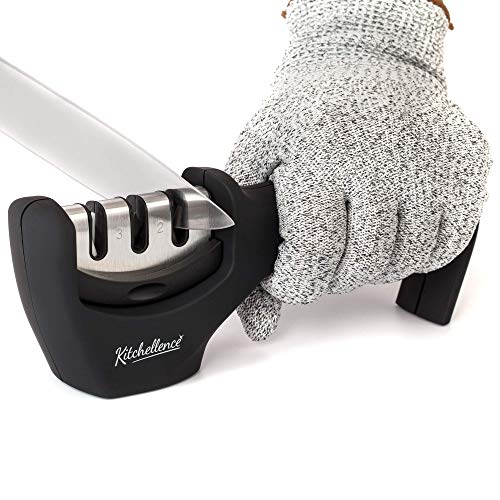
This compact 4-in-1 sharpener focuses on simple kitchen care. Its three-stage design is made to repair, restore, and polish an edge in a set order. That layout is useful for beginners because it removes much of the guesswork found with loose stones. The included cut-resistant glove adds a helpful safety layer while you learn.
I like this style for quick maintenance before meal prep. It takes up little drawer space and does not require water, soaking, or a special work area. However, a pull-through sharpener removes metal faster than careful stone work, so I would use light pressure and follow the instructions. It is a practical pick for a busy kitchen, but not the first choice for expensive handmade knives or delicate blades.
Pros:
- Three stages make the sharpening order easy to follow
- Compact size fits small kitchens and drawers
- Fast option for routine edge maintenance
- Cut-resistant glove adds extra hand protection
- Requires no soaking or stone preparation
- Simple design suits new users
Cons:
- Pull-through slots offer less control than a whetstone
- May remove more metal than needed with heavy pressure
- Not ideal for every blade shape or premium knife
My Recommendation
This sharpener is best for cooks who want a fast, low-fuss tool. It makes sense for basic stainless-steel kitchen knives that need a quick edge reset. The glove is useful for new users, but I still advise keeping the free hand behind the blade path. If convenience matters more than advanced control, this is an affordable best knife sharpener kit for everyday touch-ups.
AIERLIAN Rolling Knife Sharpener Kit

The AIERLIAN rolling sharpener uses a guided magnetic angle design rather than a fixed pull-through slot. Its 15- and 20-degree settings cover two common edge angles for kitchen knives. The rolling format lets me place the knife on a flat surface and move the sharpener along the blade. That motion feels natural for people who find whetstone technique difficult.
The diamond side is suited to sharpening, while the ceramic side helps refine the edge. The magnetic angle support can improve consistency, but I still need to keep the knife flat and use even strokes. Rolling sharpeners work best on reasonably straight-edged blades with enough room for the roller to travel. They may feel less convenient on very curved blades, thick bolsters, or unusual profiles.
Pros:
- Two common angle choices support flexible knife care
- Rolling action is easy for many beginners to understand
- Diamond and ceramic surfaces provide two stages
- Flat setup can feel safer than hand-held sharpening
- Useful for routine kitchen knife maintenance
- Magnetic guidance helps reduce angle changes
Cons:
- Requires a stable, clean counter surface
- Less suitable for strongly curved or unusual blades
- Users must control stroke speed and pressure
My Recommendation
I would choose this model for a home cook who wants guided sharpening without learning a full stone method. It is especially useful for standard chef knives, utility knives, and paring knives with fairly straight edges. The 15- and 20-degree settings make it easier to match common kitchen angles. For users who want a modern and approachable best knife sharpener kit, this rolling design deserves attention.
Sharp Pebble 1000/6000 Whetstone

The Sharp Pebble 1000/6000 stone gives home cooks a clean two-step path to a sharper edge. The 1000 side is the main working grit for dull knives, while the 6000 side provides a finer finish. This grit pairing suits normal maintenance when the blade is dull but not badly damaged. It also gives beginners a simple way to understand how coarse and fine stones differ.
Whetstones reward patience. I use light, even pressure and keep the same angle from heel to tip. The stone needs proper preparation and care, and it should be allowed to dry fully after use. This is not an instant fix, but it can create a smooth, controlled edge while removing less metal than aggressive sharpening methods.
Pros:
- Useful 1000/6000 grit pairing for home kitchens
- Fine side helps smooth and polish the edge
- Offers strong control over sharpening pressure
- Suitable for many common steel kitchen knives
- Teaches a valuable sharpening skill
- Compact format stores easily
Cons:
- Needs preparation before use
- Requires practice to hold a steady angle
- Does not include the broad grit range of a full kit
My Recommendation
This stone is best for cooks who want a straightforward entry into freehand sharpening. It works well when you prefer control and a quiet process over speed. I would pair it with a basic angle guide during the first few sessions, then practice without one as your muscle memory improves. It is a solid value for anyone seeking a traditional best knife sharpener kit without extra parts.
Work Sharp Precision Adjust Elite

The Work Sharp Precision Adjust Elite is a guided system for users who want repeatable angles. Its clamp and adjustable guide help hold the blade in a fixed position while the abrasive moves across the edge. That design reduces one of the hardest parts of sharpening: keeping the angle steady. It is suitable for kitchen knives, pocket knives, and other compatible blades.
This type of system gives me more control than a basic pull-through sharpener. I can work slowly, inspect the edge, and change the angle when the knife calls for it. The trade-off is setup time, since the knife must sit securely and the user must understand the progression of abrasives. For serious home cooks and knife owners, that extra control can pay off over many sharpening sessions.
Pros:
- Guided design helps maintain a consistent angle
- Adjustable setup supports different knife styles
- Useful for both kitchen and pocket knives
- Allows careful, controlled sharpening passes
- Better suited to precision work than basic pull-through tools
- Good long-term choice for regular knife owners
Cons:
- Costs more than simple manual sharpeners
- Setup takes longer than a quick touch-up tool
- Clamping and positioning require some practice
My Recommendation
I recommend this model for users who want accuracy but do not feel ready for freehand stones. It is a strong fit for cooks with quality knives, collectors, and people who sharpen several blade types. The guided angle system can produce more repeatable results than guessing by hand. If precision and long-term control matter most, this is one of the strongest choices for the best knife sharpener kit.
SHARPAL 202H Adjustable Sharpener

The SHARPAL 202H is built around adjustable angle control from 10 to 35 degrees. That wide range gives users more room to match thin slicing knives, general kitchen blades, and sturdier utility edges. An adjustable system can be useful when one household has knives with different bevel designs. It also helps users explore how angle affects sharpness, strength, and cutting feel.
I see this as a flexible tool for people who want more control than a fixed-angle sharpener provides. The broad adjustment range is helpful, but it also means the user must choose an appropriate setting instead of moving blindly. I would begin with the angle recommended by the knife maker when that information is available. With careful use, this design can support both regular maintenance and more focused edge work.
Pros:
- Wide 10–35-degree adjustment range
- Supports many knife types and edge preferences
- More flexible than fixed-angle sharpeners
- Useful for learning the effect of sharpening angles
- Good option for homes with mixed blade collections
- Allows a more tailored sharpening routine
Cons:
- Many angle choices may confuse new users
- Requires careful blade placement for even results
- Not as quick as a basic electric or pull-through tool
My Recommendation
This sharpener is best for an informed user who wants adjustable control. It suits people who own thin kitchen knives, thicker outdoor blades, or several brands with different edge needs. I would not choose it for someone who wants a one-step answer with no learning curve. For flexible angle work and future growth, it is a capable best knife sharpener kit option.
5 Precision Adjust Three-Stage Sharpener
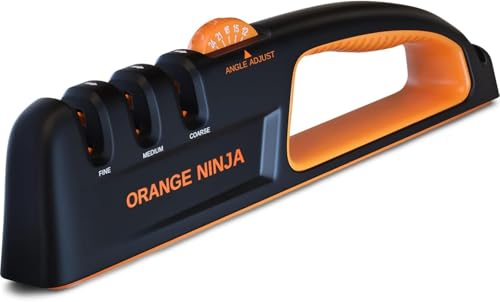
This three-stage precision adjust sharpener targets users who want guided maintenance in a compact format. Its staged process helps move from sharpening to refining without requiring a loose stone setup. The guided structure can make it easier to repeat the same motion each time. That consistency matters because an uneven bevel can make a knife feel sharp in one area and dull in another.
The system is a practical middle ground between a basic slot sharpener and a full professional sharpening station. It should appeal to users who want a clear process but do not need a large collection of stones. I recommend using modest pressure and checking the edge often instead of trying to finish the job in a few hard passes. A patient approach helps protect the blade and improves the final feel.
Pros:
- Three-stage process is easy to understand
- Guided design supports repeatable sharpening
- Compact choice for small counters and drawers
- Useful for routine kitchen knife care
- Less intimidating than freehand sharpening
- Good balance of control and convenience
Cons:
- May not suit blades with unusual profiles
- Users still need to learn correct pressure
- Provides less customization than a full whetstone set
My Recommendation
I would choose this for a beginner who wants more structure than a simple pull-through device. It is a useful option for standard kitchen knives and occasional household maintenance. The three-stage format creates a clear routine without a long setup. For practical results in a small package, it can serve as a budget-friendly best knife sharpener kit.
ORIVIX Rolling Knife Sharpener Kit

The ORIVIX rolling knife sharpener uses a magnetic base with four angle choices. This setup gives users a simple visual guide while they roll the abrasive along the blade. I find rolling tools appealing because the hand motion feels more natural than dragging a knife through a narrow slot. The magnetic angle design also gives the user a clear starting point for each side of the edge.
This kit works best when the counter is flat and the blade has a fairly even cutting edge. I would make slow passes from the heel toward the tip and avoid lifting the roller during the stroke. The tool is convenient for regular kitchen care, but it cannot replace the fine control of a carefully used whetstone. It is a good choice for users who want speed with a more guided feel.
Pros:
- Four angle choices offer useful flexibility
- Rolling movement is simple to learn
- Magnetic base helps guide the sharpening position
- Works well for many standard kitchen knives
- Easy to store and set up
- Less messy than water-based stone sharpening
Cons:
- Needs a stable, open counter space
- May struggle with highly curved blades
- Requires steady movement for an even edge
My Recommendation
The ORIVIX is best for a home cook who wants guided sharpening without a complicated clamp. It is a good match for users who like visual tools and prefer a dry, quick setup. The four angle options provide more choice than many simple sharpeners. If you want a modern best knife sharpener kit for common kitchen blades, this model is worth considering.
BOGONI Rolling Sharpener Classic Kit

The BOGONI rolling sharpener combines a diamond disc with a ceramic disc in a simple classic kit. The diamond surface can restore a dull working edge, while the ceramic side can help smooth the result. Its rolling form gives the user a steady motion and avoids the need to soak a stone. For regular kitchen use, that can make sharpening feel less like a project.
I recommend using this tool with light pressure, especially on a knife that only needs a touch-up. Heavy force can create excess wear and may make the edge rough. The roller is most comfortable on blades with a normal straight profile and enough clearance for the disc. It offers a useful blend of speed and control, though experienced sharpeners may still prefer a larger grit system.
Pros:
- Diamond and ceramic discs support two sharpening steps
- Rolling format feels natural for many users
- Dry operation reduces setup and cleanup
- Compact design stores easily
- Useful for routine home kitchen maintenance
- Simple approach for people new to sharpening
Cons:
- Less versatile than a multi-grit stone set
- Not ideal for strongly curved blade edges
- Pressure control affects the final result
My Recommendation
This BOGONI kit is best for users who want a quick rolling tool with two abrasive surfaces. It suits everyday knives that need regular care rather than major damage repair. I like it for small kitchens where a wet stone setup feels inconvenient. It provides good practical value as a compact best knife sharpener kit for routine use.
HORL 3 Cruise Rolling Sharpener

The HORL 3 Cruise is a premium-style rolling sharpener with 15- and 20-degree angle options. Its diamond and steel discs are designed for a guided sharpening routine with a clean, controlled feel. The rolling body lets the knife rest on the counter while the sharpener moves along the edge. This can help users who want a polished process without freehand stone practice.
The 15-degree setting may suit thinner, refined kitchen edges, while 20 degrees can offer a more robust everyday edge. The right choice depends on the knife and the maker’s design, so I would not change an edge angle without a reason. The HORL format is easy to understand, but its premium position may not suit someone who sharpens only once or twice a year. For frequent users, the smooth workflow and build-focused design can justify the investment.
Pros:
- Two common angle settings support varied kitchen knives
- Rolling design offers a guided sharpening motion
- Diamond disc helps restore a working edge
- Steel disc supports finishing and maintenance
- Clean setup needs no soaking or slurry
- Premium format suits frequent knife care
Cons:
- Higher cost than basic manual sharpeners
- Not designed for every unusual blade shape
- Angle choices are limited compared with adjustable systems
My Recommendation
I recommend the HORL 3 Cruise for cooks who sharpen often and value a refined user experience. It is a strong fit for quality kitchen knives with normal straight edges. The 15- and 20-degree choices are simple enough for regular use, while the rolling design reduces the learning curve. If build quality and ease matter more than the lowest price, it is a premium best knife sharpener kit option.
How I Compare a Knife Sharpener Kit
I do not judge a sharpener by the word “professional” on its package. I look at the edge control, abrasive type, safety, setup, and likely learning curve. A good tool should make the blade sharper without making the process stressful. It should also match the knife, because a tool made for a broad chef knife may not suit a serrated blade or a very thin Japanese edge.
Angle control is one of the most important factors. Many kitchen knives use an angle near 15 to 20 degrees per side, but the correct angle depends on the knife design and intended use. A thin edge can slice beautifully but may need careful handling. A wider angle can offer more strength for rough work. When a brand provides an angle guide, I treat it as a helpful starting point, not a substitute for reading the knife maker’s instructions.
Grit also changes the job. Coarse abrasives remove metal faster and help repair a damaged or very dull edge. Medium grits handle normal sharpening, while fine grits refine and polish the edge. I avoid using a coarse surface for every touch-up because unnecessary metal removal shortens the useful life of a knife. This is why a complete whetstone set can offer more control than a one-stage tool.
Whetstone, Rolling, or Pull-Through?
A whetstone is the most flexible option in this review. It lets me choose pressure, angle, and sharpening speed. It also gives the best feedback because I can feel how the blade moves across the stone. The drawback is the learning curve. A first-time user may create an uneven bevel until the hand learns the correct motion.
A rolling sharpener offers a middle path. It guides the angle and uses a dry setup, so it feels easier than freehand work. It can be a smart choice for a cook who wants control without a long lesson. The main limit is blade shape. A roller may not follow a deep curve or unusual profile as well as a stone.
A pull-through sharpener is the fastest and simplest style. It can help a busy household restore a basic edge with little preparation. Still, I use it with care because hard pressure can remove more metal than needed. It is best for common knives that need a quick refresh, not for every high-value or delicate blade.
How to Use the Best Knife Sharpener Kit Safely
Start with a clean, stable work surface. A moving stone or roller can cause a slip, so I never sharpen on a wet or crowded counter. Read the product directions before the first use, especially when the tool has a clamp, angle dial, or stone that needs soaking. Keep fingers away from the cutting edge and move the blade in a controlled path.
Use light pressure. The abrasive should do the work, not muscle. I begin with a few slow passes, then inspect the edge and remove any metal dust before continuing. If the knife is badly damaged, I take extra time rather than forcing the tool through the problem area.
After sharpening, I wash and dry the knife by hand. I also clean the sharpener according to its instructions. A whetstone needs to dry completely before storage, and some stones need occasional flattening. Good care keeps both the sharpener and the knife working longer.
How to Tell When a Knife Is Sharp
A sharp knife should cut food with little force. A tomato is a useful test because a dull blade tends to skid or crush the skin. A sharp blade should start the cut with gentle pressure. I avoid testing sharpness by running a finger across the edge. That test can cause an injury and tells me less than a real cutting task.
Look for a clean, even edge from heel to tip. If one part cuts well and another part slips, the bevel may not be even. A small burr can appear during sharpening, but the final edge should feel clean when tested on food or paper. If the knife becomes rough after sharpening, the user may need a finer finishing step or less pressure.
Best Features at a Glance
| Best for | Why |
|---|---|
| Learning traditional sharpening | The Intelitopia and Sharp Pebble stones provide hands-on angle and pressure control. |
| Fast, guided kitchen care | Rolling and three-stage tools simplify routine sharpening with less setup. |
| Advanced angle control | Work Sharp and SHARPAL systems suit users who want repeatable, adjustable results. |
Buying Guide for the Best Knife Sharpener Kit
First, consider how often you sharpen. If you cook daily, a durable system with several stages may save time and money. If you sharpen only a few times each year, a compact rolling or pull-through tool may be enough. Buying more features than you will use can create clutter rather than better results.
Next, check the knife material and edge type. Most of these tools suit standard steel kitchen knives, but not every sharpener works with ceramic blades. Serrated knives also need a special method because their teeth do not sit flat against a normal sharpening surface. When in doubt, follow the knife maker’s care instructions.
Think about storage and cleanup. Whetstones need a place to dry, while rolling and pull-through systems are usually ready to put away after cleaning. Counter space matters too. A large guided system may be excellent in a workshop but less convenient in a small apartment kitchen.
Finally, consider your patience. The best knife sharpener kit is not always the one with the most parts. It is the one you will use correctly and often. A simple tool that fits your routine can outperform an advanced system that stays in the box.
Common Mistakes to Avoid
The most common mistake is using too much pressure. Pressing hard can scratch the blade, wear the abrasive, and create an uneven edge. I let the sharpener work at a slow pace and stop when the edge improves.
Another mistake is changing angles from one stroke to the next. This can create a rounded bevel that feels dull even after many passes. Guided systems help, but freehand users can improve by resting the fingers consistently and keeping the wrist steady.
Many people also sharpen too often. A knife that only needs a few strokes should not go through a coarse stage. Regular honing or a fine ceramic pass may be enough for light maintenance. Save major sharpening for when the edge truly needs it.
FAQs Of best knife sharpener kit
What is the best knife sharpener kit for beginners?
A guided sharpener or rolling system is usually easiest for a beginner. It helps control the angle and reduces the guesswork found with freehand stones. A whetstone is also a good choice if you are willing to practice.
Are whetstones better than pull-through sharpeners?
Whetstones offer more control and can remove less metal when used correctly. Pull-through sharpeners are faster and easier, but they give the user less control. The better choice depends on your skill, knife type, and time.
What angle should I use to sharpen a kitchen knife?
Many kitchen knives use about 15 to 20 degrees per side, but the maker’s recommendation should come first. A thinner angle can slice well, while a wider angle may provide more edge strength. Always match the tool to the knife design.
Can one sharpener work on every knife?
No. Standard sharpeners may not suit serrated, ceramic, very thick, or unusually curved blades. Check compatibility before sharpening a specialty knife.
How often should I sharpen kitchen knives?
Sharpen when the knife starts to slip, crush food, or require extra force. Light users may sharpen a few times per year, while busy cooks may need more frequent care. Use a fine maintenance step before reaching for a coarse abrasive.
Final Verdict: Which Should You Buy?
For most serious home cooks, the Intelitopia set is the best knife sharpener kit because it includes useful grits, a base, a flattening stone, and a strop. Choose Work Sharp for guided precision, or a rolling model for quick daily care.
The right sharpener should match your knife and your patience. Use light pressure, keep a steady angle, and care for the edge often for safer, smoother cutting.