
Introduction
A slow cooker works by using a low electric heat source to warm a ceramic or metal crock. The crock holds the food and spreads heat slowly through the meal. A lid traps heat and moisture, so food cooks for several hours with little stirring.
In U.S. kitchens, slow cookers are often used for soups, chili, beans, roasts, pulled pork, and other meals that benefit from gentle heat. The appliance does not “boil” food in the same way as a pot on a stove. Instead, it raises the food temperature over time and keeps it warm through thermostat-controlled heating cycles.

What Is a Slow Cooker?
A slow cooker is a countertop electric appliance that cooks food in a removable vessel at a steady, low temperature. It is also called a crock-pot, although Crock-Pot is a brand name.
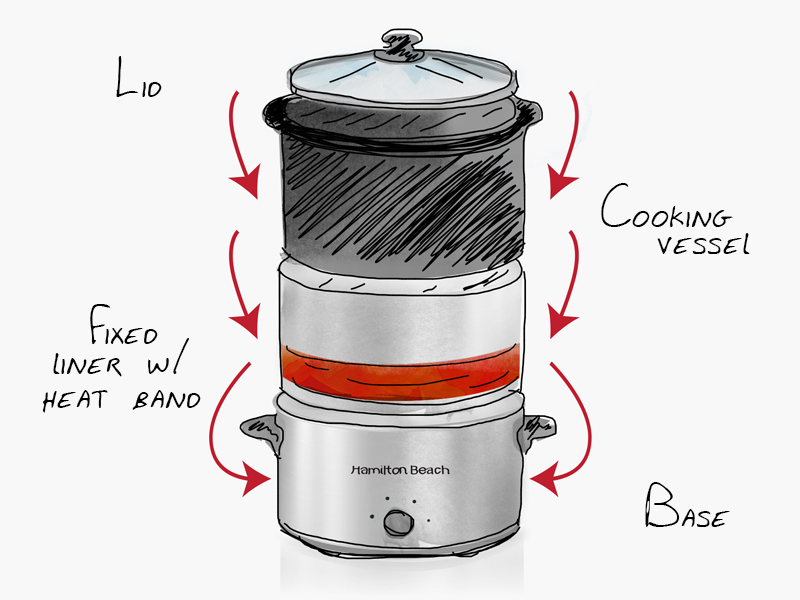
Most slow cookers have four main parts:
- Outer housing: Holds the heating parts and the cooking vessel.
- Heating element: Sits around or beneath the crock and produces heat.
- Crock: The inner bowl that holds the food.
- Lid: Traps heat and steam to reduce moisture loss.
The control may include:
- Low: Gentle cooking over a longer time.
- High: Faster cooking at a higher heat cycle.
- Warm: Holds cooked food at a serving temperature but is not meant to cook raw food.
- Off: Stops active heating.
The exact temperature and timing vary by model. The labels “low” and “high” describe cooking modes, not one universal temperature used by every appliance.
How Does a Slow Cooker Heat Food?
A slow cooker heats food from the outside in. The heating element warms the crock, the crock warms the food near its surface, and heat then moves toward the center.
Three forms of heat transfer work together:
- Conduction moves heat from the heating element into the crock and then into the food.
- Convection moves warm liquid through soups, stews, and sauces.
- Steam and trapped heat help keep the cooking space warm and moist.
The lid plays a key role. When you lift it, heat and steam escape. The slow cooker must then spend time rebuilding its heat. This can lengthen cooking time and may affect the final texture.
A slow cooker also uses a thermostat. The heating element turns on and off as needed. This cycling helps maintain the selected setting instead of applying full power at all times.
Why the food does not burn easily
The low heat and moist environment reduce the chance of rapid scorching. Liquids also help distribute heat through the food.
Burning can still occur when:
- The crock is nearly empty.
- The food has too little liquid.
- Sugary sauces sit against the hot sides.
- The cooker runs too long.
- The food is not suited to long cooking.
The risk depends on the model, recipe, food type, and cooking time.
What Is the Difference Between Low, High, and Warm?
The main difference is how quickly the slow cooker brings food to a safe cooking temperature and how long the food remains under heat.
| Setting | Main use | General effect |
|---|---|---|
| Low | Long cooking | Gentler heat and a longer cooking period |
| High | Shorter cooking | Faster heating and a shorter cooking period |
| Warm | Holding cooked food | Keeps food hot but does not replace cooking |
| Off | Storage or serving | Stops heating |
A common recipe rule says that 1 hour on high may equal about 2 hours on low. This is only a rough guide. It does not work for every recipe, appliance, cut of meat, or amount of food.
For example, a dense roast may need more time than a thin cut of meat. A full crock may also heat more slowly than a partly filled one.
Can you switch from low to high?
Usually, yes. Many recipes start on high to bring food up to temperature, then move to low for longer cooking. However, switching settings does not create a fixed time conversion.
Use the recipe as a starting point. Check the food’s internal temperature and texture before serving.
What does the warm setting do?
The warm setting is designed to hold food after it has finished cooking. It should not be used to cook raw meat, poultry, seafood, or beans.
Food should reach a safe cooking temperature before you select warm. For food safety, follow the appliance manual and current U.S. Department of Agriculture guidance.

How Does a Slow Cooker Cook Meat?
A slow cooker cooks meat through long exposure to moist heat. This process can soften some tough cuts because connective tissue slowly breaks down.
Cuts that often suit slow cooking include:
- Chuck roast
- Pork shoulder
- Beef brisket
- Chicken thighs
- Short ribs
- Dried beans and lentils
Lean meat can become dry if it cooks too long. Boneless chicken breast, pork loin, and other low-fat cuts may need shorter cooking times.
Why meat becomes tender
Some tough meat contains collagen, a structural protein in connective tissue. With enough heat and time, collagen can change into gelatin. This can make braised meat feel softer and richer.
Slow cooking does not make every cut better. Tender steaks and delicate fish may lose quality if held in the cooker for many hours.
Should you brown meat first?
Browning meat before slow cooking is optional. It can add roasted flavor and color through surface browning. It does not seal in juices.
If you brown meat, use a separate skillet unless your appliance manual says the crock can safely go on a stovetop. Do not place a cold ceramic crock on a burner.
Why meat can look pink
Color alone does not prove that meat is unsafe or safe. Some meat remains pink after slow cooking because of pigments, sauces, smoke, or cooking conditions.
Use a food thermometer in the thickest part. The thermometer should not touch bone, the crock, or a large pocket of fat.

How Does a Slow Cooker Cook Vegetables, Grains, and Beans?
Slow cookers are useful for foods that need long, gentle cooking. Root vegetables, dried beans, and hearty grains can soften as they absorb liquid and heat.
Vegetables
Dense vegetables take longer than soft vegetables. Place items such as carrots, potatoes, and onions near the bottom, where they often receive more direct heat.
Add delicate vegetables later when possible. Peas, spinach, fresh herbs, and zucchini can become dull or soft if they cook for many hours.
Dried beans
Dried beans need special care. Some raw or undercooked beans, especially red kidney beans, can contain naturally occurring toxins that are reduced by proper boiling.
A slow cooker may not provide the same heat treatment as boiling on a stovetop. Follow current package directions or guidance from a trusted food-safety source. Do not assume that every dried bean is safe after slow cooking alone.
Canned beans are already cooked. Drain and rinse them if the recipe calls for it, then add them later if you want them to keep their shape.
Grains and pasta
Rice, pasta, and other grains can become soft or absorb too much liquid during long cooking. Add them near the end unless the recipe was designed for them to cook from the start.
The amount of liquid matters. A slow cooker loses less water than an uncovered pot, so a stovetop recipe may need less liquid when adapted.

How Full Should a Slow Cooker Be?
For best results, fill the crock about one-half to two-thirds full, unless the manufacturer gives different instructions.
An underfilled crock may heat too quickly and can increase the risk of drying or scorching. An overfilled crock may heat too slowly and may not cook food evenly.
Do not pack food above the marked maximum line. The lid needs room to sit correctly, and the food needs space for heat to move through it.
Arrange food with the densest pieces near the bottom. Keep pieces similar in size so they cook at a similar rate.
Why food placement matters
The bottom and sides of the crock are usually closest to the heating element. Dense food placed there can soften sooner.
A useful general arrangement is:
- Dense vegetables or firm ingredients
- Raw meat or poultry
- Liquid, sauce, or broth
- Delicate ingredients added later
This is not a universal rule. Follow the recipe when it gives a different order.

Slow Cooker Food Safety in the United States
A slow cooker can make safe meals when you control time, temperature, and handling. The U.S. Department of Agriculture advises using a food thermometer and following safe cooking and storage practices.
Use thawed food when possible
Do not put frozen meat or poultry into a slow cooker unless the appliance maker and a reliable food-safety source specifically support that method. Frozen food can keep the center cold for too long while the outside warms.
Thaw food safely in one of these ways:
- In the refrigerator
- In cold water, with regular water changes
- In a microwave, followed by immediate cooking
The refrigerator method is usually the simplest for slow-cooker meals.
Do not use the slow cooker to reheat leftovers
Reheat leftovers on the stovetop, in an oven, or in a microwave until they reach 165°F. Then place the food in a preheated slow cooker on the warm setting if you need to hold it for serving.
A slow cooker may heat leftovers too slowly. That can leave food in the bacterial “danger zone” for too long.
The USDA commonly defines the danger zone as 40°F to 140°F. Bacteria can grow quickly in this range.
Check final temperatures
Use a food thermometer to verify doneness. Common U.S. minimum internal temperatures include:
- 165°F: Poultry and reheated leftovers
- 160°F: Ground meats
- 145°F: Whole cuts of beef, pork, veal, and lamb, followed by a three-minute rest
- 145°F: Fish, followed by a three-minute rest
These temperatures come from USDA guidance. They are not a substitute for the instructions on a specific product, such as packaged meat or ready-to-cook poultry.
Store leftovers promptly
Divide large amounts of food into shallow containers so they cool faster. Refrigerate leftovers within two hours, or within one hour when the surrounding temperature is above 90°F.
If you will not eat the food soon, freeze it in suitable containers. Do not leave a full crock of food at room temperature for long periods.

Why Does a Slow Cooker Add Less Water Than a Pot?
A slow cooker has a tight lid and operates at a low simmer or below a strong boil. Less water escapes than from an uncovered saucepan.
This creates two practical effects:
- Flavors may become concentrated.
- The final dish may be thinner if too much liquid is added.
When adapting a stovetop recipe, reduce liquid carefully rather than cutting it sharply. Meat and vegetables also release water as they cook.
Do not remove all liquid from a recipe. The food needs moisture for heat transfer, and some recipes rely on liquid to prevent sticking or drying.
When should you add dairy?
Milk, cream, sour cream, and soft cheese can separate during long cooking. Add them near the end when the recipe allows.
Hard cheese may also become oily or grainy if held at high heat for too long. Stir it in after cooking or during the final stage.
When should you add herbs and spices?
Whole herbs can handle long cooking. Fresh leafy herbs often taste brighter when added near the end.
Salt is best added in stages. Broth, canned foods, cured meat, and sauces may already contain a large amount of sodium.

Common Slow Cooker Mistakes
Small changes can improve both safety and texture.
Lifting the lid too often
Each lid lift releases heat and steam. Check the food only when needed, especially near the end of cooking.
Overfilling the crock
An overfilled cooker may heat unevenly. It may also spill or prevent the lid from sealing well.
Cooking frozen meat without checking guidance
Frozen meat can remain in an unsafe temperature range for too long. Thaw it first unless reliable instructions say otherwise.
Using warm to cook raw food
Warm is for holding cooked food. It is not a cooking setting.
Adding too much liquid
A slow cooker loses less water than a regular pot. Extra liquid can make soups thin and sauces watery.
Adding pasta too early
Pasta can turn mushy during long cooking. Add it near the end or cook it separately.
Cutting meat into uneven pieces
Large pieces may remain undercooked while small pieces become dry. Cut food into similar sizes.
Using the wrong crock on the wrong heat source
Many ceramic crocks are not designed for stovetop or oven use. Check the manual before exposing the insert to direct heat.
Leaving the appliance unattended in an unsafe place
Set the slow cooker on a stable, heat-resistant surface. Keep the cord away from water, hot surfaces, and areas where children can pull it.

How to Tell When a Slow Cooker Meal Is Done
A meal is done when it meets both a safe temperature target and the right texture.
Check meat in the thickest area. For stew, test a piece of meat and a firm vegetable. For beans, make sure they are fully tender and follow safe preparation guidance.
Signs of a problem include:
- The center is cool while the edges are hot.
- Meat remains tough after the expected time.
- Vegetables are hard.
- The sauce has dried out.
- The food smells sour or unusual.
- The cooker does not heat when switched on.
If the center is not hot enough, keep cooking and check the appliance. If the cooker fails to heat, transfer the food to another cooking method if it has been handled safely. If perishable food has sat at unsafe temperatures for too long, discard it rather than tasting it.
Never taste food to decide whether it is safe.

Slow Cooker vs. Pressure Cooker
A slow cooker and a pressure cooker use very different methods.
| Feature | Slow cooker | Pressure cooker |
|---|---|---|
| Heat method | Low, steady heat | High heat under pressure |
| Cooking time | Usually several hours | Often much shorter |
| Moisture | Trapped by a lid | Trapped under pressure |
| Best for | Long braises and hands-off meals | Fast cooking of beans, meat, and grains |
| Texture | Gradual and tender | Fast and often very tender |
A pressure cooker is not simply a faster slow cooker. Recipes need different liquid amounts, timing, and release methods.
Some electric pressure cookers include a slow-cook function. That function may not perform exactly like a traditional slow cooker because the heating pattern and lid design can differ.

Key Takeaways
- A slow cooker uses a heating element, a crock, and a lid to cook food slowly.
- Heat moves from the outside of the crock toward the center of the food.
- Low and high are cooking modes, not universal temperature values.
- Fill the crock about one-half to two-thirds full unless the manual says otherwise.
- Thaw meat before slow cooking unless reliable instructions support another method.
- Use a thermometer to confirm safe internal temperatures.
- Use warm only to hold fully cooked food.
- Avoid frequent lid lifting, overfilling, and adding delicate foods too early.
Frequently Asked Questions
Does a slow cooker boil food?
It can bring liquid to a gentle simmer, especially on high, but it usually does not produce the vigorous boil of a stovetop pot. The exact behavior depends on the appliance, the amount of food, the liquid, and the lid.
Does a slow cooker use a lot of electricity?
A slow cooker uses electricity for several hours, but its heating element is usually much smaller than a full-size oven. Actual energy use depends on wattage, cooking time, setting, and how often the heating element cycles.
You can estimate energy use with this formula:
Energy used in kilowatt-hours = watts ÷ 1,000 × hours
For a hypothetical 250-watt cooker used for 8 hours:
250 ÷ 1,000 × 8 = 2 kilowatt-hours
The actual value may be lower because the thermostat turns the element on and off.
Can you put raw meat in a slow cooker?
Yes, raw meat can usually go into a slow cooker if it is thawed, handled safely, and cooked until it reaches the proper internal temperature. Use a thermometer rather than relying only on cooking time or color.
Can you leave a slow cooker on while you are away?
Many slow cookers are designed for extended cooking, but follow the product manual. Place the unit on a stable, heat-resistant surface and keep it away from water, flammable items, and traffic areas.
Do not use an appliance with a damaged cord, cracked crock, loose plug, or signs of electrical damage.
Why is my slow-cooker meat still tough?
The meat may need more time for connective tissue to soften. It may also be a lean cut that does not suit long cooking, or the cooker may not be heating correctly.
Check the internal temperature, confirm that the lid fits, and compare the result with the appliance manual. If the cooker does not become hot, stop using it until the fault is checked.
Conclusion
A slow cooker works by applying low electric heat to a covered crock for a long period. The crock spreads heat, the lid holds in moisture, and the thermostat cycles the heating element to maintain the selected mode.
For reliable results, use thawed ingredients, fill the crock correctly, limit lid lifting, and check food with a thermometer. The best slow-cooker meals match the food to the method: tough cuts, hearty vegetables, soups, and stews usually benefit most from slow, moist heat.
Sources and scope
This guide follows general U.S. food-safety guidance from the USDA Food Safety and Inspection Service and general appliance-use principles described in slow-cooker manufacturer manuals. Exact heating behavior, capacity, and setting performance vary by model, so the product manual should control when it gives more specific instructions.
- USDA FSIS: Slow Cookers and Food Safety
- USDA FSIS: Safe Minimum Internal Temperatures
- USDA FSIS: Keep Food Safe
