
The high setting on most slow cookers heats the cooking vessel to roughly 300°F (149°C). However, this is not a fixed temperature, and it does not mean the food itself will reach 300°F.
Most slow cookers use a thermostat that turns the heating element on and off. On high, the cooker heats food faster and usually brings liquid to a gentle simmer sooner than the low setting. Once the food is hot, its temperature often stays near the simmering point of water—about 200–212°F (93–100°C), depending on altitude and the recipe.
The exact temperature varies by brand, model, amount of food, lid position, and starting temperature. For the most accurate answer, check your owner’s manual.

What Does “High” Mean on a Slow Cooker?
The high setting means faster heating, not a universal cooking temperature. A slow cooker may use the same heating element for both settings but cycle it differently.
Here is a useful general guide:
| Slow cooker setting | Approximate cooker or heating range | Practical effect |
|---|---|---|
| Low | About 200°F (93°C) | Heats food slowly and gently |
| High | About 300°F (149°C) | Heats food faster |
| Food at a simmer | About 200–212°F (93–100°C) | Cooks steadily in liquid |
| Warm | Often about 145–165°F (63–74°C) | Holds already-cooked food |
These figures are general ranges, not guaranteed settings. Slow cooker brands do not all calibrate their controls in the same way. Some models also use electronic controls rather than simple low, high, and warm switches.
The heating element may become much hotter than the food. The ceramic crock transfers heat gradually, while the food temperature is limited by moisture and evaporation. This explains why a slow cooker can have a “high” setting associated with about 300°F while stew inside remains close to the boiling point of water.

How Hot Does Food Get on the High Setting?
Food in a slow cooker commonly reaches about 185–212°F (85–100°C), with liquid foods often approaching a gentle simmer. At sea level, water boils at 212°F, but food may stay below that point because of evaporation, ingredients, and the cooker’s thermostat.
The food temperature depends on several factors:
- Amount of food: A full crock takes longer to heat than a partly filled one.
- Starting temperature: Refrigerated ingredients take longer than room-temperature ingredients.
- Food density: A thick roast heats more slowly than soup.
- Liquid level: Stews and sauces transfer heat more evenly than dry mixtures.
- Lid position: Removing the lid releases heat and can add significant cooking time.
- Altitude: Water boils at a lower temperature at higher elevations.
- Cooker design: Older, newer, oval, round, manual, and programmable models may behave differently.
Do not use the number “300°F” as a substitute for checking the food. It describes a broad appliance range, not a reliable internal temperature for meat, poultry, beans, or leftovers.
A food thermometer gives a better answer. Insert it into the thickest part of meat without touching the crock or a bone. For mixed dishes, check more than one spot because hot and cool areas can occur.
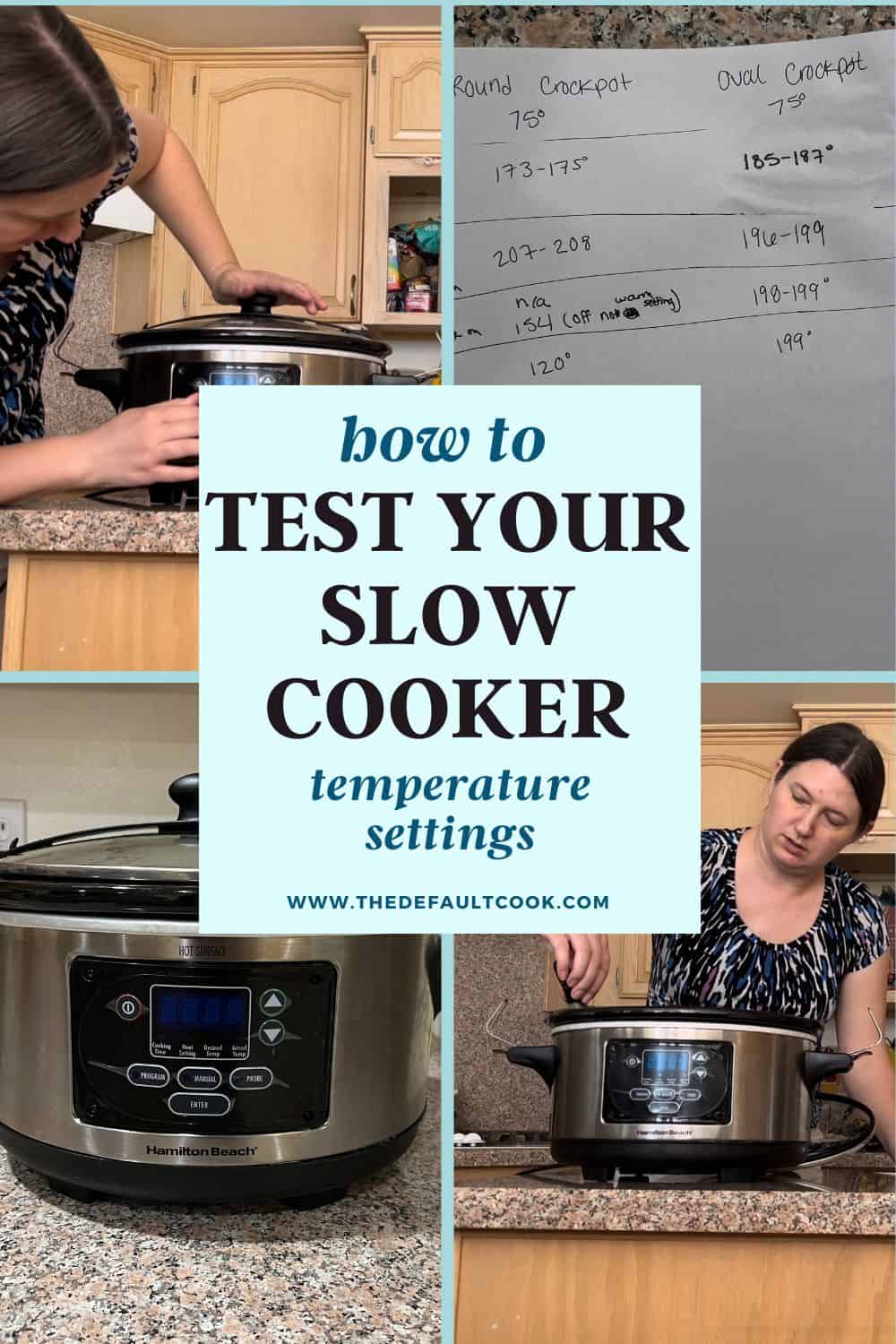
Is High on a Slow Cooker the Same as 300°F in an Oven?
No. A slow cooker set to high is not the same as an oven set to 300°F.
An oven heats the air around the food. A slow cooker heats the crock and its contents through a moist, enclosed environment. The lid holds in steam, and the liquid in the recipe helps spread heat.
This difference affects cooking time and texture:
- A slow cooker uses low, steady heat.
- An oven can brown and dry the surface of food.
- A slow cooker usually does not brown food well.
- Liquid evaporates more slowly in a slow cooker.
- A recipe written for a 300°F oven may need different timing and liquid when adapted for a slow cooker.
If you want browned meat, sear it in a skillet before adding it to the slow cooker. Searing can improve color and flavor, but it does not replace safe cooking or make the slow cooker reach a higher temperature.
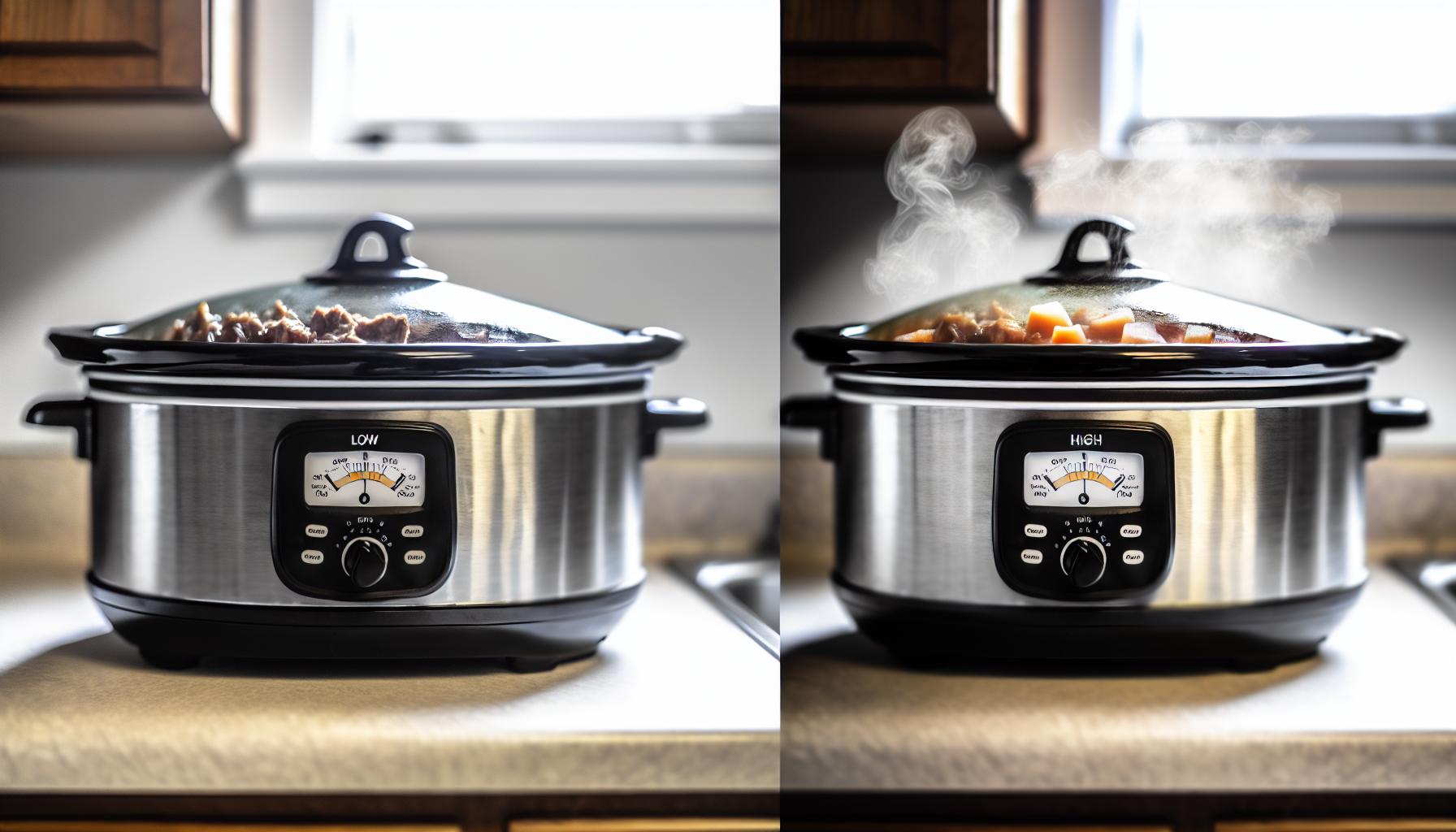
How Long Does High Take to Heat a Slow Cooker?
A slow cooker on high often takes about 3 to 4 hours to reach a cooking temperature, while low may take about 6 to 8 hours. These are common planning ranges, not strict rules.
A small amount of soup may heat faster. A large roast, a full crock, or frozen food may take much longer. The first hour can also vary because the cooker starts with cold ingredients and must heat the crock itself.
For best results:
- Put the prepared ingredients into the crock.
- Keep the lid closed.
- Set the cooker to high.
- Check the food only when the recipe’s cooking time is nearly complete.
- Use a food thermometer when safe doneness matters.
Every lid lift allows heat and steam to escape. Repeatedly checking the food can delay cooking and leave the final texture uneven.
If the cooker has not become hot after several hours, check that the outlet works and that the control is set correctly. If the crock remains only lukewarm, stop using the appliance and contact the manufacturer rather than trying to repair it yourself.

Can You Convert Low Cooking Time to High?
A common rule is that 1 hour on high equals about 2 hours on low, but this is only a rough estimate.
For example, a recipe calling for 8 hours on low may finish in about 4 hours on high. The result can change because meat size, recipe volume, ingredient density, and the cooker itself all affect heating.
Use this conversion as a starting point:
| Recipe instruction | Rough high-setting equivalent |
|---|---|
| 6 hours on low | About 3 hours on high |
| 8 hours on low | About 4 hours on high |
| 10 hours on low | About 5 hours on high |
Do not shorten cooking time for safety-sensitive foods without checking their internal temperature. Poultry, ground meat, large cuts, and dishes containing beans need enough time to heat through.
The texture may also change. High can make some meats tender more quickly, but delicate vegetables may soften too much. If you are away from home all day, low may provide a better fit for recipes designed for a long cooking period.

What Temperature Should Meat Reach in a Slow Cooker?
Use the USDA’s safe minimum internal temperatures, not the slow cooker’s high-setting number.
| Food | Safe minimum internal temperature |
|---|---|
| Poultry, including chicken and turkey | 165°F (74°C) |
| Ground meats | 160°F (71°C) |
| Beef, pork, lamb, and veal steaks, chops, and roasts | 145°F (63°C), followed by a 3-minute rest |
| Leftovers and casseroles | 165°F (74°C) |
Measure meat in its thickest section. For irregular cuts, take readings in several places. The lowest reading is the one that matters.
A slow cooker can make meat tender after it reaches a safe temperature, but tenderness and safety are different questions. A roast may be safe before it is tender. It may need more time for connective tissue to break down.
If the food has not reached a safe temperature by the recipe’s expected finish time, keep cooking on high and check it again. If it stayed below 140°F for too long, do not rely on reheating to make it safe. When in doubt, discard it.

Slow Cooker Safety on the High Setting
The high setting is generally safe when the appliance, ingredients, and cooking time are used correctly. The main risk is assuming that “high” guarantees fast or even heating in every situation.
Follow these safety practices:
- Thaw meat and poultry in the refrigerator before slow cooking.
- Cut large pieces into smaller pieces when the recipe allows.
- Fill the crock about halfway to two-thirds full unless the manual says otherwise.
- Keep the lid on during cooking.
- Do not use a slow cooker to reheat cold leftovers.
- Reheat leftovers to 165°F on a stove or in a microwave before transferring them to the slow cooker.
- Keep hot food at 140°F or above when holding it.
- Refrigerate leftovers within 2 hours, or within 1 hour if the room is above 90°F.
- Divide large amounts of leftovers into shallow containers so they cool faster.
- Follow the manual for cleaning, damaged cords, and cracked crocks.
Avoid placing a hot ceramic crock on a cold or wet surface. Sudden temperature changes can damage the insert. Also avoid using a crock or lid with cracks, chips, or other damage.

Why Is My Slow Cooker Not Getting Hot on High?
If food is still cool, check the simplest causes first:
- Confirm the power source. Test the outlet with another appliance.
- Check the control. Make sure the dial or program is set to high, not warm or off.
- Check the lid. A loose or badly seated lid allows heat to escape.
- Check the fill level. A very full crock takes longer to heat.
- Check the starting temperature. Frozen or very cold ingredients slow the process.
- Check the cooking time. Large quantities may need several hours.
- Compare with the manual. The model may have a special program or temperature behavior.
- Stop if the appliance stays lukewarm. Unplug it and contact the manufacturer.
Do not place the crock in an oven unless the manufacturer specifically says it is oven-safe. The ceramic insert and the heating base are different parts, and the base must not go into an oven.
Do not test a slow cooker by touching the food or heating surface. Use a food thermometer and handle the crock with care.

High vs. Low Slow Cooker Settings
Choose high when the recipe needs to finish sooner and the ingredients can tolerate faster heating. Choose low when the recipe is designed for a long cook or when you want a gentler texture.
| Choose high when… | Choose low when… |
|---|---|
| You have only a few hours | You have most of the day |
| The recipe includes soup, chili, or stew | The recipe includes a large roast |
| You need food to reach a simmer sooner | You want gradual cooking |
| The ingredients are already thawed | The recipe is built around a long cook |
| You can check the food near the end | You need a longer cooking window |
Neither setting is automatically better. High affects speed, while low provides more time for connective tissue to soften and flavors to blend.
For a recipe that gives only one setting, follow its instructions first. If the dish finishes early, switch to warm only if the food has already reached a safe temperature and your appliance can hold it at 140°F or above.
Frequently Asked Questions
Is 300°F the actual temperature of a slow cooker on high?
Usually, 300°F is an approximate appliance or heating range, not the exact temperature of the food. Slow cookers cycle heat, and the food often stays near a simmering temperature.
Is high hotter than low on every slow cooker?
High is intended to cook faster than low on standard slow cookers. The exact heat pattern varies by model, so the owner’s manual is the best source for model-specific information.
Does slow cooker high boil food?
It can bring liquid to a gentle simmer. A vigorous boil is not expected in every model and may indicate that the recipe is too small, the lid is not seated correctly, or the cooker runs hotter than expected.
Can I cook frozen meat on high in a slow cooker?
The USDA advises thawing meat and poultry before placing them in a slow cooker. Frozen meat may spend too long in the bacterial growth range before the center becomes hot.
Can I leave food on high all day?
Follow the recipe and appliance instructions. High is usually intended for a shorter cooking period than low. Long cooking on high can dry food, soften vegetables too much, or overcook smaller pieces.
Key Takeaways
- The high setting on many slow cookers is roughly associated with 300°F, but it is not a fixed temperature.
- Food in the crock commonly reaches about 185–212°F, depending on the recipe and conditions.
- High cooks food faster than low; it does not work like a 300°F oven.
- Use a food thermometer for meat and poultry.
- Thaw meat before slow cooking, keep the lid closed, and refrigerate leftovers promptly.
- Check your slow cooker’s manual for the most accurate temperature information.
Conclusion
For most US slow cookers, high means faster heating and is often described as an approximate 300°F setting. The food itself usually cooks at a lower temperature, often near a gentle simmer.
Treat the number as a guide, not a guarantee. Model design, food volume, starting temperature, and altitude all matter. When safety or doneness matters, measure the food directly with a reliable thermometer and follow USDA safe-temperature guidance.