
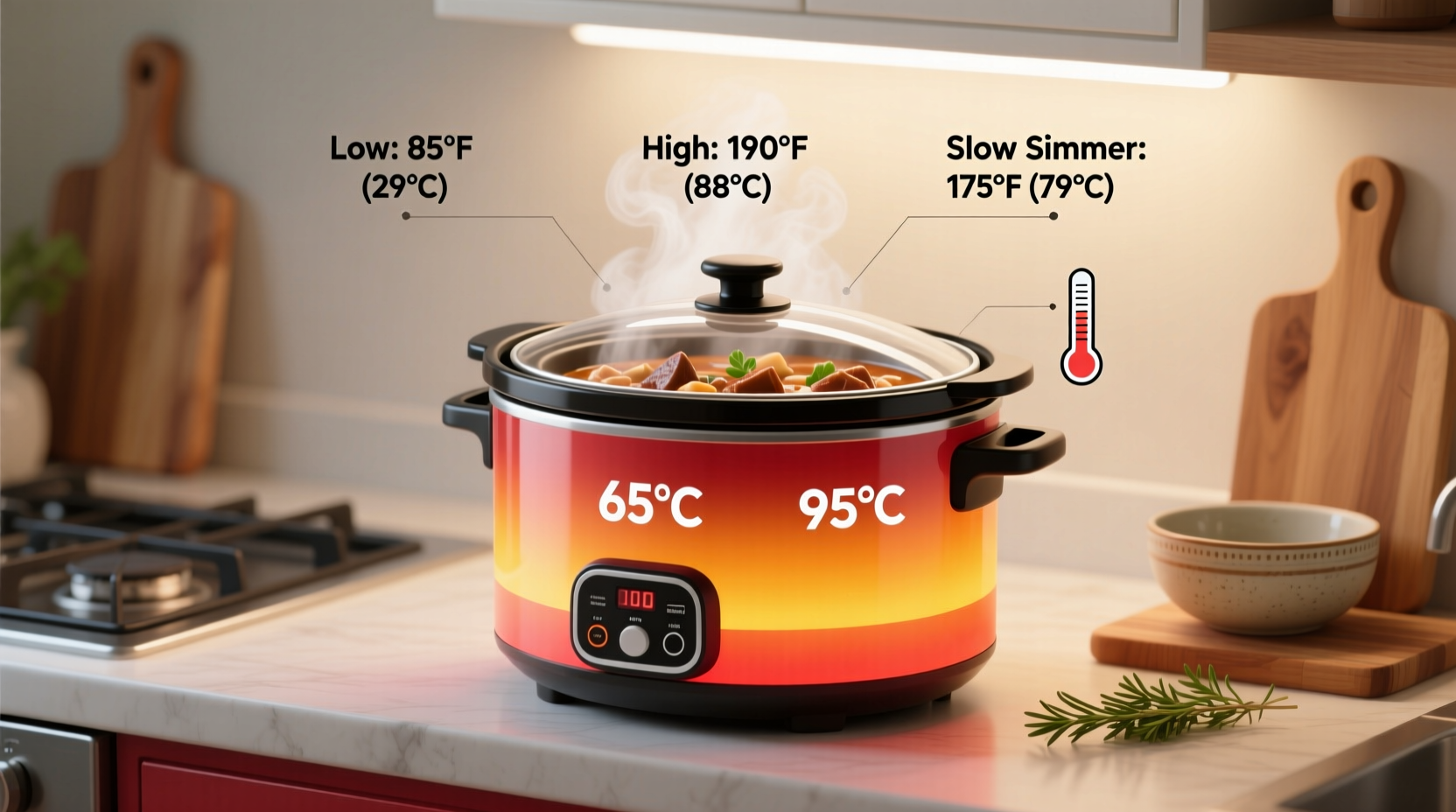
A slow cooker usually cooks food at about 170°F to 280°F (77°C to 138°C), but the exact temperature depends on the brand, model, setting, food volume, and cooking time. In most U.S. slow cookers, LOW reaches a gentle cooking temperature more slowly, HIGH reaches it faster, and WARM is meant to hold cooked food—not cook raw food.
Slow cookers do not use one universal temperature standard. Many models reach a food temperature near 190°F to 212°F during cooking, while the heating surface may become much hotter. Always check the manual for your specific appliance and use a food thermometer for safety.

Slow Cooker Temperature Settings Explained
The main slow cooker settings are LOW, HIGH, and WARM. These labels describe the cooking rate and holding function, not one fixed temperature shared by every appliance.
| Slow cooker setting | Common temperature behavior | Main use |
|---|---|---|
| LOW | Often brings food to roughly 190°F to 210°F over time | Long cooking, tough cuts, soups, and stews |
| HIGH | Often reaches a simmer sooner and may approach about 212°F in the food | Faster cooking |
| WARM | Designed to keep cooked food hot, often near or above 140°F | Short-term holding after cooking |
These ranges are general. They are not guaranteed settings. Some slow cookers run hotter or cooler than others, and the temperature can change as the thermostat cycles on and off.
What temperature is LOW on a slow cooker?
The LOW setting often brings food to a gentle simmer after several hours. In many slow cookers, the food may settle near 190°F to 210°F, although the exact result varies.
LOW is useful when you want a long cooking time. It gives connective tissue in meat more time to soften and lets flavors blend in soups, beans, and stews.
What temperature is HIGH on a slow cooker?
HIGH usually heats the food more quickly than LOW. The food may reach a simmer sooner and can approach 212°F, the boiling point of water at sea level.
HIGH does not always mean that the food will be much hotter at the end. In many models, LOW and HIGH reach a similar final food temperature. The main difference is how quickly they get there.
What temperature is WARM?
WARM is for holding food that is already fully cooked. It is not a reliable setting for cooking raw meat, poultry, beans, or other foods.
For safety, hot food should stay at 140°F or higher. If your slow cooker cannot hold food at that temperature, move the food to another safe heat source or refrigerate it within the safe time limit.

Why Slow Cooker Temperatures Are Not Exact
A slow cooker is not the same as an oven. An oven controls the air temperature around the food. A slow cooker heats a ceramic or metal insert from below and relies on the food, liquid, lid, and thermostat to spread that heat.
Several factors affect the temperature:
- Amount of food: A full cooker heats differently from a nearly empty one.
- Starting temperature: Refrigerated ingredients take longer to heat than room-temperature ingredients.
- Liquid level: Soups and sauces transfer heat well. Thick mixtures may heat less evenly.
- Lid position: Removing the lid releases heat and adds cooking time.
- Shape of the insert: A wide, shallow insert may heat differently from a tall, narrow one.
- Room temperature: A cold kitchen can slightly slow heating.
- Altitude: Water boils at a lower temperature at higher elevations.
- Thermostat design: Each manufacturer may use a different control system.
Because of these variables, a recipe that says “cook on LOW for eight hours” gives a time and setting, not a precise food temperature.
Do slow cookers reach 200°F?
Many slow cookers can bring food close to 200°F during normal cooking. Some may reach about 190°F to 210°F on LOW, while food on HIGH may approach the boiling point of water.
This does not mean every part of the food is always at 200°F. Cold spots can remain, especially when the cooker is overfilled, the lid is removed often, or dense food is packed tightly.
Do slow cookers boil?
A slow cooker can simmer, and some foods may bubble. It may not produce the vigorous boil seen in a pot on a stovetop.
A gentle simmer is normal. A rolling boil may mean the cooker runs hot, the recipe contains a lot of liquid, or the setting is too high for the food. Check the manual before changing the setting.

How to Check Your Slow Cooker’s Actual Temperature
The most useful way to check a slow cooker is with a calibrated food thermometer and a simple water test. This can show how your appliance behaves under your usual conditions.
What you need
- A digital food thermometer
- Water
- The slow cooker insert and lid
- A heat-safe spoon or tongs
Water temperature test
- Fill the insert about halfway with water.
- Put on the lid.
- Set the cooker to LOW.
- Let it heat for about four hours without lifting the lid.
- Stir the water carefully.
- Measure the temperature in the center and near the edge.
- Repeat the test on HIGH if you want to compare settings.
- Record the readings and the test conditions.
Do not rely on one reading taken near the heating element. Take several readings in different areas. The center reading is often more useful for judging the temperature of the food.
Repeat the test if your cooker behaves oddly. The result can change with the amount of water, the room temperature, and how well the lid fits.
What the test can and cannot tell you
The test can help you learn whether your cooker runs unusually cool or hot. It can also show whether the temperature is even across the insert.
It cannot prove that every recipe will heat at the same rate. Meat, beans, sauces, and frozen ingredients behave differently from water. A thermometer reading also does not replace safe cooking times or the instructions in the appliance manual.

Safe Temperatures for Slow-Cooked Food
The slow cooker setting is only part of food safety. The food must also reach a safe internal temperature and stay out of the danger zone.
The U.S. Department of Agriculture recommends these minimum internal temperatures:
| Food | Minimum internal temperature |
|---|---|
| Poultry, including chicken and turkey | 165°F |
| Ground meats | 160°F |
| Beef, pork, lamb, and veal steaks, chops, and roasts | 145°F, followed by a three-minute rest |
| Egg dishes | 160°F |
| Leftovers and casseroles | 165°F |
Measure the thickest part of the food. Avoid touching bone, the cooker insert, or the bottom of the pot with the thermometer probe.
Keep food out of the danger zone
The food safety danger zone is 40°F to 140°F. Bacteria can grow more quickly when food stays in this range for too long.
Follow these basic rules:
- Thaw meat and poultry in the refrigerator before putting them in the slow cooker.
- Start with clean hands, tools, and ingredients.
- Keep the lid on as much as possible.
- Do not fill the cooker above the manufacturer’s maximum line.
- Discard perishable food left at room temperature for more than two hours.
- Refrigerate leftovers in shallow containers.
- Use a refrigerator set at 40°F or below.
- Reheat leftovers to 165°F before serving.
A slow cooker is built for gradual cooking. It is not the best tool for quickly reheating cold leftovers. Reheat food on the stovetop or in a microwave, then use the slow cooker to keep it hot if the appliance can maintain at least 140°F.

How to Choose LOW or HIGH
Choose the setting based on the recipe, the cut of food, and the time available. Do not choose LOW or HIGH only because one setting sounds “safer.”
Use LOW when:
- You have a long cooking window.
- You are cooking a tough cut of meat.
- You want a slower change in texture.
- You are making soup, chili, beans, or stew.
- You can leave the cooker undisturbed for several hours.
Use HIGH when:
- You need the meal to cook sooner.
- The recipe gives a specific HIGH time.
- You are cooking a smaller amount of food.
- You can check the food’s internal temperature before serving.
Do not assume that eight hours on LOW equals four hours on HIGH for every recipe. The result depends on the food, its size, the liquid level, and the cooker. A large roast may need a different adjustment than a thin chicken breast or a small batch of chili.
A practical decision table
| Your situation | Better starting choice |
|---|---|
| Tough beef roast with a full pot of vegetables | LOW, following the recipe time |
| Soup that must be ready sooner | HIGH, then check the temperature and texture |
| Raw poultry | Either setting, but verify 165°F in the thickest part |
| Cooked chili for a party | WARM only after it is fully cooked |
| Frozen meat | Thaw first; do not start it frozen in the slow cooker |

Common Slow Cooker Temperature Mistakes
Many slow cooker problems come from treating the setting label as an exact temperature.
Mistake 1: Using WARM to cook raw food
WARM may not heat raw meat quickly enough. It can leave food in the danger zone for too long.
Better approach: Cook raw ingredients on LOW or HIGH according to a tested recipe. Use WARM only after the food reaches a safe internal temperature.
Mistake 2: Overfilling the insert
An overfilled slow cooker heats slowly and may cook unevenly. Food can remain cool in the center.
Better approach: Follow the appliance manual. Many manufacturers advise filling the insert about halfway to two-thirds full.
Mistake 3: Removing the lid often
Every lid lift releases heat and moisture. The cooker then needs more time to recover.
Better approach: Keep the lid closed until the recipe’s suggested check time.
Mistake 4: Trusting time without checking food
Cooking time is only a guide. A large roast and a small piece of meat do not heat at the same rate.
Better approach: Check internal temperature in the thickest area, then assess tenderness and doneness.
Mistake 5: Using a damaged cooker
A cracked insert, loose lid, frayed cord, or faulty control can affect heating and create a safety risk.
Better approach: Stop using the appliance if it is damaged. Contact the manufacturer or replace it according to the product manual.

Slow Cooker Temperature FAQs
Is LOW or HIGH hotter in a slow cooker?
HIGH heats food faster, but the final food temperature may be similar to LOW in many models. The key difference is the time needed to reach a simmer.
Can I cook chicken on LOW in a slow cooker?
Yes, if the chicken reaches 165°F in the thickest part. Use thawed chicken, avoid overfilling the cooker, and follow a reliable recipe for the cut and quantity.
Can I leave a slow cooker on WARM all day?
WARM is designed for holding cooked food, but it should maintain at least 140°F. Check your manual and, when in doubt, measure the food with a thermometer. Refrigerate leftovers within two hours after the hot-holding period ends.
Why is my slow cooker not getting hot?
Possible causes include a faulty thermostat, a poor-fitting lid, too much food, frozen ingredients, frequent lid removal, or a damaged heating element. Test it with water, then compare the result with the manufacturer’s guidance. Do not use it for perishable food if it cannot heat or hold food safely.
Should food simmer in a slow cooker?
A gentle simmer is usually normal. Food does not need a strong boil to cook. If the contents boil aggressively, check the recipe, reduce the setting if appropriate, and confirm that the cooker is not running unusually hot.
The Bottom Line
Most slow cookers operate within a broad range of about 170°F to 280°F, but their actual food temperatures vary. LOW generally cooks more slowly, HIGH reaches cooking heat sooner, and WARM is intended to hold food that is already cooked.
For safe results, follow the manufacturer’s manual, thaw meat before slow cooking, keep the lid closed, avoid overfilling the insert, and check internal temperature with a food thermometer. Use 165°F for poultry and leftovers, 160°F for ground meat, and 145°F plus a three-minute rest for whole cuts of beef, pork, lamb, and veal.
Sources
- USDA: Slow Cookers and Food Safety
- USDA: Safe Minimum Internal Temperatures
- USDA: Keep Food Safe
- The owner’s manual for the specific slow cooker model remains the best source for its settings, fill limits, and operating instructions.