
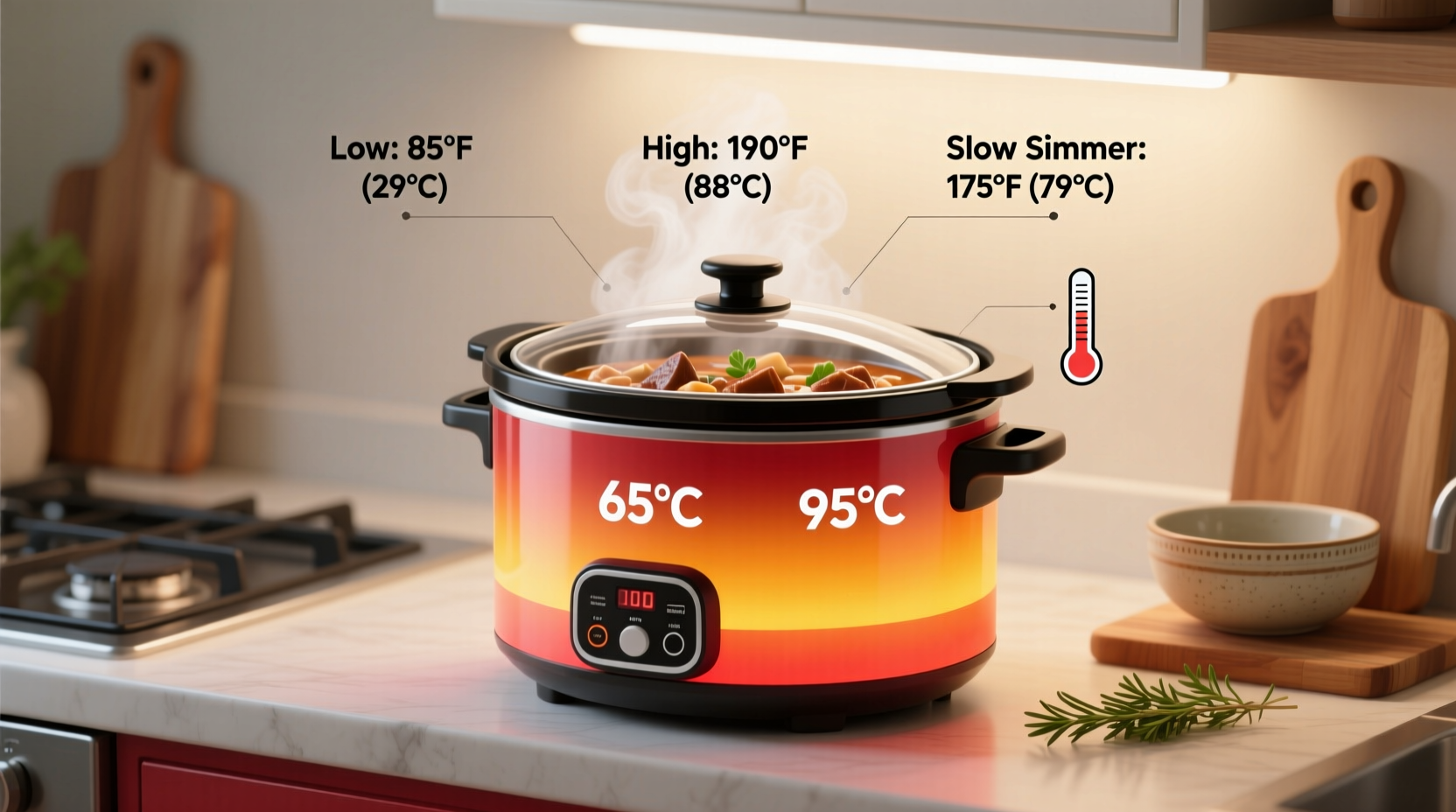
In the United States, a slow cooker set to Low usually heats food to about 190°F (88°C). The exact temperature varies by brand, model, food amount, room temperature, and whether the lid stays closed. Many slow cookers operate on Low within a broad range of roughly 170°F to 200°F.
The Low setting is not one fixed temperature. It is a heating cycle designed to bring food to a safe, gentle simmer over several hours. Use a food thermometer to check the food itself rather than relying only on the dial.

Slow Cooker Low Temperature: The Quick Answer
A slow cooker on Low commonly reaches approximately:
| Setting | Typical food temperature | Approximate Celsius |
|---|---|---|
| Low | 170°F to 200°F | 77°C to 93°C |
| High | 200°F to 212°F | 93°C to 100°C |
| Keep Warm | Often below cooking temperature | Varies by model |
The most useful single estimate is 190°F, but it is only an average. Some models may run cooler or hotter.
The temperature can also change during the cooking cycle. The heating element turns on and off to control heat. Food near the sides may be hotter than food in the center, especially before the contents are fully heated.

What Does “Low” Mean on a Slow Cooker?
“Low” means the cooker uses a lower heat cycle than the High setting. It does not necessarily mean that the food stays at one exact temperature.
A slow cooker usually has:
- A ceramic or metal cooking vessel
- An electric heating element around the sides or bottom
- A thermostat or control system
- Low, High, and sometimes Keep Warm settings
- A tight-fitting lid that traps heat and moisture
On Low, the heating element warms the vessel slowly. Once the food reaches the target range, the cooker cycles the heat to maintain a gentle simmer.
Low is not the same as a low oven temperature
A slow cooker on Low is not equivalent to setting an oven to 190°F. An oven surrounds the food with hot air, while a slow cooker heats food through the vessel and the liquid inside it.
This difference affects cooking time, moisture, browning, and texture. A recipe written for a slow cooker should not be converted to an oven by temperature alone.
Low may not look hot at first
Food may remain below its final cooking temperature for the first part of the cooking period. This is normal. The cooker must warm the vessel, ingredients, and liquid before the center becomes hot.
Do not judge the temperature by the surface alone. Stir the food, place the thermometer in the thickest part, and avoid touching the probe to the ceramic wall.

How Hot Does a Slow Cooker Get on Low?
Most slow cookers bring food on Low to a temperature near the simmering range. In many models, that means about 185°F to 200°F after several hours.
The exact result depends on several factors:
- The slow cooker’s design and age
- The size and shape of the cooking vessel
- How full the cooker is
- Whether ingredients start cold or warm
- The amount of liquid in the recipe
- The room temperature
- How often the lid is removed
- The altitude where you live
Water boils at about 212°F at sea level, but it boils at a lower temperature at higher elevations. A slow cooker may still cook properly at altitude, but the contents may not show a strong boil.
Why different sources give different numbers
Manufacturers do not all use the same control systems. Some describe Low as a heat level rather than a fixed temperature. Others publish approximate temperatures for their heating elements or food contents.
A manufacturer’s manual is the best source for a specific model. General temperature ranges are useful for planning, but they cannot replace the manual or a thermometer.
A practical temperature expectation
For most home cooking:
- Below 170°F: The food may be heating but is not yet at the typical slow-cooking range.
- About 170°F to 190°F: The cooker is hot and may be cooking gently.
- About 190°F to 205°F: This is a common Low-setting range for many models.
- Near 212°F: The liquid may simmer or boil, especially around the edges.
A few small bubbles do not mean the cooker is too hot. Slow cooking often produces a gentle simmer rather than a rolling boil.

Low vs. High on a Slow Cooker
The main difference between Low and High is usually the time needed to reach a simmer, not a completely different final cooking temperature.
| Feature | Low | High |
|---|---|---|
| Heating speed | Slower | Faster |
| Typical use | Long cooking times | Shorter cooking times |
| Final food temperature | Often similar | Often similar |
| Texture | Often gentler for tough cuts | Can cook faster |
| Best for | Workday or overnight recipes | Same-day cooking |
A common cooking guide suggests that 1 hour on High may equal about 2 hours on Low, but this is only a rough estimate. The actual conversion depends on the recipe, ingredients, cooker, and starting temperature.
For example, a roast may need 8 hours on Low but only 4 to 5 hours on High. Beans, poultry, sauces, and dense foods may not follow the same conversion.
Does High get hotter than Low?
High often heats the food more quickly. After several hours, both settings may bring the food to a similar simmering temperature. The difference is how fast the cooker reaches that range and how it cycles heat.
Do not switch from Low to High solely because the food does not look hot early in the cooking period. Check the recipe’s cooking time and measure the food safely.
How to Check the Temperature of a Slow Cooker
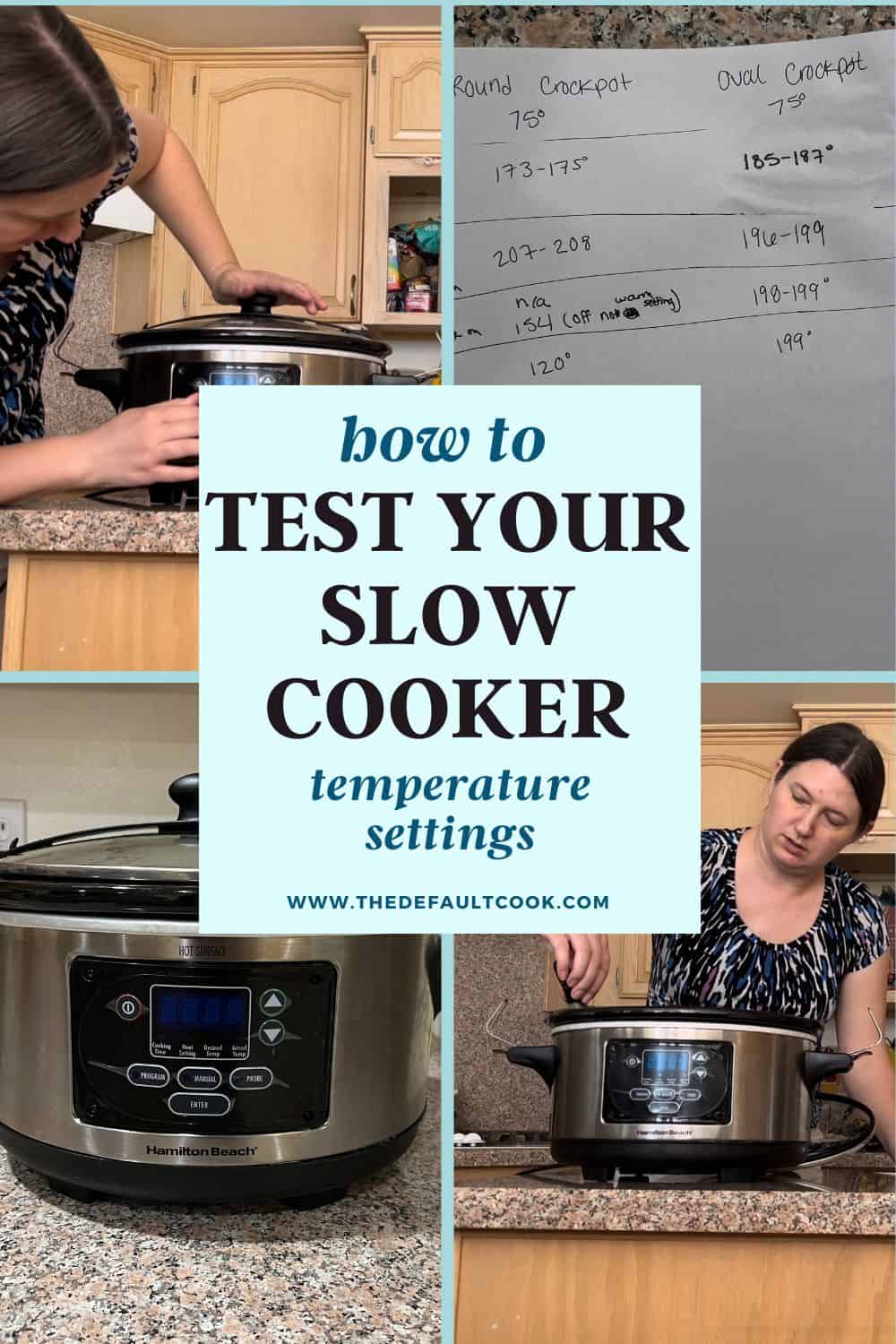
Use a calibrated instant-read food thermometer for the most reliable check.
- Keep the lid closed as much as possible.
- Wait until the cooker has had enough time to heat the food.
- Stir liquid-based food before measuring.
- Insert the thermometer into the center of the food.
- Avoid touching the probe to the bottom or sides.
- Check more than one area if the food is thick or crowded.
- Clean the thermometer after use.
For meat, place the probe in the thickest section and avoid bones. The food’s internal temperature matters more than the air temperature inside the cooker.
A slow cooker may have hot edges and a cooler center during the early stages. If the center is still cool, continue heating according to the recipe and food-safety guidance.

Is a Slow Cooker on Low Hot Enough to Cook Food Safely?
A slow cooker on Low can cook food safely when it is used correctly. The food must heat fully and remain hot during cooking and serving.
The USDA identifies 40°F to 140°F as the danger zone, where bacteria can grow more quickly. Keep perishable food out of this range as much as possible.
Follow these safety practices:
- Thaw meat and poultry in the refrigerator before slow cooking.
- Cut large pieces into smaller, even pieces when the recipe calls for it.
- Do not overfill the cooker.
- Keep the lid on during cooking.
- Start with a tested recipe and follow its time guidance.
- Confirm that meat reaches a safe internal temperature.
- Refrigerate leftovers within two hours, or within one hour if the food is exposed to temperatures above 90°F.
- Store leftovers in shallow containers so they cool quickly.
The USDA lists 165°F for poultry, 145°F for whole cuts of beef, pork, veal, and lamb with a three-minute rest, and 160°F for ground meats. These temperatures apply to the food’s internal temperature, not simply the slow cooker setting.
Some recipes, especially those containing dried kidney beans, require special preparation. Raw red kidney beans contain a toxin that can cause illness if they are not boiled properly. Follow guidance from a trusted food-safety source rather than assuming a slow cooker alone is enough.

What Temperature Should a Slow Cooker Be on to Keep Food Warm?
The Keep Warm setting is intended to hold fully cooked food, not cook raw ingredients.
For food safety, hot food should generally stay at 140°F or above. Many slow cookers are designed to keep food warm near that level, but performance varies by model and the amount of food inside.
Use a thermometer when holding food for a long period. If the food drops below 140°F for an extended time, do not assume that switching the cooker back to Low makes it safe. Reheating may not remove toxins that some bacteria can produce.
Keep Warm is useful for:
- Cooked chili
- Soups and stews
- Pulled pork after cooking
- Cooked beans
- Sauces and dips
It is not a substitute for the Low or High cooking setting when the ingredients are raw.
Why Is My Slow Cooker on Low Not Getting Hot?
A slow cooker may seem cool for several harmless reasons, but some signs point to a faulty appliance.
Common causes
The lid has been removed often.
Each lid opening releases heat and extends the cooking time. A slow cooker may lose significant heat after only a brief opening.
The cooker is overfilled.
A very full vessel heats slowly and may not cook food evenly. Follow the manufacturer’s fill guidance.
The ingredients are very cold.
Refrigerated meat, frozen vegetables, or a large amount of chilled liquid can delay heating.
The food is too dry.
Most slow-cooker recipes need enough liquid or sauce to transfer heat and prevent scorching.
The cooker is on Keep Warm.
Keep Warm may not reach the temperature needed to cook raw food.
The appliance has a problem.
If the cooker remains barely warm after several hours, the heating element, thermostat, cord, or control may be faulty.
What to do
Check the control setting, outlet, power cord, and lid position first. Then measure the food in the center with a food thermometer.
If the food has remained lukewarm for a long time, especially if it contains meat, poultry, seafood, eggs, or dairy, discard it rather than tasting it to judge safety. Do not use a slow cooker with a damaged cord, cracked vessel, or signs of electrical damage.

Common Mistakes When Using Low
Avoid these mistakes to get more even cooking and safer results.
Treating Low as a fixed temperature
The word Low describes a heat setting, not a universal temperature. Use the model manual and a thermometer when an exact temperature matters.
Using frozen meat
Frozen meat can keep the food in the bacterial growth range for too long. Thaw meat in the refrigerator before placing it in the slow cooker.
Filling the vessel too much
A packed cooker heats slowly and may cook unevenly. Many manufacturers recommend filling the vessel between about one-half and two-thirds full, but check your manual.
Lifting the lid repeatedly
Opening the lid releases heat and moisture. If you need to stir, combine that step with another necessary check.
Using Keep Warm to cook raw food
Keep Warm is for holding cooked food. It may not heat raw ingredients quickly or evenly enough.
Assuming more time always improves the result
Longer cooking can make some foods tender, but it can also dry out lean meat, soften vegetables too much, or cause sauces to separate. Follow the recipe’s time range and check for doneness.

Slow Cooker Temperature Conversion Guide
Use this table as a starting point, not a guarantee.
| Recipe instruction | Rough equivalent |
|---|---|
| 4 hours on High | About 6 to 8 hours on Low |
| 6 hours on High | About 8 to 10 hours on Low |
| 8 hours on Low | About 4 to 5 hours on High |
| Keep Warm | Holding only; not a cooking conversion |
These conversions are most reliable for recipes designed for the same type of slow cooker. They may fail for large roasts, dried beans, dense casseroles, dairy-based sauces, or recipes with little liquid.
The best sign of success is not the clock alone. Check texture, appearance, and the internal temperature required for the specific food.

Key Takeaways
- A slow cooker on Low commonly reaches about 190°F.
- The normal operating range may be roughly 170°F to 200°F, depending on the model and conditions.
- Low is a heat cycle, not one exact temperature.
- Low and High may reach similar final temperatures, but High gets there faster.
- Use a thermometer to check the food, especially when cooking meat or holding food.
- Keep cooked food at 140°F or above when using Keep Warm.
- Thaw meat first, keep the lid closed, and follow the cooker’s manual.
Frequently Asked Questions
Does a slow cooker on Low reach 200°F?
Many slow cookers can reach about 200°F on Low, but not all models behave the same way. The food may range from about 170°F to 200°F, and the temperature can vary across the vessel.
Is Low on a slow cooker the same as 200°F in an oven?
No. A slow cooker and an oven transfer heat in different ways. A slow cooker uses a heated vessel and trapped moisture, while an oven uses hot air. Do not convert settings by temperature alone.
Can I cook chicken on Low in a slow cooker?
Yes, provided the recipe and appliance are used correctly. Thawed chicken should reach 165°F in the thickest part. Do not rely on the Low setting alone to confirm that the chicken is safe.
How long does a slow cooker take to heat on Low?
The time varies by cooker, food volume, starting temperature, and recipe. A full cooker of cold food may take several hours to reach a simmering range. Keep the lid closed to reduce heat loss.
Can I leave a slow cooker on Low overnight?
Many slow cookers are designed for long cooking periods, but use a tested recipe, place the appliance on a stable heat-safe surface, and follow the manufacturer’s instructions. Do not use an appliance with damaged parts or a frayed cord.
Conclusion
The best general answer is that a slow cooker on Low reaches about 190°F, with many models operating somewhere near 170°F to 200°F. That range explains why recipes can cook gently for several hours without the food reaching a rolling boil.
For safe and consistent results, treat Low as a cooking mode rather than an exact temperature. Use the manufacturer’s manual, keep the lid closed, thaw meat before cooking, and check the food’s internal temperature when doneness or food safety matters.
Sources
- USDA: Slow Cookers and Food Safety
- USDA: Safe Minimum Internal Temperatures
- FDA Food Code
- The owner’s manual for the specific slow cooker model should be used for model-level temperature and operating instructions.