
Introduction
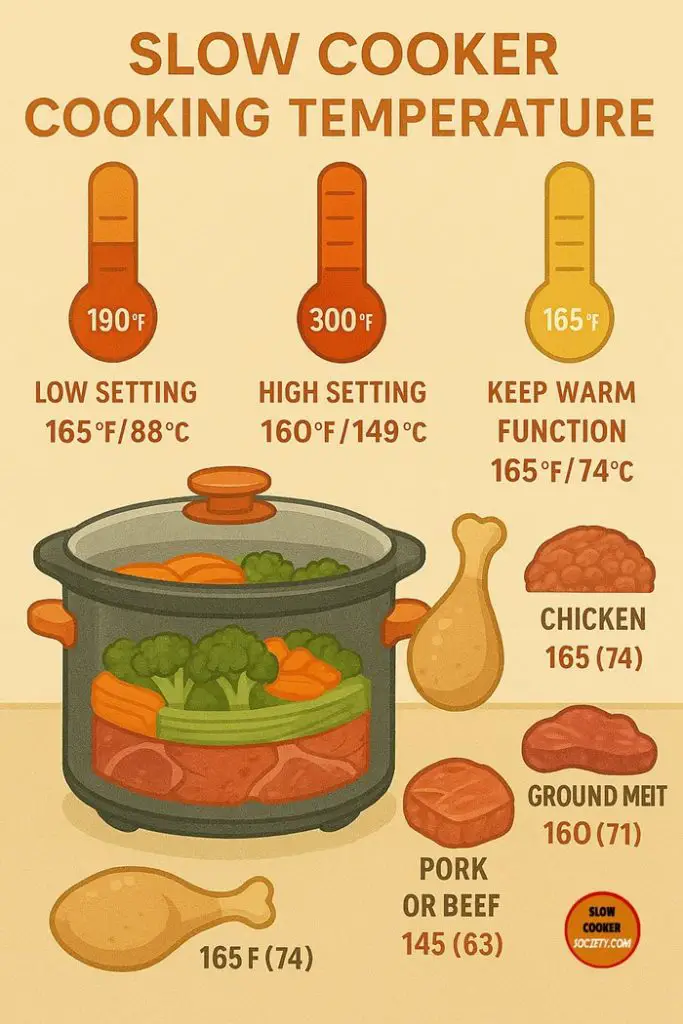
The low setting on most slow cookers heats food to about 190°F to 200°F (88°C to 93°C) once the food is fully hot and simmering. The exact temperature varies by brand, model, food volume, and cooking time.
For food safety, the setting itself matters less than the food temperature. Keep perishable food at 140°F (60°C) or hotter after cooking, and use a food thermometer to check the center of the dish. In the United States, the USDA advises against using a slow cooker to reheat cold food; reheat it first, then place it in the cooker to keep it hot.
What Does “Low” Mean on a Slow Cooker?
“Low” is a cooking setting, not one exact temperature. A slow cooker uses a heating element and a thermostat to warm the crock gradually. It cycles on and off to maintain heat, so the temperature can rise and fall during cooking.
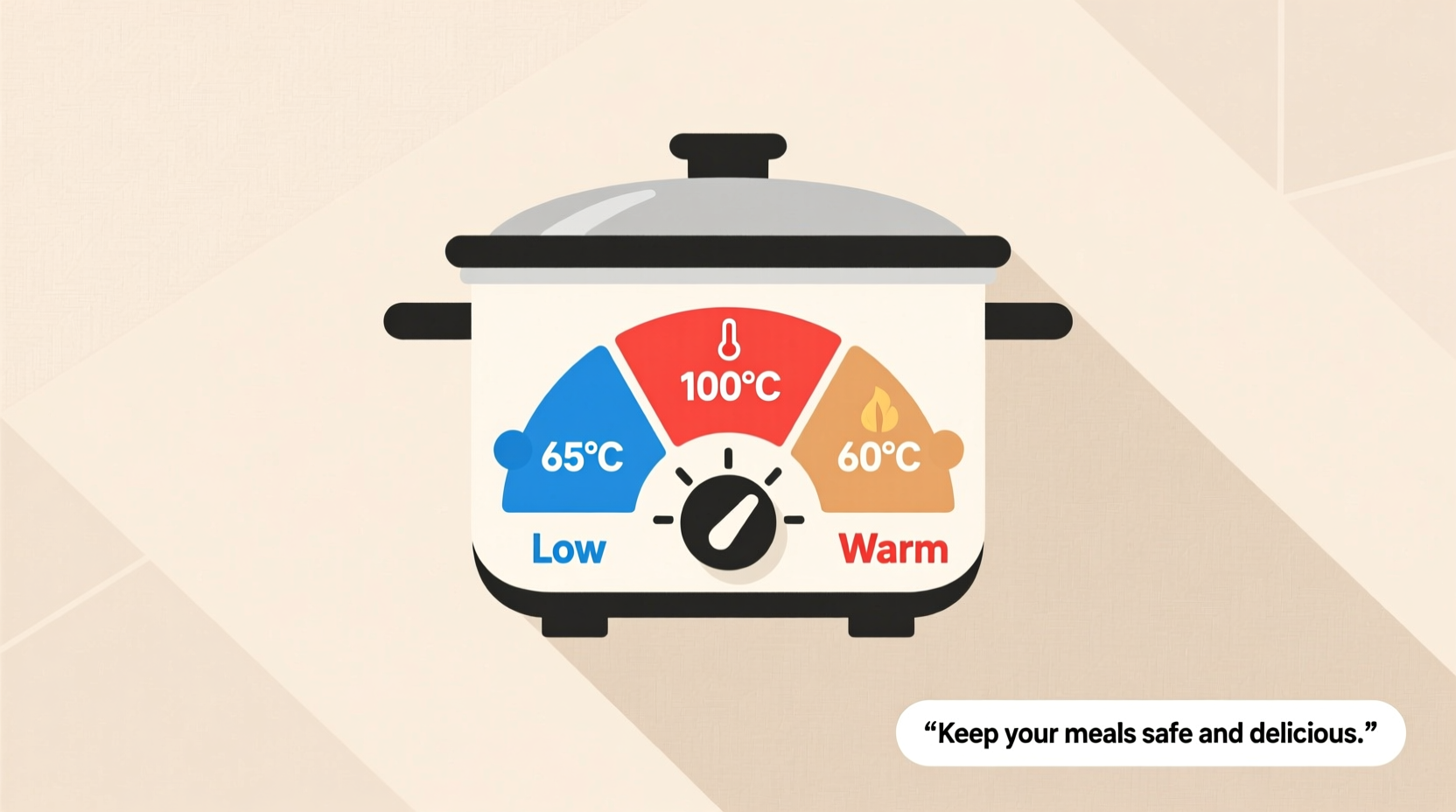
Most slow cookers do not let you set a precise temperature. Instead, they use labels such as:
- Low
- High
- Warm
- Cook
- Simmer
On many models, low cooking reaches a gentle simmer after several hours. The food may stay below the boiling point of water, which is 212°F (100°C) at sea level. The liquid can still bubble lightly, especially around the edges.
A slow cooker’s low setting is not the same as an oven set to 190°F. The heating method, covered design, food mass, and moisture level all affect the final temperature.
Typical slow cooker temperature ranges
The following ranges are useful estimates, not universal specifications:
| Slow cooker setting | Common food temperature after heating | Main use |
|---|---|---|
| Warm | About 140°F to 165°F (60°C to 74°C) | Holding cooked food |
| Low | About 190°F to 200°F (88°C to 93°C) | Long, gentle cooking |
| High | About 200°F to 212°F (93°C to 100°C) | Faster cooking and simmering |
Some appliances may run outside these ranges. The owner’s manual is the best source for the intended operation of a specific model.
What Temperature Is Low on a Slow Cooker?
The best short answer is about 190°F (88°C) to 200°F (93°C) after the food becomes fully hot. Many cooks use 190°F as a practical estimate for the low setting.
That does not mean every part of the food reaches that temperature at the same time. Cold ingredients may begin much lower. The center of a thick roast may take hours to warm, while liquid near the sides may become hot sooner.
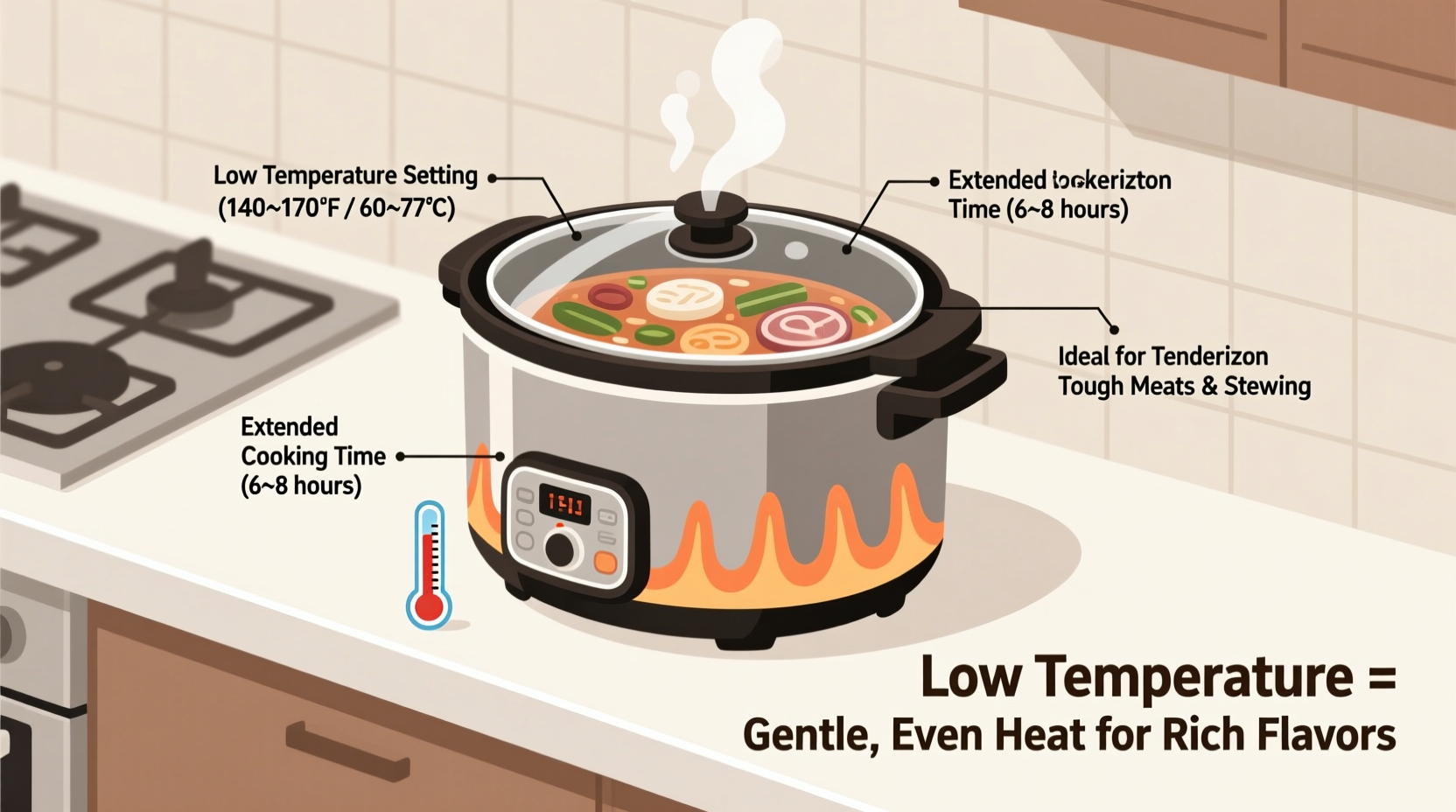
The low setting usually cooks more slowly because the food takes longer to reach a steady simmer. It is useful for:
- Tough cuts of beef, pork, and lamb
- Beans and lentils
- Soups and stews
- Pulled meat
- Braised vegetables
- Recipes designed for six to 10 hours of cooking
The low setting does not always produce a lower final food temperature than high. Instead, it usually takes longer to reach a similar simmering range.

How Hot Is Low Compared With High?
Low and high settings often reach similar final temperatures, but they heat food at different speeds. High gets the food hot sooner. Low raises the temperature more gradually.
A common cooking conversion is:
- 1 hour on high equals about 2 hours on low
- 4 hours on high equals about 8 hours on low
This is only a guide. The result changes with the recipe, the amount of food, the starting temperature, and the slow cooker itself.
Low versus high
| Feature | Low setting | High setting |
|---|---|---|
| Heating speed | Slower | Faster |
| Typical cooking time | 6 to 10 hours | 3 to 6 hours |
| Texture | Often gentle and tender | Can cook the same foods faster |
| Risk of overcooking | Lower during a long cook, but still possible | Higher for delicate foods |
| Best for | Tough meat, beans, stews | Shorter schedules and quick meals |
A recipe written for eight hours on low may not give the same texture when cooked for four hours on high. Meat may be safe at both settings but still be tough if the collagen has not softened.
Is the Low Setting Safe for Cooking Meat?
Yes, the low setting can safely cook meat when the slow cooker is used correctly and the meat reaches a safe internal temperature. Start with thawed meat when possible, use the correct amount of liquid, and avoid overfilling the crock.
The USDA lists these minimum internal temperatures:
| Food | Minimum internal temperature |
|---|---|
| Whole cuts of beef, pork, lamb, and veal | 145°F (63°C), followed by a 3-minute rest |
| Ground meats | 160°F (71°C) |
| Poultry, including chicken and turkey | 165°F (74°C) |
| Leftovers and casseroles | 165°F (74°C) |
Check the thickest part of the food with a food thermometer. Do not touch the bone, crock, or a large pocket of fat with the probe because these areas can give a false reading.
The USDA recommends keeping cooked food at 140°F or above. The food safety “danger zone” is 40°F to 140°F, where bacteria can grow more quickly.
Can You Cook Frozen Meat on Low?
It is safer to thaw meat before placing it in a slow cooker. Frozen meat may spend too long warming through the food safety danger zone before the center becomes hot.
Thaw meat in one of these ways:
- In the refrigerator.
- In cold water that you change often.
- In a microwave, followed by immediate cooking.
Do not thaw meat on the kitchen counter. The outside can become warm while the inside remains frozen.
If a recipe calls for frozen ingredients, follow the slow cooker manufacturer’s instructions and the recipe’s safety guidance. Frozen vegetables are usually less concerning than a large frozen roast because they warm in smaller pieces, but the entire dish still needs to reach a safe temperature.
How to Check the Temperature of a Slow Cooker
Use a calibrated instant-read food thermometer. Do not judge safety by steam, bubbling, or the appearance of the liquid.
Follow these steps:
- Stir the food if the recipe allows it.
- Insert the thermometer into the thickest portion.
- Avoid touching the crock or a bone.
- Check more than one spot in a large batch.
- Wait for the reading to stop changing.
- Clean the probe with hot, soapy water after use.
For a slow cooker test, fill the crock about halfway with water. Run it on low for several hours, then measure the water in the center and near the sides. This can show how your appliance behaves, but it is not a substitute for checking food during real cooking.
A slow cooker that never gets food above 140°F after several hours may be defective, too full, or being used in a very cold setting. Stop using it for perishable food until you identify the problem.
How Full Should a Slow Cooker Be?
Fill a slow cooker about one-half to two-thirds full unless the manufacturer gives different instructions. A very full crock may heat too slowly. A nearly empty crock may cook too fast and can increase the risk of scorching.
Keep the lid on during cooking. Each time you lift the lid, heat and steam escape. The food then needs more time to return to its cooking temperature.
Other factors that change the temperature include:
- The size and shape of the crock
- The amount of food
- Whether ingredients begin cold or warm
- The amount of liquid
- The room temperature
- The age and condition of the appliance
- The placement of the cooker on the counter
- Whether the lid fits tightly
Do not put a hot ceramic crock on a cold or wet surface. Sudden temperature changes can crack some ceramic inserts.
Is Warm the Same as Low?
No. Warm is designed to hold already-cooked food, while low is designed to cook food.
The warm setting may keep food around or above 140°F, but it may not heat raw meat, dried beans, or a cold casserole safely or quickly. Use low or high to cook, and use warm only after the food has reached a safe serving temperature.
For best quality, serve cooked food within a reasonable time. The USDA recommends refrigerating leftovers within two hours, or within one hour when the surrounding temperature is above 90°F (32°C). Divide large amounts into shallow containers so they cool faster.
Do not use the warm setting as a way to slowly reheat refrigerated food. Reheat leftovers to 165°F first, then use warm to hold them.
What to Do If a Slow Cooker Is Not Getting Hot
If food remains lukewarm, check the problem in a safe order:
- Measure the food. Use a thermometer rather than relying on steam.
- Check the setting. Make sure the control is on low or high, not warm.
- Check the lid. A loose or cracked lid can allow heat to escape.
- Check the fill level. A very large batch may heat too slowly.
- Check the outlet. Confirm that the cooker is receiving power.
- Review the manual. Some models have different heating cycles.
- Discard risky food. If perishable food has stayed below 140°F for too long, do not taste it to decide whether it is safe.
If the cooker repeatedly fails to heat food properly, replace it or have it inspected according to the manufacturer’s guidance. Do not try to repair an electrical appliance while it is plugged in.
Common Mistakes When Using the Low Setting
Several habits can make slow cooking unsafe or reduce food quality.
Starting with frozen meat
Frozen meat can heat too slowly in a covered cooker. Thaw it first in the refrigerator or by another safe method.
Overfilling the crock
An overfilled cooker may not heat the center quickly enough. Leave space for heat to move through the food.
Using warm to cook raw food
Warm is for holding cooked food. It is not a reliable replacement for low or high.
Lifting the lid often
Opening the lid releases heat and moisture. Check the food only when needed.
Adding too much liquid
A slow cooker loses little water during cooking. Extra liquid can make a stew thin and may reduce flavor.
Assuming bubbling proves safety
A few bubbles do not prove that the thickest part of the food has reached a safe temperature. Use a thermometer.
Cooking dry kidney beans without boiling
Some dried kidney beans contain a toxin that is reduced by vigorous boiling. The FDA advises boiling soaked kidney beans for at least 30 minutes before slow cooking them. Canned kidney beans have already been cooked and can be added directly according to the recipe.

Quick Temperature Guide
Use this guide when choosing a setting:
- About 190°F to 200°F: Typical low-setting cooking range after the food is hot.
- About 200°F to 212°F: Typical high-setting range near a simmer.
- At least 140°F: Minimum hot-holding temperature for cooked food.
- 165°F: Safe final temperature for poultry, leftovers, and casseroles.
- 160°F: Safe final temperature for ground meat.
- 145°F plus a 3-minute rest: Safe final temperature for whole cuts of beef, pork, lamb, and veal.
- 212°F: Water’s boiling point at sea level, though altitude changes this value.
These numbers serve different purposes. A slow cooker setting describes how the appliance operates. A food safety temperature describes the temperature the food must reach or maintain.
Frequently Asked Questions
Does low on a slow cooker equal 200°F?
Often, but not always. Many slow cookers reach about 190°F to 200°F on low after several hours. The exact temperature depends on the model, load, liquid, lid, and cooking conditions.
Can I cook chicken on low in a slow cooker?
Yes. Chicken can cook on low, but the thickest part must reach 165°F. Use thawed chicken when possible, avoid overfilling the cooker, and check the meat with a thermometer.
How long does low take in a slow cooker?
Many recipes take six to 10 hours on low. Tough meat and beans may need the longer end of that range. Cooking time depends on the recipe, portion size, starting temperature, and appliance.
Can I leave a slow cooker on low overnight?
Many slow cookers are designed for long cooking, including overnight recipes. Use a tested recipe, keep the cooker on a stable heat-safe surface, and do not leave raw food sitting at room temperature before starting. Check the manufacturer’s instructions for unattended use.
Can I put a slow cooker on low after cooking on high?
Usually, yes, if the recipe and manufacturer allow it. The cooking time will change, and delicate ingredients may become soft if they stay hot too long. Check the food’s internal temperature and texture rather than relying only on the clock.
What should I do if I forgot to turn on the slow cooker?
If the food has been sitting at room temperature for more than two hours, or more than one hour in temperatures above 90°F, discard it. If less time has passed, start cooking promptly and confirm that the food reaches a safe internal temperature.
Conclusion
The low setting on a typical slow cooker reaches roughly 190°F to 200°F (88°C to 93°C) after the food becomes fully hot. It cooks more slowly than high, but both settings may reach a similar final simmer.
Use low for long, gentle cooking. Keep the cooker half to two-thirds full, keep the lid closed, thaw meat first, and check the food with a thermometer. For safety, remember the separate targets: cook food to its required internal temperature and keep cooked food at 140°F or hotter.
For the most accurate answer, check the manual for your slow cooker and measure the food at its thickest point.