
In a typical U.S. slow cooker, the High setting usually brings the cooking liquid to about 200°F to 212°F (93°C to 100°C). Once the liquid reaches a simmer, many slow cookers cycle the heating element to maintain heat rather than holding one exact temperature.
The exact temperature depends on the brand, model, amount of food, starting temperature, lid position, and how full the crock is. The High setting does not always mean a higher final temperature than Low. In many models, both settings eventually reach a similar simmer, but High gets there sooner.

Quick answer: How hot is a slow cooker on High?
A slow cooker set to High commonly reaches these temperature ranges:
| Slow cooker condition | Typical temperature |
|---|---|
| Heating toward a simmer | 180°F–205°F |
| Simmering liquid | About 200°F–212°F |
| Boiling point of water at sea level | 212°F |
| Safe minimum internal temperature for many meats | 145°F–165°F, depending on the food |
| Food held hot after cooking | At least 140°F, according to USDA guidance |
These are useful reference points, not guaranteed readings for every appliance. A slow cooker may run slightly below or above these temperatures during its heating cycle.
The most useful rule is simple: High is a faster cooking setting, not a precise temperature setting. Follow the cooking time and food-safety guidance for the recipe and appliance.
What the High setting actually means
The High setting controls how quickly the slow cooker heats food. It does not function like a conventional oven dial with a fixed temperature such as 350°F.
Most slow cookers use a heating band around the outside of the ceramic or metal crock. A thermostat or control system turns the heater on and off. This creates temperature swings instead of one perfectly steady temperature.
On High:
- The heating element runs more often or for longer periods.
- Food heats faster.
- Liquid may reach a gentle simmer sooner.
- The cooker may cycle after reaching its target range.
On Low, the food may eventually reach a similar simmer. It usually takes longer to get there. This is why a recipe may recommend four to six hours on High or eight to ten hours on Low, although times vary by recipe and appliance.
A slow cooker also heats differently from a pot on a stovetop. The lid traps steam, the crock warms gradually, and the food is surrounded by gentle heat. The result is steady cooking with little evaporation.
Why your slow cooker may not reach 212°F
Water boils at about 212°F at sea level, but a slow cooker does not need to produce a strong boil. Many models maintain a quiet simmer below or near that point.
Altitude also changes the boiling point. At higher elevations, water boils at a lower temperature. The cooker can still cook food safely, but recipes may need more time.
Other factors include:
- A very full crock
- Frozen or very cold ingredients
- A loose or frequently lifted lid
- A large piece of meat
- An older or inaccurate thermostat
- A slow cooker designed to cook gently
- A small amount of food that heats faster
removing the lid can lower the temperature and extend cooking time. Each lid lift releases heat and steam, so keep it closed unless the recipe calls for stirring or adding ingredients.

High versus Low: do they reach the same temperature?
In many traditional slow cookers, High and Low eventually reach a similar simmering temperature. The main difference is the time needed to reach that temperature.
| Setting | Main effect | Typical use |
|---|---|---|
| Low | Heats food more slowly | Long cooking times, tough cuts, overnight meals |
| High | Heats food more quickly | Shorter recipes, faster cooking |
| Warm | Holds cooked food hot | Serving or brief holding, not raw-food cooking |
This pattern is common, but it is not universal. Some modern appliances use different heating programs for High and Low. Check the owner’s manual when the model has digital controls, temperature probes, or special cooking modes.
Can you substitute High for Low?
Usually, yes, but the cooking time will change. A common recipe conversion is:
- 1 hour on High equals about 2 hours on Low
This is only a starting point. The shape of the meat, the amount of liquid, the starting temperature, and the recipe itself can change the result.
Do not use this conversion for every food without checking for doneness. Poultry, ground meat, seafood, beans, and large roasts need special care. Use a food thermometer in the thickest part of the food.
Does High make food cook better?
Not always. High can shorten the cooking time, but Low may produce more tender results for some tough meats. Connective tissue in cuts such as chuck roast and pork shoulder needs time to soften.
High may also be less forgiving if:
- The recipe has little liquid
- The food is cut into large pieces
- The crock is overfilled
- The meat starts frozen
- The lid is removed often
The best setting depends on the recipe, not just the desired temperature.
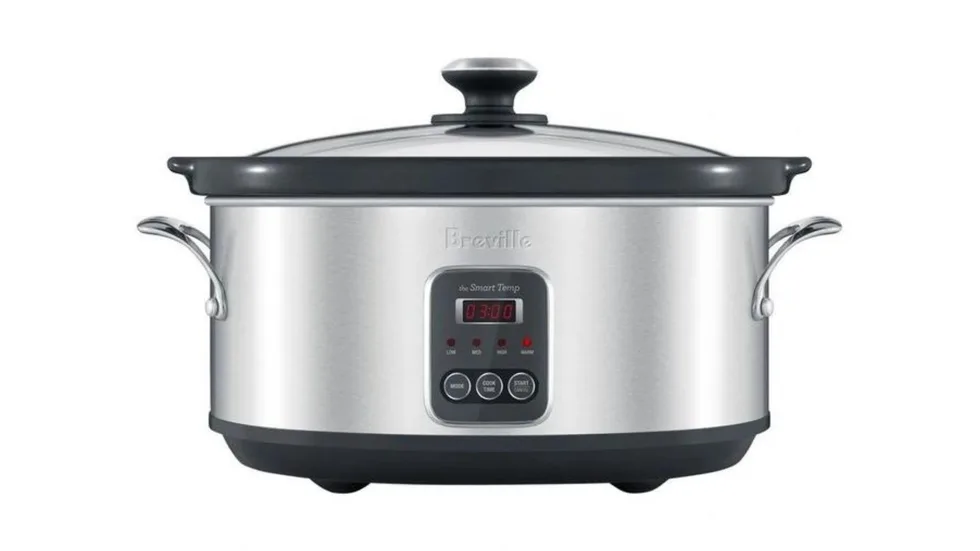
How to check your slow cooker’s temperature
You can check the temperature of the cooking liquid with a food thermometer. This can help you understand how your appliance behaves, but one reading does not prove that the cooker maintains that temperature throughout the entire cycle.
Safe temperature-checking method
- Fill the slow cooker at least halfway with water. Do not overfill it.
- Put the lid on the crock.
- Set the cooker to High.
- Let it heat for several hours without lifting the lid.
- Insert a clean, calibrated food thermometer into the water.
- Measure near the center without touching the crock or heating surface.
- Take another reading after a short interval to see whether the temperature is stable.
Use the thermometer according to its instructions. A probe touching the side of the crock can give a misleading reading.
Do not test by tasting the water or food. Temperature measurement is safer and more useful.
What a temperature reading means
A reading near 200°F to 212°F in the liquid suggests that the cooker can reach a normal simmer on High. A lower reading may still be normal if:
- The cooker has not finished preheating.
- The lid was removed.
- The crock is very full.
- The food contains little free liquid.
- The measurement was taken at the edge.
- The unit is designed to cycle heat.
If the cooker remains lukewarm after several hours on High, or food never becomes hot, stop using it until you check the manual and the appliance. A faulty slow cooker may not heat food safely.

Is the High setting hot enough to cook meat safely?
Yes, a properly working slow cooker on High can cook meat safely when used correctly. However, the setting itself is not the safety test. The food must reach the safe internal temperature for its type.
The USDA lists these minimum internal temperatures:
| Food | Minimum internal temperature |
|---|---|
| Whole cuts of beef, pork, lamb, and veal | 145°F, followed by a 3-minute rest |
| Ground meats | 160°F |
| Poultry, including chicken and turkey | 165°F |
| Leftovers and casseroles | 165°F |
| Fish | 145°F, or until the flesh is opaque and separates easily |
Measure the thickest part of the food. For poultry, test the breast and the innermost part of the thigh or wing when appropriate. Avoid touching bone, the crock, or a large pocket of fat with the probe.
A slow cooker can bring food to a safe temperature, but it may take time. This is why food should not be judged by the temperature of the cooking liquid alone.
Safe slow-cooker habits
The USDA recommends several basic practices:
- Thaw meat and poultry before putting them in a slow cooker.
- Start with a clean cooker, utensils, and work area.
- Keep the lid on during cooking.
- Cut large pieces into smaller portions when the recipe directs you to do so.
- Use the slow cooker according to the manufacturer’s instructions.
- Refrigerate leftovers within two hours.
- Keep cooked food at 140°F or above when holding it for service.
Do not use the Warm setting to cook raw meat. Warm is meant to hold food that has already been cooked to a safe temperature.

How full should a slow cooker be?
For many slow-cooker recipes, filling the crock about one-half to two-thirds full gives the best balance of heating and circulation. The exact recommendation depends on the manufacturer.
An underfilled crock can heat differently from a full one. Food may dry out or cook faster. An overfilled crock may take too long to heat and can spill when the contents simmer.
Keep the lid closed and make sure it fits well. A cracked crock, damaged lid, or faulty power cord can affect safe operation and should be replaced before use.
Should you brown meat first?
Browning meat before slow cooking is optional for safety, but it can improve flavor and color. Brown the meat in a separate skillet, then transfer it to the slow cooker.
Do not partially cook meat and leave it to finish later. If you brown meat, move it into the slow cooker promptly and continue cooking.
Can you put frozen meat in a slow cooker?
The USDA advises against placing frozen meat or poultry directly into a slow cooker. Frozen food may spend too long in the bacterial “danger zone,” which is between 40°F and 140°F.
Thaw food safely in the refrigerator, in cold water that is changed often, or in the microwave if you cook it right away. Do not thaw meat on the kitchen counter.
Why is my slow cooker on High not hot enough?
If food stays cool or barely warm, check the simplest causes first.
The lid may have been removed
Each time you lift the lid, heat escapes. The cooker then needs extra time to recover. Leave the lid closed and avoid checking food until the recipe’s recommended minimum time.
The crock may be too full
A very full crock heats slowly. Keep the contents within the fill limits in the owner’s manual. If the cooker is packed tightly with cold food, it may need more time to reach a safe temperature.
The ingredients may have started frozen
Frozen food can keep the center cold for too long. Thaw meat and poultry before slow cooking.
The appliance may be faulty
If a properly filled cooker remains below a hot cooking temperature after several hours on High, test it with water. If it still fails to heat, unplug it and contact the manufacturer or replace it.
Do not try to repair an electrical appliance unless you are qualified to do so.
The temperature reading may be inaccurate
Thermometers can be wrong. Test the thermometer according to its manufacturer’s instructions, or compare it with a known reference such as an ice-water test. Take readings in the center of the liquid and avoid contact with the crock.

Common mistakes when using High
The most common mistake is treating High as an exact temperature. It is a heat program, and its performance varies by appliance.
Avoid these errors:
- Assuming every slow cooker reaches exactly 212°F
- Putting frozen meat directly into the crock
- Filling the crock to the rim
- Removing the lid again and again
- Using Warm to cook raw food
- Relying on color instead of a thermometer
- Leaving leftovers at room temperature for several hours
- Holding food on Warm longer than the manufacturer allows
- Assuming a large roast cooks as quickly as small meat pieces
- Adding too much liquid without accounting for the recipe
A slow cooker should cook gently. A rolling boil is not required for most recipes. If food boils hard, dries out, or burns around the edge, the cooker may be too hot for that recipe or too small for the amount of food.
Key takeaways
- A slow cooker on High commonly reaches about 200°F to 212°F in its cooking liquid.
- High usually heats food faster than Low.
- High and Low may reach a similar final simmer in many traditional models.
- The dial is not a precise temperature control.
- Use a food thermometer to check doneness.
- Thaw meat and poultry before slow cooking.
- Keep the lid closed and avoid overfilling the crock.
- Use Warm only to hold food that has already reached a safe temperature.
FAQs
Does a slow cooker boil on High?
It may produce a gentle simmer, but it usually should not create a vigorous boil. The cooking liquid may approach the boiling point of water, which is about 212°F at sea level. The exact behavior varies by model and altitude.
Is a slow cooker hotter on High than on Low?
High generally heats food faster. In many models, both settings eventually reach a similar simmering range. The owner’s manual is the best source for the behavior of a specific appliance.
Can I cook chicken on High in a slow cooker?
Yes. Thawed chicken can be cooked on High, but it must reach 165°F in the thickest part. Use a food thermometer rather than judging by cooking time or appearance alone.
How long does a slow cooker take to heat on High?
Many slow cookers need several hours to heat a full load of cold food. The time depends on the amount, starting temperature, recipe, crock size, and model. Do not assume that a quick warm-up means the center is already safe to eat.
Is 180°F hot enough for a slow cooker?
A reading of 180°F may be normal while the cooker is heating or cycling. It is not enough information by itself to confirm that meat is done. Check the internal temperature of the food and follow the recipe’s timing and safety instructions.
Can I leave a slow cooker on High while I am away?
Only do so if the appliance is in good condition, placed on a stable heat-safe surface, and used according to its manual. Keep the power cord away from hot surfaces, and do not operate a damaged cooker. For long cooking, Low may suit the recipe better, but it still requires safe food handling.
Conclusion
A slow cooker set to High generally heats its contents to a simmering range of about 200°F to 212°F, but it does not hold one exact temperature. High mainly means faster heating, while Low often reaches a similar final range more slowly.
For safe results, thaw meat first, keep the lid closed, avoid overfilling, and check the food with a thermometer. The temperature that matters most is the internal temperature of the food—not simply the number on the slow cooker dial.