
The best knife sharpener for chef knives is the Chef’sChoice 15XV for fast, precise, and reliable edge repair.
A dull chef knife can turn a simple dinner into a tiring chore. Tomatoes crush, onions slip, and extra force makes every cut less safe. I have tested and compared electric, manual, pull-through, rolling, and multi-stage sharpeners to see which tools truly help at home. The right choice depends on your knife steel, skill level, budget, and how much control you want. This guide covers the best knife sharpener for chef knives in 2026, with clear pros, limits, and buying advice.
Chef’sChoice 15XV Electric Knife Sharpener
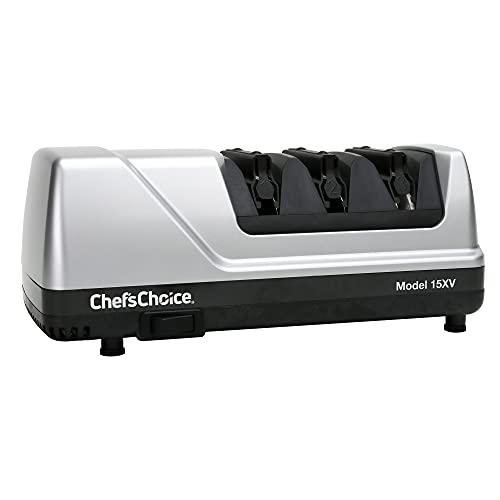
The Chef’sChoice 15XV is one of the strongest choices for cooks who want a fast, repeatable edge. Its three stages use diamond abrasives and guided slots to shape, sharpen, and polish the blade. The 15-degree design suits many modern Asian-style knives and converts many traditional 20-degree edges to a finer angle. I like how the guides reduce guesswork during each pass.
This model handles both straight-edge and serrated knives, although serrated blades need the correct stage and a slower touch. It can restore a knife that has lost its bite, not just refresh a nearly sharp edge. The motor does the hard work, so it helps busy home cooks and people with limited hand strength. As with any powered sharpener, light pressure matters because pushing too hard can remove more steel than needed.
Pros:
- Three-stage process covers repair, sharpening, and polishing
- Diamond abrasives work quickly on many kitchen steels
- Angle guides help create a consistent edge
- Works with straight and serrated knives
- Excellent choice for badly dull chef knives
- Simple operation for beginners
Cons:
- Costs more than a basic manual sharpener
- Takes up more counter space than compact tools
- Can remove excess metal if used with heavy pressure
4-in-1 Kitchen Knife Sharpener With Glove
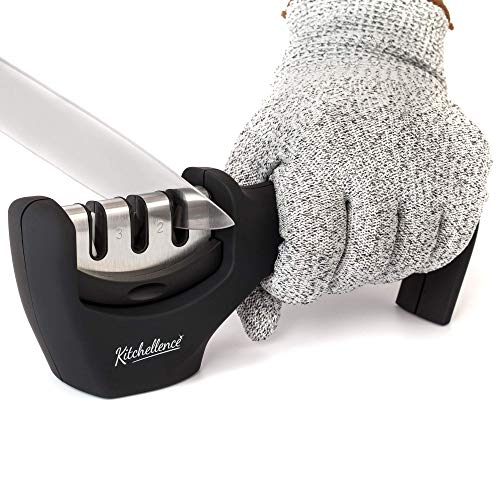
This 4-in-1 kitchen sharpener targets shoppers who want several basic functions in one small tool. Its stages are designed to repair, sharpen, and polish kitchen blades. The included cut-resistant glove adds a useful safety layer, especially for people new to pull-through sharpeners. Its compact size makes it easy to store in a drawer or cabinet.
I would use this model for common stainless-steel chef knives, utility knives, and household blades. It offers a simple path from a rough edge to a smoother cutting line, but it does not give the same fine control as a guided stone or rolling system. The safety base and handle help keep the tool steady during use. For occasional home sharpening, it can provide good value without a large investment.
Pros:
- Combines several sharpening steps in one tool
- Includes a cut-resistant glove for added hand protection
- Compact design suits small kitchens
- Easy for first-time users to understand
- Useful for routine kitchen knife maintenance
- Usually costs less than powered sharpeners
Cons:
- May not restore severely damaged blades quickly
- Pull-through slots offer limited angle control
- Results can vary with pressure and technique
AccuSharp Ergonomic Knife Sharpener

The AccuSharp is a compact handheld tool built for quick touch-ups. Its ergonomic handle feels natural in the hand, and the wide body gives better control than many tiny sharpeners. It can restore a working edge on straight and serrated knives with only a few careful strokes. I see it as a practical tool for cooks who value speed over fine edge tuning.
This sharpener fits well in a busy home kitchen, camper, or toolbox. It does not need electricity, oil, water, or a separate stone, so it is ready whenever a blade starts to drag. The tool works best when I use gentle, even pulls and let the abrasive do the work. It may not create the refined edge that a premium three-stage system can produce, but it offers very convenient maintenance.
Pros:
- Very easy to use and carry
- Comfortable ergonomic handle
- Works on straight and serrated knives
- Does not need power or messy sharpening fluid
- Good for quick edge restoration
- Fits well in small drawers and travel kits
Cons:
- Offers less angle precision than guided systems
- May leave a rougher edge than a polishing stage
- Not the best option for expensive thin Japanese knives
AIERLIAN Rolling Knife Sharpener Kit

The AIERLIAN rolling sharpener takes a different approach from a pull-through tool. It rolls along the blade while a magnetic angle guide helps hold the knife at either 15 or 20 degrees. The kit uses diamond and ceramic surfaces to shape and refine the edge. This design gives the user a more hands-on sharpening experience.
The magnetic guide can make angle control easier than freehand sharpening on a stone. I would choose it for someone who enjoys learning a simple technique and wants more control than a fixed slot allows. The rolling motion also feels gentle when used on a stable, clean surface. However, beginners should practice with an inexpensive knife first and keep fingers clear of the blade path.
Pros:
- Offers 15- and 20-degree angle choices
- Rolling design provides visible sharpening control
- Combines diamond and ceramic surfaces
- Works with many types of kitchen steel
- Magnetic guide helps beginners hold the angle
- Reusable system with no power cord
Cons:
- Requires a flat and stable work surface
- Has a learning curve compared with electric models
- May not suit serrated blades
Chef’sChoice Manual 2-Stage Sharpener
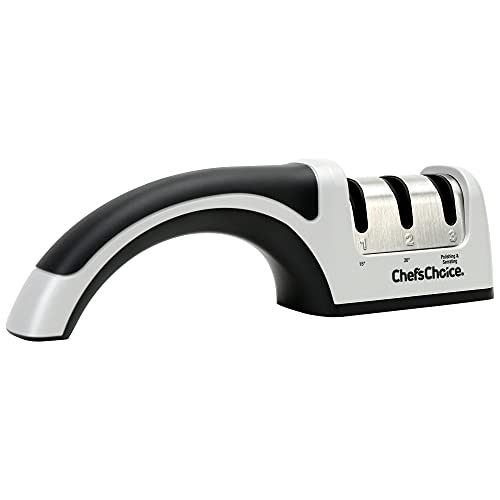
This Chef’sChoice manual sharpener brings guided angle control to a compact body. Its two stages use diamond abrasives to sharpen 15- and 20-degree knives. The separate slots let me match the tool to the knife instead of forcing every blade into one angle. It is a strong choice for cooks who want manual control without learning a full whetstone technique.
The small footprint makes this model easy to keep near a cutting board. It works well for regular maintenance and can handle both straight and serrated edges when used as directed. Because the user supplies the pulling motion, the tool runs quietly and needs no outlet. I recommend light pressure and a slow, steady pass for a cleaner result.
Pros:
- Supports both 15- and 20-degree knife edges
- Compact and easy to store
- Diamond abrasives sharpen efficiently
- Manual design gives good feedback
- Works with straight and serrated knives
- Does not require batteries or electricity
Cons:
- Needs more hand effort than an electric model
- Two stages offer less polishing than a three-stage unit
- Users must select the correct angle slot
Chef’sChoice Pronto Hone Manual Sharpener

The Pronto Hone is a small two-stage manual sharpener made for 15-degree straight-edge and serrated knives. Its diamond abrasives help restore a dull edge without a motor. The guided slots make the angle more consistent than freehand work. I find this style useful for apartment kitchens where counter space and noise both matter.
This tool rewards a calm, measured technique. I would make several light strokes rather than press hard or rush the blade through the slots. It is especially useful for cooks who want a dependable sharpener but do not need advanced electric features. The black housing is simple, sturdy, and easy to place in a cabinet after use.
Pros:
- Small footprint saves valuable counter space
- Diamond stages work on common kitchen knives
- Designed for a 15-degree edge
- Manual use keeps noise low
- Useful for straight and serrated knives
- Simple design suits routine maintenance
Cons:
- Not ideal for knives that need a 20-degree angle
- Does not offer a separate fine ceramic polishing stage
- Manual sharpening takes more time than electric sharpening
5 Precision Adjust 3-Stage Knife Sharpener
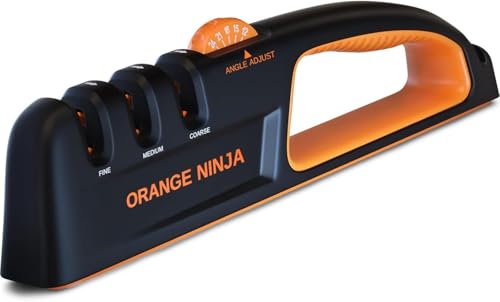
This three-stage kitchen sharpener is designed for cooks who want a clear progression from repair to polish. The stages help remove damage, set an edge, and smooth the final cutting surface. Its guided format is less intimidating than using a loose stone by hand. It can be a useful middle ground between a basic pull-through sharpener and a professional sharpening system.
I would choose this model for regular home use when a knife needs more than a quick touch-up. The three steps can improve bite and smoothness when I use the correct order and light pressure. It is important to check the included instructions because sharpening stages vary by model. Like other abrasive tools, it should not be used more often than needed.
Pros:
- Three stages support repair, sharpening, and polishing
- Guided design helps reduce angle mistakes
- Useful for routine home knife care
- More complete than a single-stage tool
- Easy learning path for new users
- Suitable for cooks who want a refined edge
Cons:
- May remove too much steel with repeated hard strokes
- Instructions should be followed closely
- Can take longer than a simple one-pass sharpener
Chef’sChoice AngleSelect Electric Sharpener

The Chef’sChoice AngleSelect is made for cooks who want powered sharpening with two angle options. It supports 15- and 20-degree straight-edge and serrated knives. Diamond abrasives work quickly, while the angle guides help keep the blade aligned. This makes it a practical choice for households with several knife styles.
The electric motor reduces hand work and makes edge repair faster than most manual tools. I would use it when several knives need attention or when a blade has become noticeably dull. It is still important to use a gentle feed rate and avoid forcing the knife into the slot. The larger body needs more storage room, but the speed can justify that trade-off for frequent cooks.
Pros:
- Electric operation saves time and hand effort
- Supports both 15- and 20-degree edges
- Diamond abrasives handle common kitchen steels
- Works with straight and serrated knives
- Guided slots improve repeatability
- Good for homes with mixed knife collections
Cons:
- Requires counter space and an electrical outlet
- Costs more than basic manual sharpeners
- Can overgrind an edge if used carelessly
Chef Master Handheld Knife Sharpener

The Chef Master handheld sharpener comes as a two-pack and uses reversible carbide blades. Its stainless-steel body and finger guard give it a practical, workmanlike feel. The compact shape makes it convenient for a kitchen drawer, food truck, workshop, or camping kit. It is designed for fast sharpening rather than delicate edge polishing.
This tool suits people who want a simple backup sharpener within easy reach. The finger guard helps keep the hand away from the blade, but I still recommend placing the tool on a stable surface when possible. Carbide sharpeners can restore a working edge quickly, yet they may be too aggressive for thin or high-end blades. For standard chef knives, it offers useful convenience at a modest price.
Pros:
- Two-pack provides a spare or second kitchen tool
- Reversible carbide blades can restore dull edges
- Stainless-steel construction feels durable
- Finger guard adds a useful safety feature
- Compact for travel and storage
- Good for quick maintenance of standard knives
Cons:
- Carbide blades can remove steel quickly
- Not the best match for delicate premium knives
- Provides less edge refinement than diamond and ceramic systems
SHARPAL 191H Knife and Scissors Sharpener

The SHARPAL 191H is a multi-purpose sharpener for knives and scissors. It gives households one compact tool for several common cutting jobs. The design is useful when kitchen shears, pocket knives, and chef knives all need occasional attention. I like this type of tool for practical homes that prefer fewer gadgets.
Its main advantage is flexibility, not the finest possible chef-knife edge. I would use it for everyday blades and basic upkeep, then choose a dedicated system for expensive Japanese knives or major edge damage. The tool is easy to store and can help bring back a useful bite with controlled strokes. Always follow the marked slot for the item being sharpened and keep the tool stable.
Pros:
- Sharpens both knives and scissors
- Useful multi-purpose design for home kitchens
- Compact and easy to store
- Good for routine blade maintenance
- Helps reduce the need for separate tools
- Simple choice for mixed household cutting tools
Cons:
- May not create a highly refined chef-knife edge
- Multiple functions can limit specialized control
- Users need to choose the correct slot carefully
My Recommendation
For most serious home cooks, I recommend the Chef’sChoice 15XV as the best knife sharpener for chef knives. Its three-stage system gives a clear repair, sharpen, and polish process, while the guides make repeatable results easier. It suits cooks who want fast results and do not want to master a whetstone. If you own mostly standard knives and sharpen only a few times each year, the AccuSharp or a compact Chef’sChoice manual model may offer better value.
The AIERLIAN rolling kit is best for people who want more control and enjoy a hands-on method. The AngleSelect electric model works well for homes with both 15- and 20-degree knives. The 4-in-1 tool, Chef Master, and SHARPAL are better for budget upkeep and general household use. In my view, the best knife sharpener for chef knives should match the blade, not just the price tag.
| Best for | Why |
|---|---|
| Fast, deep sharpening | Chef’sChoice 15XV uses guided, multi-stage electric sharpening. |
| Manual angle control | AIERLIAN offers rolling movement with 15- and 20-degree guides. |
| Low-cost daily upkeep | AccuSharp gives quick, portable sharpening without power. |
How I Chose These Chef Knife Sharpeners
A sharpener should do more than make a blade feel rough or toothy. I look for a true improvement in cutting control, edge consistency, and ease of use. I also consider how much metal the tool removes, because aggressive sharpening can shorten a knife’s useful life. A good product should make safe sharpening feel simple rather than stressful.
I compare the abrasive material, angle system, stages, handle design, base stability, and blade compatibility. Diamond abrasives can work well on many hard steels, while ceramic surfaces often help refine an already shaped edge. Carbide tools are fast, but I use them with more care. A sharpener earns extra credit when it works well for beginners without limiting experienced users too much.
Product descriptions and manufacturer instructions remain important, but real kitchen use adds another layer. A tool may look impressive online yet feel awkward when the handle slips or the base moves. I also check whether the model suits straight edges, serrations, thin blades, and common Western chef knives. These details help separate a useful kitchen tool from a gadget that stays in a drawer.
What Type of Knife Sharpener Should You Buy?
Electric sharpeners
Electric sharpeners are usually the fastest option. They use a motor to move abrasive wheels through guided stages. This helps people who need to repair several dull knives or who have trouble holding a steady angle. The trade-off is a higher price, more storage space, and a greater risk of overgrinding when the user applies too much force.
Manual pull-through sharpeners
Manual models are small, quiet, and easy to use. Most have one or more slots that set the angle for you. They work well for routine home maintenance, but cheap models may remove metal unevenly. I suggest choosing a model with a stable base, clear angle guidance, and a fine stage when possible.
Rolling sharpeners
Rolling systems offer a more visual and controlled method. A wheel moves along the blade while a guide holds the angle. Many users find this less intimidating than freehand stone work. These systems need a flat surface, careful handling, and practice, especially near the tip and heel of a chef knife.
Whetstones
Whetstones can produce excellent results, but they require the most skill. The user must control the angle, pressure, lubrication, and number of strokes. A stone can be a great long-term choice for a keen cook, yet it may frustrate someone who wants a fast answer. For many beginners, a guided manual or electric model creates a gentler learning curve.
How to Use a Knife Sharpener Safely
Read the instructions before the first use. Set the sharpener on a dry, stable surface and keep the cutting edge pointed away from your fingers. Hold the handle firmly, then move the knife at the speed suggested by the maker. Never force the blade through a slot.
Use the correct stage for the job. A coarse stage repairs damage and reshapes an edge, while a fine stage smooths and polishes it. Most knives need the coarse stage only when they are truly dull. For regular care, a fine or honing stage may be enough.
Clean the knife after sharpening. Small metal particles can remain on the blade, so wash and dry it before preparing food. Wipe the sharpener according to its instructions, and do not submerge an electric model. A clean tool gives more consistent results and helps prevent debris from building up in the slots.
How Often Should You Sharpen a Chef Knife?
The answer depends on use, knife steel, cutting board material, and storage. A busy home cook may need a light touch-up every few weeks and a full sharpening several times each year. A casual cook may need it only a few times a year. If the knife slides off a tomato skin or crushes soft herbs, it likely needs attention.
Honing and sharpening are not the same. Honing realigns a slightly bent edge, while sharpening removes a small amount of steel to create a new edge. Many home cooks sharpen too often because they confuse these jobs. Use a honing rod or fine stage for light maintenance, and reserve a coarse stage for a genuinely dull or damaged blade.
Angle Guide for Chef Knives
Many Western chef knives use an edge near 20 degrees per side. Many Japanese-style knives use an edge near 15 degrees per side. The correct angle depends on the maker, blade thickness, steel, and intended use. A smaller angle can feel very sharp but may be less durable during heavy cutting.
Do not change the angle just because a number sounds better. Check the knife maker’s guidance when available. If no guidance exists, match the existing edge as closely as possible. This is one reason guided sharpeners are helpful: they reduce the chance of creating a strange or uneven bevel.
Can These Sharpeners Handle Serrated Knives?
Some can, but not every slot is suitable. Serrated knives have teeth and valleys, so a flat abrasive slot may damage their shape. Electric models with a dedicated serrated stage can be more useful. For other tools, I would use a tapered ceramic rod that fits the individual grooves.
Always check the product instructions before sharpening a bread knife or serrated utility knife. Use slow movements and avoid pressing the teeth against a flat surface. If the knife is valuable, professional service may be safer than experimenting with a general kitchen sharpener.
Common Buying Mistakes to Avoid
The first mistake is choosing the most aggressive tool for every knife. Fast carbide slots can help with a cheap, dull blade, but they may shorten the life of a thin premium knife. The second mistake is ignoring the blade angle. A 15-degree sharpener may not suit a knife designed for 20 degrees.
Another mistake is focusing only on the number of stages. More stages do not always mean better results. Stability, abrasive quality, angle control, and correct technique matter more. I also avoid judging a sharpener by a dramatic “razor sharp” claim alone. A good chef knife needs a clean, durable edge that works safely in real food prep.
FAQs Of best knife sharpener for chef knives
What is the best knife sharpener for chef knives?
The Chef’sChoice 15XV is my top overall pick for many home cooks. It offers guided three-stage sharpening, diamond abrasives, and support for straight and serrated knives. The best choice can still vary based on knife angle, budget, and preferred sharpening method.
Is an electric knife sharpener safe for chef knives?
Yes, when used as directed. Use light pressure, keep the knife moving at a steady speed, and select the correct stage. Avoid repeated coarse passes because they can remove more steel than needed.
Are manual sharpeners better than electric models?
Neither type is always better. Manual sharpeners cost less, stay quiet, and give more hand feedback. Electric models work faster and reduce effort, which helps people with several dull knives or limited hand strength.
Can I use a pull-through sharpener on an expensive chef knife?
You can use one only if its angle and abrasive match the knife. For thin, hard, or high-end blades, choose a controlled rolling system, quality guided sharpener, or skilled professional service. Avoid aggressive carbide tools unless the knife maker allows them.
How do I know when my chef knife needs sharpening?
A dull knife crushes food, slips on skins, and needs extra force. Try slicing a ripe tomato or a sheet of paper with care. If the blade drags or tears instead of cutting cleanly, it may need sharpening.
Final Verdict: Which Should You Buy?
The Chef’sChoice 15XV is the best knife sharpener for chef knives for most home cooks. It is fast, guided, and versatile, with stages for repair and polish. Choose AccuSharp for low-cost touch-ups or AIERLIAN for hands-on angle control.
Match the sharpener to your knife and use light pressure. With the right tool, a dull chef knife can feel smooth, safe, and ready for the next meal.