
Yes. It is usually safe to leave a slow cooker on overnight when the cooker is in good shape, sits on a safe surface, and you follow the manufacturer’s instructions. Slow cookers are made to cook food for many hours at low heat.
Still, “safe” is not automatic. A damaged cord, a covered outlet, poor food handling, or a power outage can create a fire or food safety risk. Use the checklist below before leaving your slow cooker on while you sleep.
This guide applies to homes in the United States and follows food safety guidance from the U.S. Department of Agriculture (USDA) and the National Fire Protection Association (NFPA).

When Is It Safe to Leave a Slow Cooker On Overnight?
Leaving a slow cooker on overnight is generally safe when all of these conditions are met:
- The appliance has no cracked housing, loose parts, damaged cord, or burned plug.
- It sits on a firm, dry, heat-safe surface.
- It has open space around it.
- The food and liquid stay within the manufacturer’s fill limits.
- The recipe uses safe ingredients and cooking times.
- The cooker is plugged directly into a suitable wall outlet.
- You follow the manual for your exact model.
- No one can easily knock it over.
A slow cooker is different from a stovetop pan. It uses a heating base and a controlled cooking cycle. However, it is still an electrical heating appliance. Do not treat it as risk-free just because it cooks at a low temperature.
The safest answer is this: an overnight slow-cooker meal is reasonable when the appliance is sound and the setup is controlled. Do not leave a questionable cooker running while you sleep.

How Long Can a Slow Cooker Run?
Many slow-cooker recipes run for six to 10 hours. Some models have cooking programs that last longer. The correct time depends on the recipe, the food, the heat setting, and the model.
Check the owner’s manual before using an overnight setting. Some newer cookers switch to “keep warm” after cooking. Others turn off. A keep-warm mode is not the same as a cooking mode, and it should not be used to cook raw food unless the manufacturer says it is designed for that purpose.
Typical cooking times
| Food type | Common cooking range | Key safety point |
|---|---|---|
| Beef, pork, or lamb stew | About 6–10 hours | Use enough liquid and cut food into similar sizes |
| Chicken or turkey pieces | About 4–8 hours | Start with thawed poultry |
| Dried beans | Often 6–10 hours | Follow a tested recipe and cook beans fully |
| Vegetables | About 4–8 hours | Dense vegetables may need more time |
| Oatmeal or grains | Often 4–8 hours | Use a recipe made for slow cooking |
| Leftovers on “keep warm” | Follow the manual | Keep food at 140°F or hotter |
These are broad cooking ranges, not guarantees. A full cooker may heat more slowly than a partly full cooker. Large meat cuts may also need more time.
Do not use a slow cooker’s timer as a substitute for safe food handling. A delayed start can leave raw meat, poultry, dairy, or cooked food at unsafe temperatures for too long.

Slow Cooker Food Safety: What to Know Before Bed
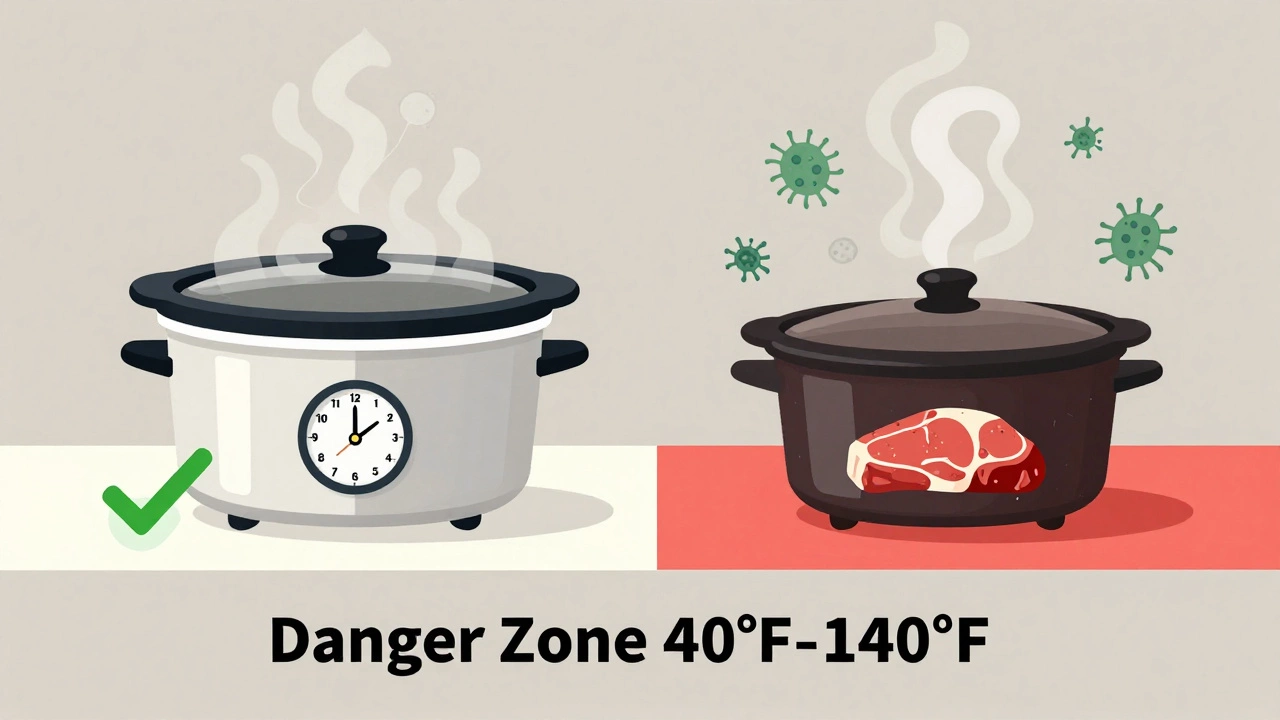
The main food safety rule is to keep perishable food out of the “danger zone” of 40°F to 140°F for as little time as possible. Bacteria can grow quickly in this range.
The USDA says to thaw meat and poultry before placing them in a slow cooker. Frozen food may spend too long warming before it reaches a safe cooking temperature.
Follow these steps:
- Thaw meat, poultry, and frozen ingredients in the refrigerator.
- Cut large pieces into smaller, similar-sized pieces when the recipe calls for it.
- Add the recommended amount of liquid.
- Keep the lid on during cooking.
- Start the cooker soon after adding perishable ingredients.
- Use a food thermometer to confirm doneness when needed.
- Refrigerate leftovers within two hours after cooking ends.
Do not lift the lid often. Each lift lets heat escape and may add cooking time. If you need to check doneness, lift the lid once near the end and use a clean food thermometer.
Safe internal temperatures
Use the USDA’s current temperature guidance:
- Poultry: 165°F
- Ground meats: 160°F
- Whole cuts of beef, pork, veal, and lamb: 145°F, followed by a three-minute rest
- Leftovers: 165°F when reheated
A slow cooker can make meat tender, but tenderness alone does not prove that food reached a safe temperature. A thermometer gives a better answer.

How to Set Up a Slow Cooker Overnight
Set up the cooker before you go to bed. A few simple checks can lower both fire and food safety risks.
1. Inspect the appliance
Do not use the cooker if you see:
- A frayed or cut power cord
- A cracked ceramic insert
- A loose plug
- Melted plastic
- Burn marks
- A broken lid
- A heating base that rocks or feels unstable
Replace damaged parts with parts approved by the manufacturer. Do not use tape as a long-term repair for a power cord.
2. Choose the right location
Place the slow cooker on a stable, dry, heat-resistant counter. Keep it away from:
- Curtains
- Paper towels
- Dish towels
- Wooden shelves
- The edge of the counter
- The sink
- Other hot appliances
Leave space around the cooker so heat can escape. Do not place it inside a closed cabinet or under a low shelf.
3. Use the correct outlet
Plug the slow cooker directly into a wall outlet when possible. Avoid overloaded extension cords, power strips, and adapters. If an extension cord is necessary, use one that the manufacturer permits and that is rated for the appliance.
Do not run the cord under a rug or where someone can trip over it.
4. Fill it correctly
Most manufacturers advise filling the insert between one-half and two-thirds full. Too little food may cook too fast. Too much food may cook too slowly and may spill.
Follow your model’s manual if it gives a different fill range.
5. Keep the lid closed
The lid helps hold heat and moisture. A loose or missing lid can extend cooking time and affect food safety. Do not cover the cooker with towels or other materials.
6. Choose the right setting
Use the setting listed in the recipe. Low heat often suits meals designed for overnight cooking. High heat may finish food sooner, but the timing depends on the recipe and model.
Do not switch to “keep warm” at the start unless the manual clearly says the setting can safely cook the food.

Foods That Work Well for Overnight Slow Cooking
Meals with enough liquid and a long cooking time often work best overnight. Examples include:
- Beef or vegetable stew
- Chili
- Pulled pork
- Braised beef
- Lentil dishes
- Some bean recipes
- Steel-cut oats made with a tested slow-cooker recipe
Foods that can lose quality during a long cook include:
- Seafood
- Small pieces of chicken
- Pasta
- Some dairy-based sauces
- Fresh herbs
- Delicate vegetables
These foods may become dry, split, mushy, or overcooked. Food quality and food safety are separate issues. A meal can be safe to eat but still have poor texture.
Be cautious with recipes that contain milk, cream, cheese, or sour cream. Add dairy near the end when the recipe directs you to do so. Long cooking can cause dairy to curdle.

When Should You Not Leave a Slow Cooker On Overnight?
Do not leave a slow cooker running overnight if:
- The appliance is damaged or recalled.
- The cooker is new to you and you have not read the manual.
- The outlet sparks, feels hot, or is loose.
- The cord runs through a walking path.
- The cooker is near fabric, paper, or water.
- The recipe needs frequent stirring.
- The food is frozen.
- The cooker is filled above its limit.
- You plan to use a delayed start with raw meat or poultry.
- You will be away for a long period after the meal finishes.
- A storm or outage may affect power.
People with limited mobility, memory problems, or a higher risk of falls may need a different meal plan. A slow cooker that is safe for one home may not be safe in a home where it can be pulled down or knocked over.
If you are unsure about the appliance, cook the meal while you are awake. The small loss of convenience is better than an avoidable risk.

What Happens if the Power Goes Out Overnight?
Treat food carefully after a power outage. A slow cooker may stop heating even if the display later comes back on.
The USDA advises that perishable food is generally safe for about four hours in a refrigerator without power, but a slow cooker is not a refrigerator. The temperature and length of the outage may be hard to know.
Use this approach:
- Find out how long the power was off, if possible.
- Check the food with a thermometer if it is still warm.
- If the food stayed below 140°F for too long, discard it.
- Do not taste food to decide whether it is safe.
- When in doubt, throw it out.
Do not restart a slow cooker and assume the food is safe. Restarting may not undo the time the food spent at an unsafe temperature.

Can You Leave a Slow Cooker on While You Are Away?
Many people leave a slow cooker running while they work or sleep. Some also leave home for several hours. The appliance may be designed for long cooking, but being away increases the time before someone can notice a problem.
Before leaving home, check the manual and the appliance condition. Keep the area clear, use a safe outlet, and avoid recipes that can scorch or foam. A smoke alarm should be working on every level of the home and near sleeping areas, but not directly above a cooking appliance where normal cooking may trigger false alarms.
A slow cooker should not replace basic fire safety. Never leave other stovetop burners, ovens, or broilers running while you sleep or leave the home.

Common Overnight Slow-Cooker Mistakes
Starting with frozen meat
Frozen meat may thaw too slowly in a slow cooker. Thaw it in the refrigerator first.
Filling the insert to the top
An overfilled cooker may heat unevenly and spill. Stay within the fill range in the manual.
Using a delayed start
A delay timer can hold perishable food at unsafe temperatures before cooking begins. Add food and start the cooker without an unsafe delay.
Removing the lid again and again
Frequent lid removal releases heat and extends cooking time. Keep the lid closed unless the recipe requires a check.
Leaving leftovers in the cooker
A turned-off cooker does not keep food safe for an unlimited time. Move leftovers to shallow containers and refrigerate them within two hours.
Using “keep warm” as a cooking setting
Keep-warm mode is meant to hold already cooked food. It may not heat raw ingredients fast enough.
Ignoring the cord
Do not use a cooker with a damaged cord, hot plug, loose outlet, or signs of electrical damage.

Overnight Slow Cooker Safety Checklist
Use this short checklist before bed:
- The cooker and cord are undamaged.
- The insert and lid fit correctly.
- The cooker sits on a stable, heat-safe surface.
- Combustible items are several inches away.
- The outlet is not overloaded.
- Ingredients were thawed safely.
- The cooker is not overfilled.
- The lid is closed.
- The selected setting matches the recipe.
- The food will finish before you need to refrigerate it.
- Smoke alarms work properly.
- You know what to do if the power fails.
If every answer is yes, an overnight cook is usually a reasonable use of a working slow cooker.
Frequently Asked Questions
Is it safer to use low or high overnight?
Use the setting named by the recipe and the owner’s manual. Low is common for long, overnight recipes, but high may be correct for some foods. The setting alone does not prove that a meal is safe.
Can a slow cooker catch fire overnight?
It can, although slow cookers are designed for long cooking. Fire risk rises with damaged cords, overloaded outlets, nearby fabric or paper, unstable placement, and poor maintenance. A clean setup and a working appliance reduce the risk but cannot remove it.
Can I leave chicken in a slow cooker overnight?
Yes, if the chicken is thawed, the recipe is designed for long cooking, and the chicken reaches 165°F. Do not use frozen chicken or a delayed start with raw chicken.
Can I leave chili in a slow cooker overnight?
Chili is often suitable for overnight cooking when the recipe provides enough liquid and the cooker is not overfilled. Refrigerate leftovers within two hours after cooking ends.
Is it safe to leave a slow cooker on warm all night?
Only if the food is already fully cooked, the cooker is designed for that function, and the food stays at 140°F or hotter. “Warm” should not be used to slowly cook raw food.
Should I turn off my slow cooker before going to bed?
Not necessarily. If the cooker, recipe, placement, and ingredients meet the safety checks above, it may run overnight. Turn it off if anything seems wrong or if the food has finished and the cooker lacks a safe keep-warm function.
Conclusion: Is Leaving a Slow Cooker On Overnight Safe?
Yes, usually—but only with the right setup. Use a sound appliance, thaw food first, follow the recipe and manual, keep the cooker away from flammable items, and manage leftovers promptly.
The safest next step is to inspect your slow cooker and read the instructions for your exact model before starting an overnight meal. If the cord, outlet, cooker, food, or timing raises doubt, do not leave it running while you sleep.