
If you are in the United States and want to cook a whole turkey in a slow cooker, the safest answer is do not cook a whole turkey in a slow cooker. The turkey may be too large for the cooker to heat evenly. The center can stay in the food-safety danger zone for too long.
The U.S. Department of Agriculture (USDA) recommends cooking a whole turkey in an oven, not a slow cooker. You can safely cook a turkey breast, turkey tenderloin, or smaller turkey pieces in a slow cooker when the meat reaches 165°F (74°C) in the thickest part.
This guide explains why a whole turkey is risky in a slow cooker, how to cook a whole turkey safely in the oven, and how to use a slow cooker for turkey parts instead.

Can You Cook a Whole Turkey in a Slow Cooker?
You should not cook a whole turkey in a slow cooker. A whole bird is often too large to fit safely, and the cooker may not heat the turkey quickly or evenly enough.
Slow cookers work best with smaller cuts of meat. A turkey breast or turkey thigh has a more predictable shape. A whole turkey has a large cavity, thick breast meat, dense legs, and often a frozen or partly frozen center.
The USDA advises against cooking whole poultry in a slow cooker. This advice applies to common home slow cookers and includes whole chickens and whole turkeys.
A slow cooker also creates other problems:
- The lid may not close fully.
- The turkey may touch the lid or sides.
- The cavity may slow heat movement.
- The breast can dry out before the legs become tender.
- The center may remain below a safe temperature.
- Stuffing inside the bird may not reach 165°F quickly enough.
A turkey can look cooked on the outside while still being unsafe inside. Color is not a reliable safety test. Use a food thermometer for any turkey preparation.

Why a Whole Turkey Is Unsafe in a Crock-Pot
The main risk is slow and uneven heating. Harmful bacteria can multiply when poultry stays between 40°F and 140°F, known as the food-safety danger zone.
A slow cooker is designed to warm food over time. That is useful for small pieces and planned recipes. It is not a reliable way to heat the center of a large whole bird.
The turkey cavity adds another challenge. Hot air and liquid do not move through the cavity as they do around smaller pieces. The thickest parts may warm at different speeds.
The USDA recommends that all turkey reach 165°F in these areas:
- The thickest part of the breast
- The innermost part of the thigh
- The innermost part of the wing
- The center of stuffing, if the turkey is stuffed
For the safest and most even cooking, cook stuffing in a separate dish. Do not place stuffing inside a turkey that you plan to cook in a slow cooker.

The Safe Way to Cook a Whole Turkey: Use an Oven
For a whole turkey, use an oven set to 325°F or higher. Roast the turkey until a food thermometer shows 165°F in the required locations.
What you need
- A fully thawed whole turkey
- A roasting pan with a rack
- A food thermometer
- Aluminum foil
- Oil or softened butter
- Salt, pepper, and other seasonings
- A separate baking dish for stuffing, if desired
Step-by-step method
-
Thaw the turkey fully.
Thaw it in the refrigerator. Allow about 24 hours for every 4 to 5 pounds of turkey. Keep the turkey in its original package and place it on a tray to catch drips. -
Remove the packaging and giblets.
Check both the neck area and the body cavity. Remove the gravy packet or giblets if they are included. -
Do not wash the turkey.
Rinsing raw poultry can spread bacteria around the sink and nearby surfaces. Cooking destroys harmful bacteria. -
Pat the turkey dry.
Use paper towels. Discard the towels and wash your hands. -
Season the turkey.
Rub the skin with oil or softened butter. Add salt, pepper, and herbs if you like. -
Place the turkey breast-side up on a rack.
Put the rack in a roasting pan. Add a small amount of water or stock to the pan if your recipe calls for it, but do not cover the turkey tightly at the start. -
Roast at 325°F.
Use cooking time as a guide only. The thermometer decides when the turkey is done. -
Check the temperature.
Insert the thermometer into the thickest part of the breast and the inner thigh. Avoid touching bone. If you use stuffing, check its center too. -
Remove the turkey at 165°F.
If one area is below 165°F, return the turkey to the oven and check it again after several minutes. -
Rest before carving.
Let the turkey rest for about 20 minutes. This helps the juices settle and makes carving easier.
Approximate roasting times
The times below are estimates for a fully thawed turkey roasted at 325°F. They are not a substitute for temperature checks.
| Turkey size | Unstuffed estimate | Stuffed estimate |
|---|---|---|
| 8 to 12 pounds | 2¾ to 3 hours | 3 to 3½ hours |
| 12 to 14 pounds | 3 to 3¾ hours | 3½ to 4 hours |
| 14 to 18 pounds | 3¾ to 4¼ hours | 4 to 4¼ hours |
| 18 to 20 pounds | 4¼ to 4½ hours | 4¼ to 4¾ hours |
| 20 to 24 pounds | 4½ to 5 hours | 4¾ to 5¼ hours |
These estimates come from USDA turkey-cooking guidance. Oven type, turkey shape, starting temperature, and pan design can change the cooking time.

How to Use a Slow Cooker for Turkey Safely
A slow cooker is a good choice for turkey breast or smaller turkey pieces. It is not a good choice for a whole turkey.
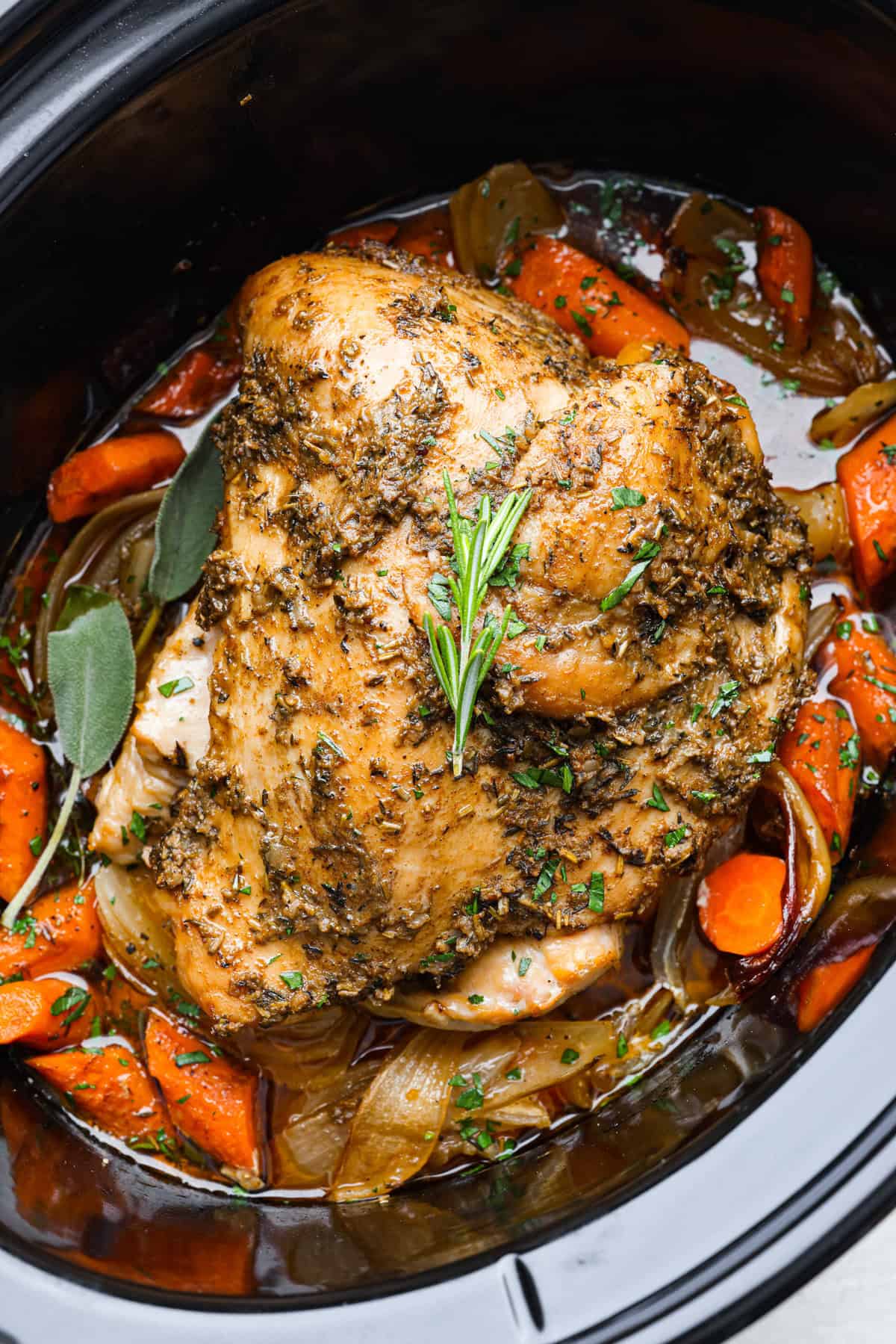
Slow cooker turkey breast
Choose a boneless or bone-in turkey breast that fits without touching the lid. The lid must close completely.
Ingredients
- 1 turkey breast, about 2 to 6 pounds
- 1 cup low-sodium broth or water
- 1 tablespoon olive oil or softened butter
- Salt and pepper
- Garlic powder, onion powder, sage, thyme, or rosemary
- Optional vegetables, such as onion, celery, or carrots
Method
- Thaw the turkey breast completely in the refrigerator.
- Pat it dry with paper towels.
- Rub it with oil or butter.
- Season all sides.
- Place vegetables in the bottom of the slow cooker if using them.
- Set the turkey breast on top of the vegetables.
- Add the broth around the turkey.
- Cover the slow cooker.
- Cook on LOW until the thickest part reaches 165°F.
- Check the temperature with a food thermometer before serving.
Cooking time varies by size, shape, bone structure, and appliance. A small turkey breast may take several hours, but do not use time alone to judge doneness.
Turkey thighs or drumsticks
Turkey thighs and drumsticks can also work well in a slow cooker. Trim excess skin and fat if desired. Add enough liquid to create moist heat, but do not fully submerge the meat unless the recipe calls for it.
Cook until the thickest part reaches at least 165°F. For tender dark meat, many cooks prefer a higher temperature, but 165°F is the USDA minimum safe temperature.
Slow cooker safety rules
- Start with thawed turkey.
- Do not overfill the cooker.
- Keep the lid closed during cooking.
- Do not use the slow cooker to reheat cooked turkey.
- Refrigerate leftovers within two hours.
- Store leftovers in shallow containers.
- Use refrigerated turkey leftovers within 3 to 4 days.
- Reheat leftovers to 165°F.
What to Do If You Already Put a Whole Turkey in a Slow Cooker
If the turkey has been in the slow cooker for only a short time, move it to an oven set to 325°F or higher. Continue cooking until every required area reaches 165°F.
If the turkey has stayed in the slow cooker for several hours but the temperature is unknown, use caution. Measure the breast, thigh, wing area, and stuffing if present. If any area is below 165°F, continue cooking in the oven.
Do not taste the turkey to see whether it is safe. If the turkey remained warm but below 140°F for an unknown length of time, the safest choice is to discard it. Smell and appearance cannot confirm safety.
Do not use a slow cooker to finish a partly cooked turkey. The USDA advises against partially cooking poultry and finishing it later. Cook the turkey completely in one continuous process.

Common Mistakes When Cooking Turkey in a Slow Cooker
Starting with a frozen turkey
A frozen turkey can take too long to reach a safe temperature. Thaw the turkey completely in the refrigerator before cooking.
Using the slow cooker for a large turkey breast
A turkey breast that touches the lid may prevent proper heat circulation. Choose a smaller cut or use an oven.
Relying on the cooking time
Slow cookers vary. Turkey size and shape also vary. A food thermometer gives a safer answer than a recipe timer.
Opening the lid often
Each lid lift releases heat. This can extend cooking time and make the heating pattern less predictable.
Putting stuffing inside the turkey
Stuffing inside a large bird heats slowly. Cook stuffing in a separate baking dish instead.
Checking the wrong spot
Do not place the thermometer against bone. Insert it into the thickest meat. Check more than one location.
Leaving cooked turkey at room temperature
Refrigerate turkey within two hours. If the room temperature is above 90°F, refrigerate it within one hour.

Slow Cooker Turkey vs. Oven-Roasted Turkey
The best method depends on the turkey cut.
| Turkey preparation | Recommended method | Main reason |
|---|---|---|
| Whole turkey | Oven | Better heat circulation and easier temperature control |
| Turkey breast | Slow cooker or oven | Smaller shape heats more evenly |
| Turkey thighs | Slow cooker or oven | Works well with moist heat |
| Turkey tenderloin | Slow cooker, oven, or skillet | Small cut cooks quickly |
| Stuffed whole turkey | Oven only | The stuffing needs safe, even heating |
| Frozen whole turkey | Thaw first, then oven | A frozen bird may heat too slowly |
A slow cooker can produce moist turkey and free oven space. The trade-off is that it cannot safely handle every turkey size and shape.
If you need the oven for other dishes, cook a turkey breast in the slow cooker and prepare the rest of the meal separately. This gives you the convenience of slow cooking without the risk of placing a whole bird in the appliance.

How to Keep Slow Cooker Turkey Moist
Use a turkey breast with the skin on if you want more protection from drying. You can remove the skin after cooking.
Add broth, stock, or water to the cooker. Aromatic vegetables can add flavor, but they do not replace the need for safe temperature control.
Avoid cooking the turkey far past 165°F. Turkey breast is lean and can become dry with extended cooking.
For better texture:
- Use a meat thermometer.
- Let the turkey rest for 10 to 15 minutes.
- Slice across the grain.
- Spoon cooking liquid over the slices.
- Store turkey with a little broth to reduce drying during reheating.

Key Takeaways
- Do not cook a whole turkey in a slow cooker.
- Use an oven at 325°F or higher for a whole turkey.
- Cook turkey breast, thighs, or smaller pieces in a slow cooker instead.
- Start with fully thawed turkey.
- Check the thickest parts with a food thermometer.
- Turkey and stuffing must reach 165°F.
- Refrigerate leftovers within two hours.
FAQs
Can I cook a 5-pound turkey in a slow cooker?
A 5-pound whole turkey is still a whole bird, so it is not a recommended slow cooker preparation. Cook it in an oven. A 5-pound turkey breast may be suitable if it fits easily and the lid closes fully.
Can I cook a turkey breast in a Crock-Pot?
Yes. A turkey breast can be cooked in a Crock-Pot or another slow cooker when it is fully thawed, fits without touching the lid, and reaches 165°F in the thickest part.
Should I put water in the slow cooker with turkey?
Add broth or water around turkey breast or turkey pieces to create moist heat. Use only enough to support the recipe. The turkey does not need to be fully covered.
Can I put a frozen turkey breast in a slow cooker?
No. Thaw the turkey breast fully in the refrigerator before placing it in a slow cooker.
How long can cooked turkey stay in the refrigerator?
Use refrigerated cooked turkey within 3 to 4 days. Freeze it if you will not eat it within that time.
Conclusion
A whole turkey should be cooked in an oven, not a slow cooker. The oven provides more reliable heat around the entire bird and makes it easier to reach the USDA-safe temperature of 165°F.
Use your slow cooker for turkey breast, thighs, drumsticks, or tenderloins. Start with thawed meat, keep the lid closed, and verify the final temperature with a food thermometer.